 Indietro
Periodicity and Periodic Trends: Structure, Electron Configuration, and Properties of the Elements
Guida di studio - Note intelligenti
 Appunti personalizzati basati sui tuoi materiali, ampliati con definizioni chiave, esempi e contesto.
The Periodic Table and the Periodic Law
Development of the Periodic Table
The periodic table organizes elements based on recurring chemical and physical properties. Dmitri Mendeleev arranged elements by increasing atomic mass and grouped elements with similar properties into columns, allowing him to predict the properties of undiscovered elements. The discovery of noble gases by Ramsay and Rayleigh added a new group to the table, further refining its structure.
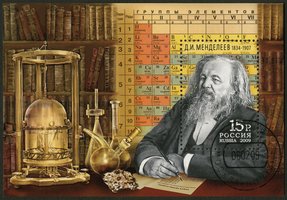
Periodic Law: When elements are arranged in order of increasing atomic number, their properties recur periodically.
Groups: Columns of elements with similar properties.
Periods: Rows of elements with gradually changing properties.
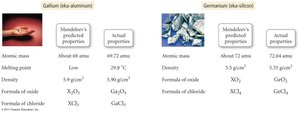
Example: Mendeleev predicted the properties of elements such as gallium and germanium before their discovery, and his predictions closely matched the actual properties.
Electron Configuration and Quantum Numbers
Quantum-Mechanical Model of the Atom
Electrons in atoms occupy orbitals, which are regions of space with a high probability of finding an electron. The arrangement of electrons in these orbitals is described by the electron configuration, which follows specific rules based on quantum mechanics.
Principal Quantum Number (n): Indicates the energy level and size of the orbital.
Azimuthal Quantum Number (l): Describes the shape of the orbital (s, p, d, f).
Magnetic Quantum Number (ml): Specifies the orientation of the orbital.
Spin Quantum Number (ms): Indicates the direction of electron spin (+½ or −½).
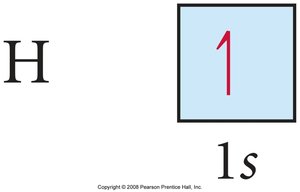
Example: The electron configuration of hydrogen is 1s1, and helium is 1s2.
Electron Spin and the Pauli Exclusion Principle
Electron spin is a fundamental property, and each orbital can hold a maximum of two electrons with opposite spins. The Pauli Exclusion Principle states that no two electrons in an atom can have the same set of four quantum numbers.
s sublevel: 1 orbital, 2 electrons
p sublevel: 3 orbitals, 6 electrons
d sublevel: 5 orbitals, 10 electrons
f sublevel: 7 orbitals, 14 electrons
Hund's Rule and Aufbau Principle
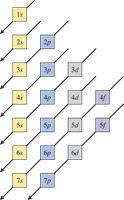
When filling orbitals of equal energy (degenerate orbitals), electrons fill singly first (Hund's Rule). Orbitals fill in order of increasing energy (Aufbau Principle): s → p → d → f.
Electron Configuration and the Periodic Table
Relationship Between Electron Configuration and Table Structure
The periodic table is structured so that elements with similar valence electron configurations are grouped together. The group number corresponds to the number of valence electrons, and the period number corresponds to the principal energy level of the valence electrons.
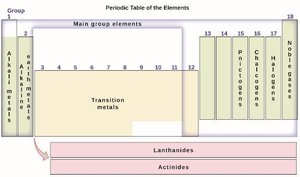
Valence electrons: Electrons in the outermost shell, responsible for chemical behavior.
Core electrons: Electrons in inner shells.
Transition and Inner Transition Elements
For d-block (transition) metals, the principal quantum number of the d sublevel is one less than the period number. For f-block (lanthanide and actinide) elements, it is two less.
Irregular Electron Configurations
Some transition metals have irregular electron configurations due to small energy differences between s and d sublevels. These configurations are determined experimentally.
Example: Chromium: [Ar] 4s1 3d5 (not [Ar] 4s2 3d4)
Periodic Trends
Atomic and Ionic Size
Atomic radius increases down a group and decreases across a period. This is due to the addition of energy levels down a group and increased effective nuclear charge across a period.
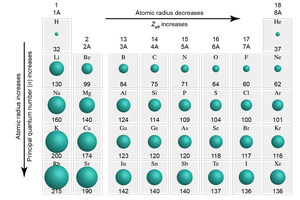
van der Waals radius: Nonbonding atomic radius.
Covalent radius: Half the distance between nuclei in a molecule.
Ionization Energy
Ionization energy is the energy required to remove an electron from a gaseous atom. It decreases down a group and increases across a period due to changes in effective nuclear charge and atomic size.
First ionization energy (IE1): Energy to remove the first electron.
Successive ionization energies: Increase as more electrons are removed, with a large jump when core electrons are removed.
Electron Affinity
Electron affinity is the energy change when an atom gains an electron. It generally becomes more negative across a period and less negative down a group, with exceptions for certain groups.
Metallic Character
Metallic character refers to how closely an element's properties match those of metals. It increases down a group and decreases across a period.
Metals: Malleable, ductile, good conductors, form cations.
Nonmetals: Brittle, poor conductors, form anions.
Summary Table: Periodic Trends
Trend | Down a Group | Across a Period |
|---|---|---|
Atomic Radius | Increases | Decreases |
Ionization Energy | Decreases | Increases |
Electron Affinity | Less negative | More negative |
Metallic Character | Increases | Decreases |
Practice and Application
Predict the electron configuration, atomic radius, ionization energy, and metallic character for a given element based on its position in the periodic table.
Explain exceptions to periodic trends using quantum-mechanical principles (e.g., sublevel stability, electron pairing).
