 Indietro
Physical Properties and Structures of Selected Organic Compounds
Guida di studio - Note intelligenti
 Appunti personalizzati basati sui tuoi materiali, ampliati con definizioni chiave, esempi e contesto.
Physical Properties and Structures of Selected Organic Compounds
Overview
This section provides a comparative summary of several aromatic and carboxylic acid derivatives, focusing on their physical state, molecular structure, melting points, and molecular formulas. Understanding these properties is essential for the identification, synthesis, and application of organic compounds in laboratory and industrial settings.
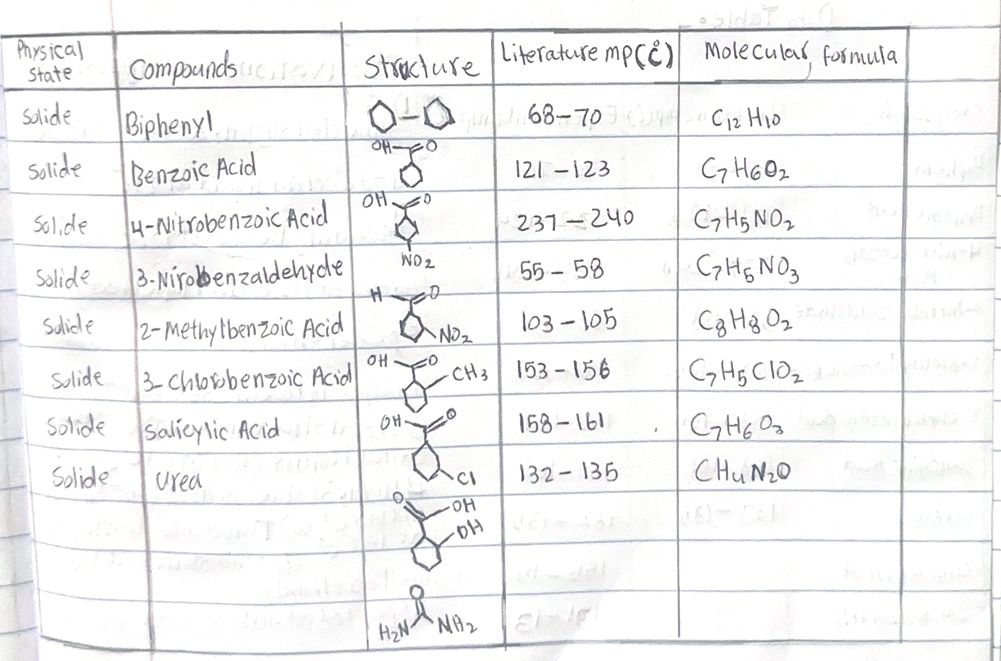
Table: Physical State, Structure, Melting Point, and Molecular Formula of Selected Compounds
The following table summarizes the physical state, chemical structure, literature melting point (mp, in °C), and molecular formula for each compound. This information is crucial for distinguishing between compounds with similar functional groups and for predicting their chemical behavior.
Physical State | Compound | Structure | Literature mp (°C) | Molecular Formula |
|---|---|---|---|---|
Solid | Biphenyl |
| 68–70 | C12H10 |
Solid | Benzoic Acid | 121–123 | C7H6O2 | |
Solid | 4-Nitrobenzoic Acid | 237–240 | C7H5NO4 | |
Solid | 3-Nitrobenzaldehyde | 55–58 | C7H5NO3 | |
Solid | 2-Methylbenzoic Acid | 103–105 | C8H8O2 | |
Solid | 3-Chlorobenzoic Acid | 153–156 | C7H5ClO2 | |
Solid | Salicylic Acid | 158–161 | C7H6O3 | |
Solid | Urea | 132–135 | CH4N2O |
Key Concepts
Aromatic Compounds: Many of the compounds listed are derivatives of benzene, featuring various functional groups such as carboxylic acids, nitro groups, and aldehydes.
Melting Point (mp): The melting point is a key physical property used to identify and assess the purity of organic compounds. Pure compounds typically have a sharp melting point range.
Molecular Formula: The molecular formula provides the number and type of atoms in a molecule, which is essential for determining molecular weight and for stoichiometric calculations.
Examples and Applications
Benzoic Acid: Commonly used as a food preservative and in the synthesis of various organic compounds.
Salicylic Acid: Used in the production of aspirin and as a topical treatment for acne.
Biphenyl: Used as a heat transfer agent and in the production of polychlorinated biphenyls (PCBs).
Additional Info
Functional group modifications (e.g., nitro, methyl, chloro) significantly affect the melting point and reactivity of aromatic compounds.
Urea, while not aromatic, is included as a common organic compound with important applications in fertilizers and pharmaceuticals.
