 Indietro
Protecting Groups, Ethers, and Epoxides in Organic Synthesis
Guida di studio - Note intelligenti
 Appunti personalizzati basati sui tuoi materiali, ampliati con definizioni chiave, esempi e contesto.
Protecting Groups (PGs) in Organic Synthesis
Why Protecting Groups Are Needed
In organic synthesis, protecting groups are used to temporarily mask reactive functional groups to prevent unwanted side reactions. This is especially important when using Grignard reagents, which are highly reactive nucleophiles and strong bases. Alcohols and other acidic or electrophilic groups must be protected to avoid reaction with the Grignard reagent.
Grignard reagents react with acidic protons (such as those in alcohols), so alcohols must be protected before Grignard formation.
Common protecting groups for alcohols include silyl ethers (e.g., trimethylsilyl (TMS) ethers).
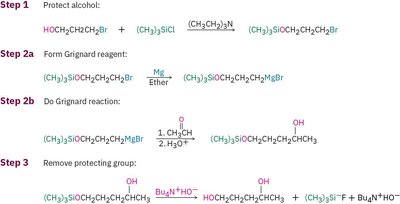
Example: The image above shows the stepwise process of protecting an alcohol, performing a Grignard reaction, and then removing the protecting group to regenerate the alcohol.
Other Protecting Groups
Other functional groups can also be protected using different strategies, depending on the reactivity and the synthetic route. The choice of protecting group depends on the required stability and ease of removal under specific conditions.
Pinacol Rearrangement (Aside)
The Pinacol rearrangement is an unusual reaction (not covered in all textbooks) where a 1,2-diol is converted to a ketone or aldehyde under acidic conditions, involving a carbocation rearrangement. This is an example of a rearrangement reaction that can occur with certain alcohols.
Ethers and Epoxides; Thiols and Sulfides
Simple Naming of Ethers (18.1)
Ethers are compounds with the general structure R–O–R', where R and R' are alkyl or aryl groups. Simple ethers are named by listing the two groups attached to oxygen in alphabetical order, followed by the word "ether." For more complex ethers, the alkoxy group is named as a substituent.
Diethyl ether: CH3CH2OCH2CH3
Anisole: Methyl phenyl ether (C6H5OCH3)
Tetrahydrofuran (THF): A cyclic ether commonly used as a solvent.
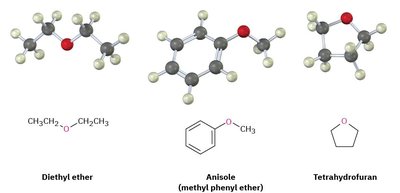
Example: The image above shows the structures of diethyl ether, anisole, and tetrahydrofuran, illustrating the diversity of ether structures.
Other Examples of Ethers
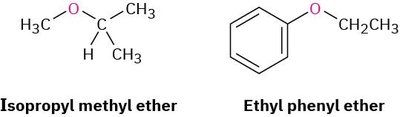
Isopropyl methyl ether: (CH3)2CHOCH3
Ethyl phenyl ether: C6H5OCH2CH3
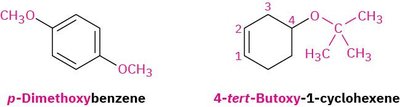
p-Dimethoxybenzene: 1,4-dimethoxybenzene, a benzene ring with methoxy groups at the para positions.
4-tert-Butoxy-1-cyclohexene: A cyclohexene ring with a tert-butoxy group at the 4-position.
Polarity and Peroxides (18.2)
Ethers are generally less polar than alcohols but more polar than hydrocarbons. They can form peroxides upon exposure to oxygen, which are potentially explosive. Proper storage and handling are essential for safety.
Preparation of Ethers
Williamson Ether Synthesis (SN2 Mechanism)
The Williamson ether synthesis is a classic method for preparing ethers via an SN2 reaction. An alkoxide ion reacts with a primary alkyl halide to form an ether. This method is limited to primary (and some secondary) alkyl halides due to competing elimination reactions with more hindered substrates.
General reaction:
Cannot efficiently make unsymmetrical ethers with tertiary alkyl halides due to elimination.
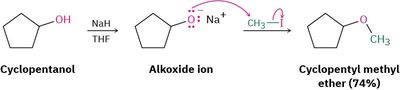
Example: The image above shows the conversion of cyclopentanol to cyclopentyl methyl ether via the alkoxide intermediate.
Oxymercuration: Alcohol as Nucleophile
Oxymercuration can be used to synthesize ethers by using an alcohol as the nucleophile instead of water. This method allows for the formation of ethers from alkenes under milder conditions and with high regioselectivity.
Mercuric acetate reacts with an alkene and an alcohol to form an ether after reduction.
Commonly used for the synthesis of alkoxy-substituted alkanes.
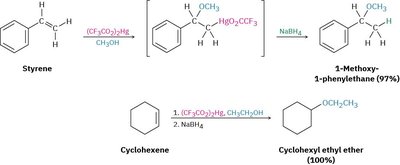
Example: The image above shows the oxymercuration of styrene and cyclohexene to form 1-methoxy-1-phenylethane and cyclohexyl ethyl ether, respectively.
Summary Table: Ether Synthesis Methods
Method | Reactants | Product | Notes |
|---|---|---|---|
Williamson Ether Synthesis | Alkoxide + Alkyl halide | Ether | Best for primary alkyl halides; SN2 mechanism |
Oxymercuration | Alkene + Alcohol + Hg(OAc)2 | Ether | Regioselective; avoids carbocation rearrangement |
Acid-catalyzed dehydration | 2 Alcohols + Acid | Ether | Best for symmetrical ethers; limited by competing elimination |
Key Terms and Concepts
Protecting group (PG): A chemical group used to temporarily mask a functional group during a synthetic sequence.
Grignard reagent: An organomagnesium compound used as a nucleophile in organic synthesis.
Ether: An organic compound with an oxygen atom connected to two alkyl or aryl groups.
Williamson ether synthesis: A method for preparing ethers via SN2 reaction of an alkoxide with an alkyl halide.
Oxymercuration: A method for adding an alcohol across an alkene to form an ether.
