 Indietro
Ochem Module 7
Guida di studio - Note intelligenti
 Appunti personalizzati basati sui tuoi materiali, ampliati con definizioni chiave, esempi e contesto.
Radical Reactions
Introduction to Radicals
Radicals are species with an unpaired electron, making them highly reactive intermediates in organic reactions. Radical reactions are fundamental in organic chemistry, especially in halogenation and addition processes.
Definition: A radical is an atom or molecule with at least one unpaired electron.
Formation: Radicals are typically formed via homolytic bond cleavage.
Reactivity: Radicals participate in chain reactions, including initiation, propagation, and termination steps.
Homolytic vs. Heterolytic Bond Cleavage
Bond cleavage can occur in two distinct ways, affecting the nature of the products formed.
Homolytic Cleavage: The bond breaks evenly, and each atom takes one electron, forming two radicals.
Heterolytic Cleavage: The bond breaks unevenly, with one atom taking both electrons, forming a cation and an anion.
Example: Homolytic cleavage of Cl2 produces two Cl• radicals; heterolytic cleavage produces Cl+ and Cl-.
Mechanism of Radical Chain Reactions
All radical reactions follow a chain mechanism with three main steps:
Initiation: Formation of radicals, usually by heat or light.
Propagation: Radicals react with non-radicals to form new radicals, continuing the chain.
Termination: Two radicals combine to form a stable, non-radical product.
Radical Stability
Factors Affecting Radical Stability
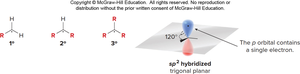
The stability of a radical depends on its structure and the surrounding atoms or groups.
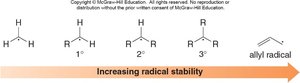
Alkyl Substitution: More substituted radicals (2° and 3°) are more stable due to hyperconjugation and inductive effects.
Resonance: Radicals stabilized by resonance (e.g., allylic radicals) are more stable than alkyl radicals.
Order of Stability: Allylic > 3° > 2° > 1° > methyl.
Radical Stability and Reaction Selectivity
The stability of radicals influences the selectivity and outcome of halogenation reactions.
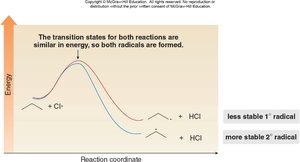
Chlorination: Less selective, forms both 1° and 2° radicals due to similar transition state energies.
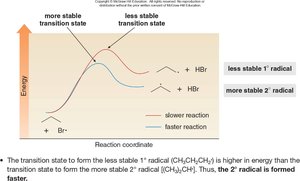
Bromination: More selective, favors formation of the more stable 2° or 3° radicals.
Halogenation of Alkanes
Predicting Products of Radical Reactions
Halogenation of alkanes with Cl2 or Br2 proceeds via radical mechanisms, and the product distribution depends on radical stability.
Chlorination: Produces a mixture of products, with less selectivity for more substituted positions.
Bromination: Highly selective for the most substituted (and thus most stable) radical positions.
Example: Bromination of propane yields mostly 2-bromopropane due to the stability of the 2° radical.
Radical Addition Reactions
Radical addition reactions can occur at allylic positions or across double bonds.
Allylic Halogenation: Halogenation at the allylic position is favored due to resonance stabilization of the allylic radical.
Radical Addition of HBr to Alkenes: In the presence of peroxides, HBr adds to alkenes via a radical mechanism, favoring anti-Markovnikov products.
Mechanisms and Synthetic Applications
Steps in Radical Chain Reactions
Initiation:
Propagation:
Termination:
Synthetic Usefulness of Radical Reactions
Radical reactions are valuable in organic synthesis for selective functionalization and for introducing halogens or other groups at specific positions.
Allylic Halogenation: Used to selectively halogenate allylic positions in alkenes.
Radical Addition: Enables anti-Markovnikov addition of HBr to alkenes, useful for preparing alkyl bromides.
Halogenation: Allows selective introduction of halogens into alkanes and alkenes.
Stereochemistry of Radical Reactions
Overview
Radical reactions can affect the stereochemistry of products, especially when new chiral centers are formed. The planar nature of the radical intermediate allows for attack from either face, often leading to racemic mixtures.
Example: Radical halogenation at a chiral center can produce both enantiomers.
Summary Table: Radical Stability
Type of Radical | Stability |
|---|---|
Methyl (CH3•) | Least stable |
1° (RCH2•) | Low stability |
2° (R2CH•) | Moderate stability |
3° (R3C•) | High stability |
Allylic (resonance-stabilized) | Highest stability |
Key Equations
General Radical Halogenation:
Radical Addition of HBr:
