 Indietro
Reactions of Alkenes: Addition Mechanisms, Nomenclature, and Industrial Relevance
Guida di studio - Note intelligenti
 Appunti personalizzati basati sui tuoi materiali, ampliati con definizioni chiave, esempi e contesto.
Chapter 8: Reactions of Alkenes
8.1 Introduction to Addition Reactions
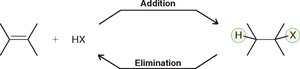
Addition reactions are fundamental transformations in organic chemistry, particularly involving alkenes. In these reactions, the carbon-carbon π bond is converted into two new σ bonds, effectively increasing the saturation of the molecule. Addition is the reverse of elimination, and the direction of equilibrium depends on reaction conditions.
Addition Reaction: Two reactants combine to form a single product.
Elimination Reaction: A single reactant splits into two products.
Key Concept: Addition reactions are favored at lower temperatures due to enthalpy, while elimination is favored at higher temperatures due to entropy.
8.2 Alkenes in Nature and Industry
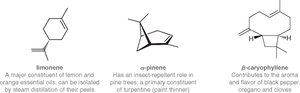
Alkenes are prevalent in both biological systems and industrial processes. Cyclic and polycyclic alkenes are found in essential oils and pheromones, and simple alkenes like ethylene and propylene are major industrial feedstocks.
Natural Alkenes: Compounds such as limonene, α-pinene, and β-caryophyllene are found in plants and contribute to aromas and flavors.
Pheromones: Alkenes are structural components of insect pheromones, influencing behavior and communication.
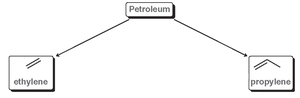
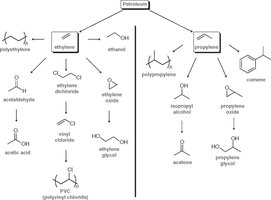
Industrial Importance: Ethylene and propylene are produced from petroleum cracking and serve as precursors for polymers and other chemicals.

8.3 Nomenclature and Stability of Alkenes
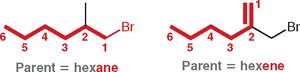
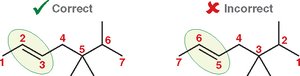
Alkenes are named according to IUPAC rules, with modifications to account for the double bond. The parent chain must include the C=C bond, and the double bond receives the lowest possible number. Substituents are listed alphabetically, and the double bond's position is indicated in the name.
Parent Chain: Must contain the double bond; ends in -ene.
Numbering: Assign the lowest number to the double bond; substituents are numbered accordingly.
Configuration: E/Z (or cis/trans) notation is used for geometric isomers.

8.4 Addition vs. Elimination: Thermodynamic Perspective
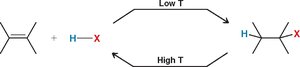
Addition and elimination reactions are in equilibrium, and the favored direction depends on temperature. Addition is enthalpically favored due to the formation of strong σ bonds, but entropy favors elimination at higher temperatures.
Enthalpy: Addition forms stronger bonds ().
Entropy: Addition decreases entropy (two reactants to one product).
Temperature: Lower temperatures favor addition; higher temperatures favor elimination.
8.5 Hydrohalogenation
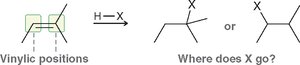
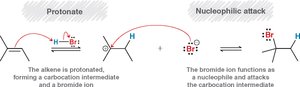
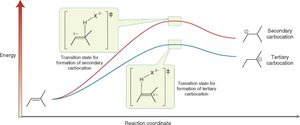
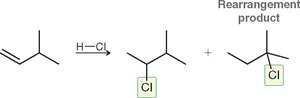
Hydrohalogenation involves the addition of HX (where X = Cl, Br, or I) to an alkene. The reaction is regioselective, typically following Markovnikov's rule, where the halogen attaches to the more substituted carbon. The presence of peroxides can reverse this selectivity (anti-Markovnikov).
Markovnikov Addition: H adds to the less substituted carbon, X to the more substituted.
Anti-Markovnikov Addition: Occurs with peroxides, especially with HBr.
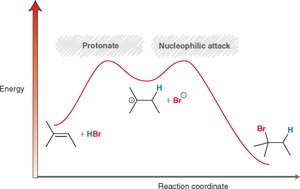
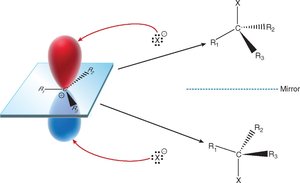
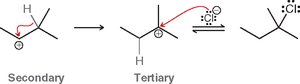
Mechanism: Proceeds via carbocation intermediate; rearrangements may occur.
Stereochemistry: Formation of chiral centers leads to racemic mixtures.


8.6 Acid-Catalyzed Hydration
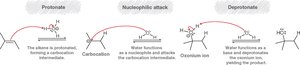
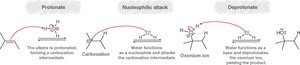
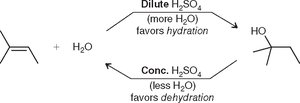
Acid-catalyzed hydration adds water (H and OH) across the alkene, following Markovnikov regioselectivity. The reaction is catalyzed by acids such as sulfuric acid and proceeds via a carbocation intermediate.
Regioselectivity: OH attaches to the more substituted carbon.
Mechanism: Protonation, nucleophilic attack, and deprotonation steps.
Equilibrium: Controlled by Le Châtelier’s principle; excess water favors alcohol formation.
8.7 Oxymercuration-Demercuration
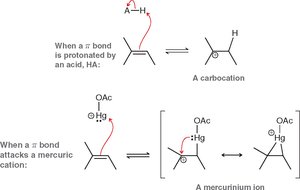
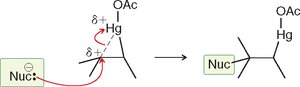
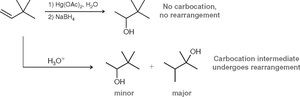
Oxymercuration-demercuration is an alternative hydration method that avoids carbocation rearrangements. It involves Markovnikov addition of H and OH, using mercuric acetate as the electrophile and NaBH4 for demercuration.
Mechanism: Alkene attacks mercuric cation, forming a mercurinium ion intermediate.
Regioselectivity: Markovnikov addition; no rearrangement.
Product: Alcohol, same as acid-catalyzed hydration but with higher selectivity.

8.8 Hydroboration-Oxidation
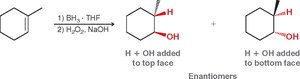
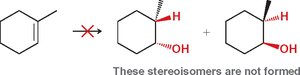
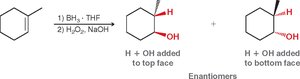
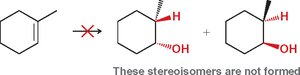
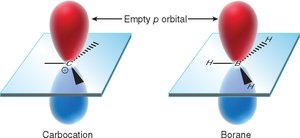
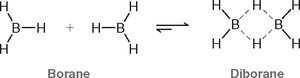
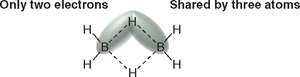
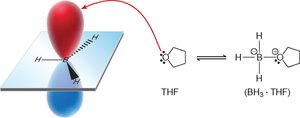
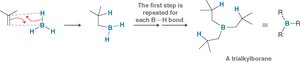
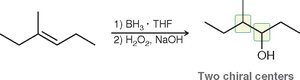
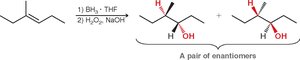
Hydroboration-oxidation is a two-step process that adds H and OH across an alkene with anti-Markovnikov regioselectivity and syn stereochemistry. The reaction uses BH3 (often as BH3·THF) and is followed by oxidation with H2O2/NaOH.
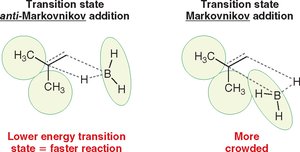
Regioselectivity: OH attaches to the less substituted carbon.
Stereochemistry: Syn addition; both H and OH add to the same face.
Mechanism: Boron atom is attacked by the less substituted carbon; hydride shift stabilizes the intermediate.



8.9 Catalytic Hydrogenation
Catalytic hydrogenation reduces alkenes to alkanes by adding H2 across the double bond. The reaction is stereospecific, producing only syn addition products, and requires a metal catalyst such as Pt, Pd, or Rh (Wilkinson's catalyst).
Mechanism: Alkene and H2 adsorb onto the metal surface; both H atoms add to the same face.
Stereochemistry: Syn addition; meso compounds may result from symmetrical alkenes.
Catalysts: Heterogeneous (Pt, Pd) or homogeneous (Wilkinson's catalyst).




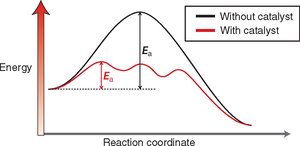
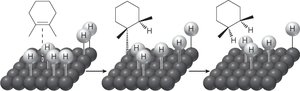
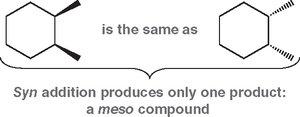

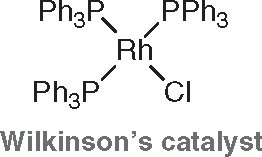
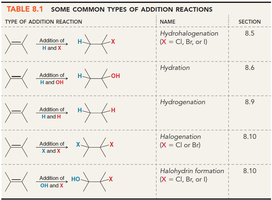
Table 8.1: Common Types of Addition Reactions
This table summarizes the main addition reactions of alkenes, their reactants, and the section in which they are discussed.
Type of Addition Reaction | Name | Section |
|---|---|---|
Addition of H and X | Hydrohalogenation (X = Cl, Br, or I) | 8.5 |
Addition of H and OH | Hydration | 8.6 |
Addition of H and H | Hydrogenation | 8.9 |
Addition of X and X | Halogenation (X = Cl or Br) | 8.10 |
Addition of X and HO | Halohydrin formation (X = Cl, Br, or I) | 8.10 |
Additional info:
These notes cover the main addition reactions of alkenes, their mechanisms, stereochemistry, and industrial relevance. For exam preparation, focus on understanding the regioselectivity (Markovnikov vs. anti-Markovnikov), stereospecificity (syn vs. anti addition), and the conditions that favor each reaction type.
