 Indietro
Reactions of Alkenes Involving Cyclic Transition States: Hydroboration-Oxidation, Carbene Addition, and Epoxidation
Guida di studio - Note intelligenti
 Appunti personalizzati basati sui tuoi materiali, ampliati con definizioni chiave, esempi e contesto.
Reactions of Alkenes Involving Cyclic Transition States
Hydroboration–Oxidation of Alkenes
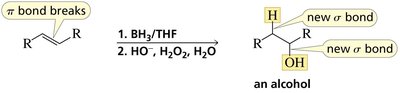
Hydroboration–oxidation is a two-step reaction that converts alkenes to alcohols via a syn addition mechanism, avoiding carbocation rearrangements. The process involves the addition of borane (BH3) or a dialkylborane (such as 9-BBN) to the alkene, followed by oxidation with hydrogen peroxide.
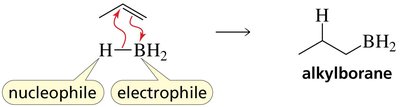
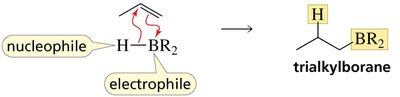
Step 1: Hydroboration – Borane acts as an electrophile, adding to the less substituted sp2 carbon of the alkene. The π bond breaks, and new σ bonds form between boron and carbon, and hydrogen and carbon.
Step 2: Oxidation – The boron atom is replaced by an OH group using H2O2 and base, resulting in an alcohol.
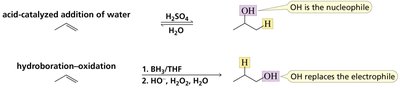
Regioselectivity – The OH group attaches to the less substituted carbon, opposite to Markovnikov addition.
Stereochemistry – Both H and OH add to the same side (syn addition).
Carbocation Rearrangement – Does not occur, as no carbocation intermediate is formed.
Mechanism and Transition States
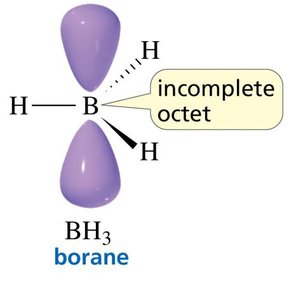
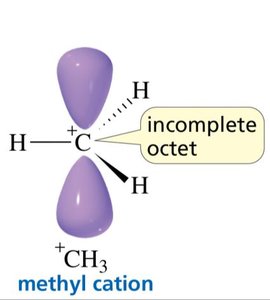
Borane Structure – BH3 has an incomplete octet, making it highly electrophilic.
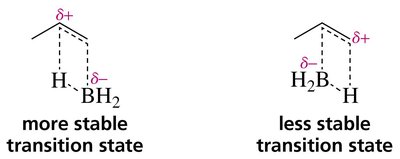
Transition State Stability – The more stable transition state forms when boron adds to the less substituted carbon, minimizing steric hindrance and charge buildup.
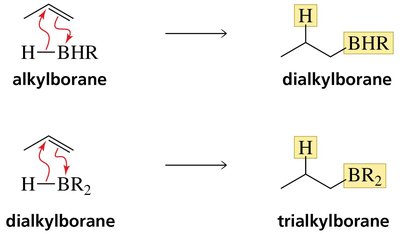
Multiple Additions – BH3 can react with three alkene molecules due to its three hydride ions.
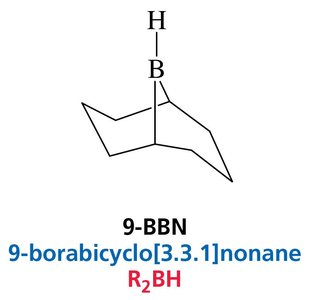
Bulky Dialkylboranes – Reagents like 9-BBN (9-borabicyclo[3.3.1]nonane) are more selective for the less substituted carbon due to steric effects.


Oxidation Mechanism
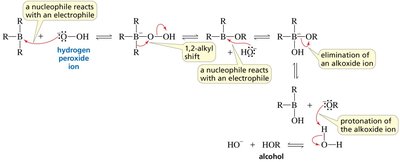
Oxidation Step – Hydrogen peroxide reacts with the alkylborane, leading to a 1,2-alkyl shift and elimination of an alkoxide ion, followed by protonation to yield the alcohol.
Examples and Applications
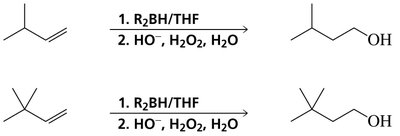
Hydroboration–Oxidation of Unsymmetrical Alkenes – Produces alcohols with anti-Markovnikov regioselectivity.
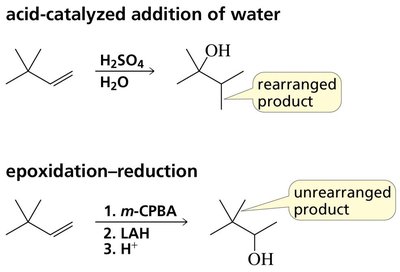
Comparison with Acid-Catalyzed Addition – Acid-catalyzed addition can lead to carbocation rearrangement, while hydroboration–oxidation does not.
Addition of Carbenes to Alkenes
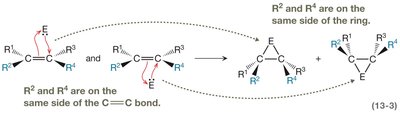
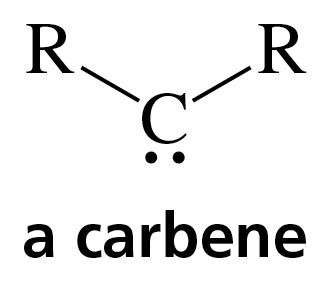
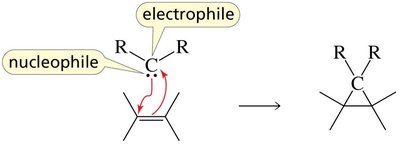
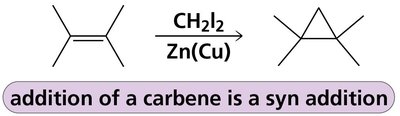
Carbenes are neutral species with a divalent carbon atom possessing a lone pair and an incomplete octet. They can add to alkenes to form cyclopropane rings via a syn addition mechanism.
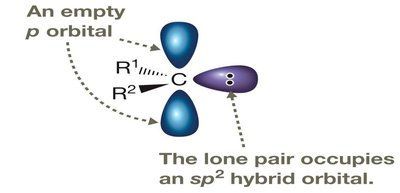
Carbene Structure – Carbenes have two substituents, a lone pair, and an empty p orbital.
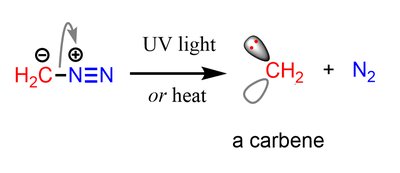
Generation of Carbenes – Carbenes can be generated from diazomethane (CH2N2) or from chloroform (CHCl3) and base.
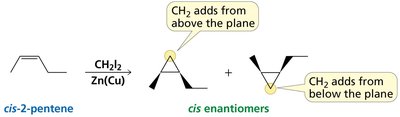
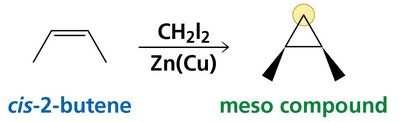
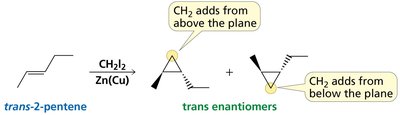
Simmons–Smith Reaction – Uses Zn(Cu) and CH2I2 to generate a carbene for cyclopropanation.
Stereochemistry – Only syn addition occurs, preserving the cis/trans relationship of the alkene.



Epoxidation of Alkenes
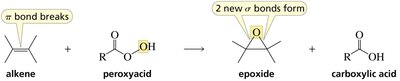
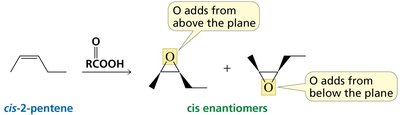
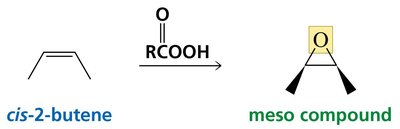
Epoxidation is the addition of a peroxyacid to an alkene, forming an epoxide (oxirane) via a syn addition mechanism. Epoxides are three-membered cyclic ethers.
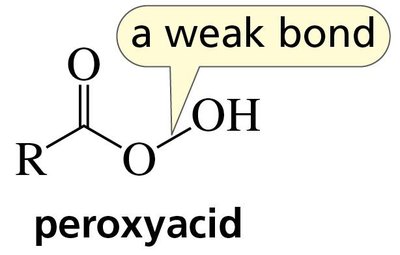
Peroxyacid Structure – Contains a weak O–O bond, facilitating oxygen transfer.
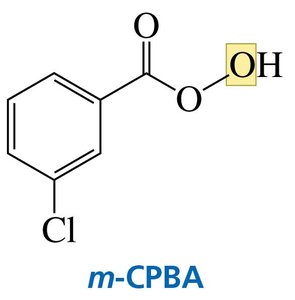
Common Reagents – m-CPBA (meta-chloroperoxybenzoic acid) is frequently used.
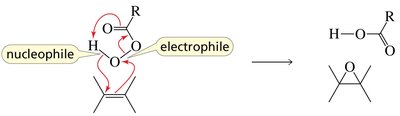
Mechanism – The alkene acts as a nucleophile, attacking the electrophilic oxygen of the peroxyacid, forming the epoxide and a carboxylic acid.
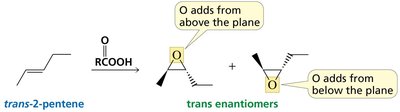
Stereochemistry – Syn addition; the oxygen adds to the same side of the double bond.
Naming Epoxides – Common names add "oxide" to the alkene; systematic names use "oxirane" or "epoxy" as a prefix.



Epoxidation–Reduction: Alcohol Formation Without Rearrangement
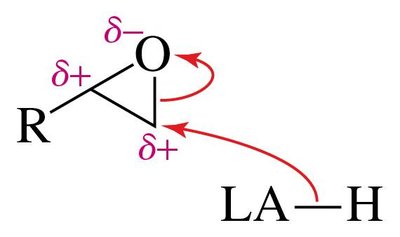
Epoxidation followed by reduction with lithium aluminum hydride (LAH) provides a method to convert alkenes to alcohols without carbocation rearrangement, maintaining the original carbon skeleton.
Step 1: Epoxidation – Alkene is converted to an epoxide using m-CPBA.
Step 2: Reduction – LAH opens the epoxide ring, followed by protonation to yield the alcohol.
Advantage – No carbocation intermediate, so no rearrangement occurs.

Oxymercuration–Reduction: Alcohol Formation Without Rearrangement
Oxymercuration–reduction is another method to convert alkenes to alcohols with Markovnikov regioselectivity, but without carbocation rearrangement. Mercury salts are used, followed by reduction with sodium borohydride.
Regioselectivity – H adds to the less substituted carbon, OH to the more substituted carbon.
Advantage – No carbocation intermediate, so rearrangement is avoided.
Disadvantage – Mercury salts are toxic.

Stereochemistry of Alkene Addition Reactions
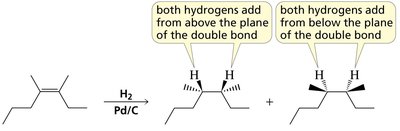
The stereochemistry of addition reactions to alkenes is determined by the mechanism and the nature of the reactants. Reactions can be syn or anti, and may produce enantiomers or meso compounds depending on the starting alkene and substituents.
Stereospecific Reactions – Each stereoisomer of the reactant forms a different stereoisomer of the product.
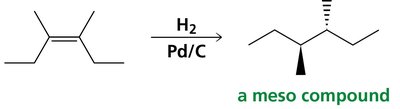
Syn Addition – Both groups add to the same side of the double bond (e.g., hydroboration–oxidation, epoxidation, carbene addition, hydrogenation).
Anti Addition – Groups add to opposite sides of the double bond (e.g., halogenation).
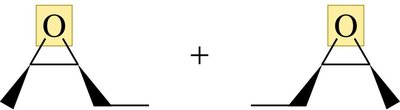
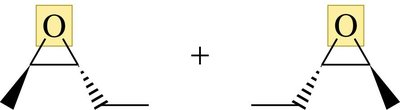
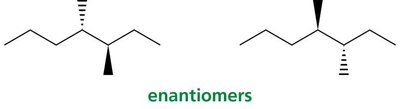
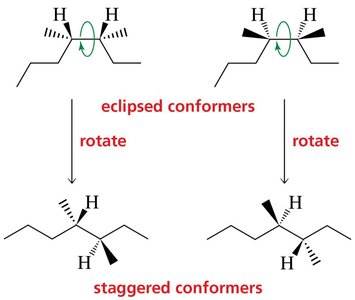
Enantiomers and Meso Compounds – Cis alkenes with identical substituents can form meso compounds; trans alkenes form pairs of enantiomers.




Summary Table: Types of Electrophilic Addition to Alkenes
Reaction Type | Intermediate | Example |
|---|---|---|
Addition of hydrogen halide | Carbocation | HBr to alkene |
Acid-catalyzed addition of water | Carbocation | H2SO4 + H2O |
Hydroboration–oxidation | No intermediate | BH3/THF, H2O2 |
Epoxidation | Three-membered ring | m-CPBA |
Carbene addition | Three-membered ring | Simmons–Smith |
Halogenation | Three-membered ring | Br2 or Cl2 |
Ozonolysis | Five-membered ring | O3 |
Learning Objectives
Name alkenes and draw their structures.
Use curved arrows to show bond-breaking and bond-making.
Predict products of electrophilic addition reactions.
Identify carbocations that will rearrange.
Explain differences in alcohol products from hydroboration–oxidation vs acid-catalyzed addition.
Describe synthesis of alkyl halides, alcohols, ethers, alkanes, epoxides, cyclopropanes, vicinal dibromides, halohydrins, aldehydes, and ketones from alkenes.
Predict relative stabilities of carbocations.
Describe mechanisms for electrophilic addition to alkenes.
Identify oxidation and reduction reactions.
Predict stereoisomers from electrophilic addition to alkenes.
Additional info: Academic context was added to clarify mechanisms, stereochemistry, and comparisons between reaction types, as well as to provide a summary table for exam preparation.
