 Indietro
Reactions of Alkynes and Related Mechanisms: A Mini-Textbook Study Guide
Guida di studio - Note intelligenti
 Appunti personalizzati basati sui tuoi materiali, ampliati con definizioni chiave, esempi e contesto.
Reactions of Alkynes and Related Mechanisms
Introduction
Alkynes are hydrocarbons containing at least one carbon-carbon triple bond. Their unique reactivity allows for a variety of addition, reduction, and rearrangement reactions, many of which parallel those of alkenes but with important differences. Understanding these mechanisms is crucial for mastering multistep organic synthesis.
Carbocation Rearrangements
1,2-Hydride and 1,2-Methyl Shifts
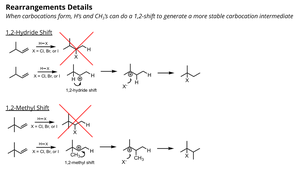
When carbocations form during reactions, they can undergo rearrangements to generate more stable intermediates. The two most common rearrangements are the 1,2-hydride shift and the 1,2-methyl shift.
1,2-Hydride Shift: A hydrogen atom with its bonding electrons moves from one carbon to an adjacent carbocation, stabilizing the intermediate.
1,2-Methyl Shift: A methyl group migrates to the carbocation center, also increasing stability.
These shifts occur only if they lead to a more stable carbocation (e.g., from secondary to tertiary).
Carbocation Stability
The stability of carbocations is a key factor in predicting rearrangements and reaction outcomes. The order of stability is:
Tertiary > Secondary > Primary > Methyl > Vinyl
Allylic and benzylic carbocations are especially stabilized by resonance.

Functional Group Priority
Overview
In IUPAC nomenclature, functional groups are assigned priorities that determine the parent chain and numbering. Alkynes are prioritized below most functional groups but above simple alkyl substituents.
Highest priority: Carboxylic acids, followed by derivatives (esters, amides, etc.), then aldehydes, ketones, alcohols, amines, alkenes, and alkynes.
When both alkene and alkyne are present, the chain is numbered to give the lowest possible numbers to both groups.
Major Reactions of Alkynes
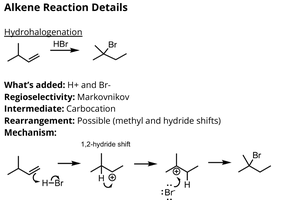
Hydrohalogenation
Hydrohalogenation involves the addition of hydrogen halides (HX) to alkynes, leading to haloalkenes or dihaloalkanes depending on the equivalents used.
What's added: H+ and Br- (or other halide)
Regioselectivity: Markovnikov (halogen adds to the more substituted carbon)
Intermediate: Carbocation
Rearrangement: Possible (methyl and hydride shifts)
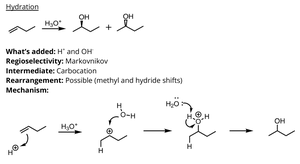
Hydration
Hydration of alkynes adds water across the triple bond, typically in the presence of acid and a mercuric catalyst, yielding ketones (via enol intermediates).
What's added: H+ and OH-
Regioselectivity: Markovnikov
Intermediate: Carbocation
Rearrangement: Possible (methyl and hydride shifts)
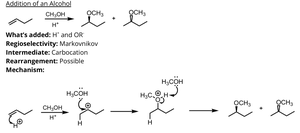
Addition of an Alcohol
Alkynes can react with alcohols in the presence of acid to form vinyl ethers via Markovnikov addition.
What's added: H+ and OR-
Regioselectivity: Markovnikov
Intermediate: Carbocation
Rearrangement: Possible
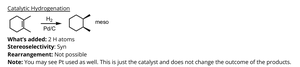
Catalytic Hydrogenation
Catalytic hydrogenation reduces alkynes to alkanes by adding hydrogen atoms across the triple bond. Common catalysts include Pd/C, Pt, or Ni.
What's added: 4 H atoms (for complete reduction to alkane)
Stereoselectivity: Syn addition
Rearrangement: Not possible
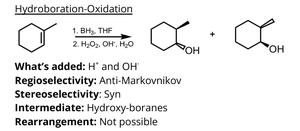
Hydroboration-Oxidation
This two-step reaction converts alkynes to aldehydes (from terminal alkynes) or ketones (from internal alkynes) via anti-Markovnikov addition of water.
What's added: H+ and OH-
Regioselectivity: Anti-Markovnikov
Stereoselectivity: Syn addition
Intermediate: Hydroxy-boranes
Rearrangement: Not possible
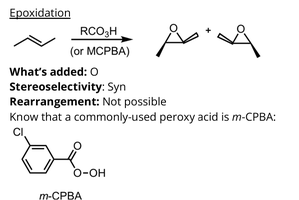
Epoxidation
Epoxidation introduces an oxygen atom across a double bond (or triple bond in some cases), forming an epoxide. Peroxy acids such as m-CPBA are commonly used.
What's added: O
Stereoselectivity: Syn addition
Rearrangement: Not possible
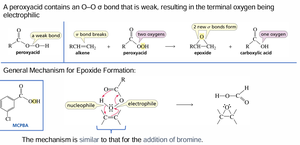
Epoxidation Mechanism
The mechanism involves the transfer of an oxygen atom from the peroxy acid to the alkene or alkyne, forming an epoxide and a carboxylic acid byproduct.
The O-O bond in the peroxy acid is weak, making the terminal oxygen electrophilic.
The reaction proceeds via a concerted mechanism.
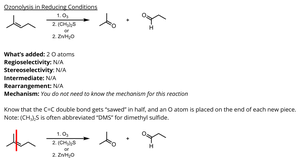
Ozonolysis
Ozonolysis cleaves carbon-carbon multiple bonds, introducing oxygen atoms at the cleavage sites. For alkynes, this typically yields carboxylic acids or ketones, depending on the substrate and conditions.
What's added: 2 O atoms
Mechanism: Not required for basic understanding
Ozone (O3) is used, followed by a reducing workup (e.g., Zn/H2O or (CH3)2S).
Halogenation
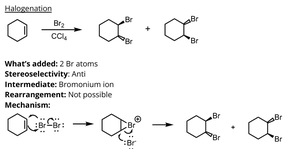
Halogenation adds halogen atoms (e.g., Br2) across the triple bond, forming dihaloalkenes or tetrahaloalkanes depending on the equivalents used.
What's added: 2 Br atoms (per equivalent)
Stereoselectivity: Anti addition
Intermediate: Bromonium ion
Rearrangement: Not possible
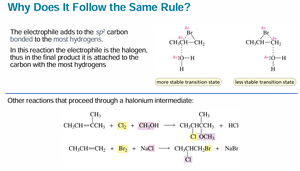
Bromination in H2O
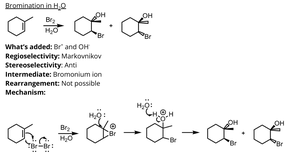
When bromination occurs in water, a bromohydrin is formed due to nucleophilic attack by water on the bromonium ion intermediate.
What's added: Br- and OH-
Regioselectivity: Markovnikov
Stereoselectivity: Anti addition
Intermediate: Bromonium ion
Rearrangement: Not possible
Bromination in Alcohol
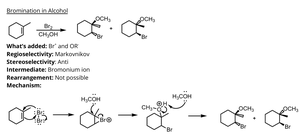
Similar to bromination in water, but the nucleophile is an alcohol, resulting in the formation of bromoethers.
What's added: Br- and OR-
Regioselectivity: Markovnikov
Stereoselectivity: Anti addition
Intermediate: Bromonium ion
Rearrangement: Not possible
Bromination Mechanism
The mechanism for bromination involves the formation of a bromonium ion intermediate, which is then attacked by a nucleophile (water or alcohol) to yield the final product.
Anti addition is observed due to the backside attack on the bromonium ion.
Catalytic Hydrogenation of Alkynes
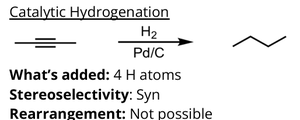
Complete catalytic hydrogenation of alkynes yields alkanes. The process is stereoselective for syn addition and does not allow rearrangement.
What's added: 4 H atoms
Stereoselectivity: Syn
Rearrangement: Not possible
Reduction to Cis or Trans Alkene
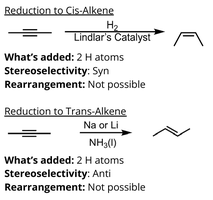
Partial reduction of alkynes can yield either cis (Z) or trans (E) alkenes, depending on the reagents used:
Cis (Z) Alkene: Lindlar's catalyst (Pd/CaCO3, poisoned with Pb(OAc)4 or quinoline) and H2 gas; syn addition.
Trans (E) Alkene: Sodium or lithium in liquid ammonia (Na/NH3 or Li/NH3); anti addition.
Nomenclature and Structure Drawing
IUPAC Naming of Alkynes
Alkynes are named by identifying the longest chain containing the triple bond, numbering to give the triple bond the lowest possible number, and applying substituent rules.
Example: 5-bromo-5-methyl-2-hexyne indicates a six-carbon chain with a triple bond starting at C-2, a bromo and methyl group at C-5.
For multiple double or triple bonds, use suffixes -diene, -triyne, etc., and indicate the position of each bond.
Drawing Alkynes with Substituents
To draw structures such as 3-sec-butyl-1-heptyne, identify the parent chain (hept- for seven carbons), place the triple bond at C-1, and add the sec-butyl group at C-3.
Summary Table: Key Reactions of Alkynes
Reaction | Reagents | Product | Regioselectivity | Stereoselectivity |
|---|---|---|---|---|
Hydrohalogenation | HX | Haloalkene/dihaloalkane | Markovnikov | None |
Hydration | H2O, H+, HgSO4 | Ketone (via enol) | Markovnikov | None |
Hydroboration-Oxidation | 1. BH3, 2. H2O2, OH- | Aldehyde/ketone | Anti-Markovnikov | Syn |
Halogenation | X2 | Dihaloalkene/tetrahaloalkane | None | Anti |
Catalytic Hydrogenation | H2, Pd/C | Alkane | None | Syn |
Partial Reduction (cis) | H2, Lindlar's | Cis-alkene | None | Syn |
Partial Reduction (trans) | Na/NH3 | Trans-alkene | None | Anti |
Ozonolysis | O3, Zn/H2O | Carboxylic acids/ketones | None | None |
Conclusion
Mastering the reactions of alkynes involves understanding the mechanisms, regio- and stereoselectivity, and the role of intermediates such as carbocations and bromonium ions. These principles are foundational for advanced organic synthesis and problem-solving in organic chemistry.
