 Indietro
Resonance in Organic Chemistry: Principles, Contributors, and Applications
Guida di studio - Note intelligenti
 Appunti personalizzati basati sui tuoi materiali, ampliati con definizioni chiave, esempi e contesto.
Resonance in Organic Chemistry
Introduction to Resonance
Resonance is a fundamental concept in organic chemistry used to describe the delocalization of electrons within molecules that cannot be adequately represented by a single Lewis structure. Resonance forms, or contributing structures, are alternative Lewis structures for a molecule that differ only in the arrangement of electrons, not the positions of atoms. The actual structure of the molecule is a resonance hybrid, which is a weighted average of all valid resonance forms.
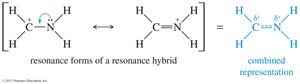
Resonance forms are interconverted by moving only electrons (usually π electrons or lone pairs).
The true structure is a resonance hybrid, which is more stable than any individual resonance form.
Resonance stabilizes molecules by delocalizing charge and electron density.
Criteria for Comparing Resonance Forms
Not all resonance forms contribute equally to the resonance hybrid. The relative importance of each form is determined by several criteria:
Octet Rule: The most significant resonance forms have as many atoms as possible with complete octets.
Number of Bonds: Structures with more covalent bonds are favored.
Electronegativity: Negative charges are more stable on more electronegative atoms (e.g., oxygen over carbon).
Charge Separation: Structures with minimal charge separation are more stable.
Major and Minor Contributors
Resonance forms are classified as major or minor contributors based on their stability and adherence to the above criteria. The major contributor is the most stable and thus contributes most to the resonance hybrid.
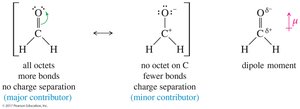
Major Contributor: All atoms have complete octets, more bonds, and minimal charge separation.
Minor Contributor: May have incomplete octets, fewer bonds, or greater charge separation.
Example: In the resonance forms of formaldehyde anion, the structure with all octets and no charge separation is the major contributor.
Electronegativity and Charge Placement
When multiple resonance forms satisfy the octet rule, the placement of charges becomes important. The major contributor will have the negative charge on the most electronegative atom.
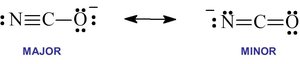
Example: For a structure with both carbon and oxygen bearing a negative charge, the form with the negative charge on oxygen (the more electronegative atom) is the major contributor.
Non-Equivalent Resonance and Charge Separation
When resonance forms have opposite charges, the most stable form is the one with the smallest separation of oppositely charged atoms. Opposite charges should be on adjacent atoms to maximize stability.
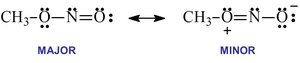
Minimizing charge separation increases the stability of the resonance form.
Worked Examples: Drawing and Evaluating Resonance Forms
Example 1: [CH3OCH2]+
To draw resonance forms, move electrons (not atoms) to generate alternative structures. Evaluate each for octet completion and charge placement.
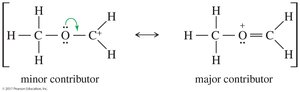
The minor contributor has a carbon atom with only six electrons (incomplete octet).
The major contributor has octets on all atoms and an additional bond.
Example 2: Resonance in a Carbonyl Compound
Consider a compound with resonance forms where the negative charge can be placed on either carbon or oxygen.
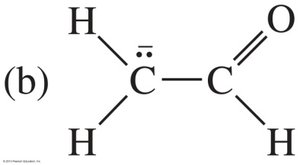
Both forms have octets on all atoms and the same number of bonds.
The form with the negative charge on oxygen is the major contributor due to oxygen's higher electronegativity.
Resonance in the Acetate Ion
When acetic acid loses a proton, the resulting acetate ion exhibits resonance. The negative charge is delocalized over both oxygen atoms, stabilizing the ion. Each carbon–oxygen bond is intermediate between a single and double bond.

Delocalization of charge increases stability.
Both oxygen atoms share the negative charge equally.
Additional Examples of Resonance Forms
Practice drawing resonance forms for various organic compounds. Consider the placement of electrons, octet completion, and charge distribution.
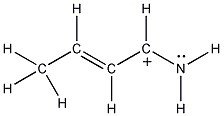
For each compound, draw all valid resonance forms and identify the major and minor contributors based on the criteria discussed.
Summary Table: Criteria for Major and Minor Resonance Contributors
Criterion | Major Contributor | Minor Contributor |
|---|---|---|
Octet Rule | All atoms have complete octets | One or more atoms lack octet |
Number of Bonds | More covalent bonds | Fewer covalent bonds |
Charge Placement | Negative charge on more electronegative atom | Negative charge on less electronegative atom |
Charge Separation | Minimal charge separation | Greater charge separation |
Key Equations and Notation
Resonance is indicated by a double-headed arrow () between contributing structures.
The resonance hybrid is often depicted with partial bonds or charges (, ).
Practice Problems
Draw all resonance forms for the following compounds and identify the major contributor:
Explain why delocalization of charge leads to increased stability in the acetate ion.
