 Indietro
Step-by-Step Guidance for Organic Compound Nomenclature (IUPAC)
Guida di studio - Note intelligenti
 Appunti personalizzati basati sui tuoi materiali, ampliati con definizioni chiave, esempi e contesto.
Q1. Name the following compound using the IUPAC system:
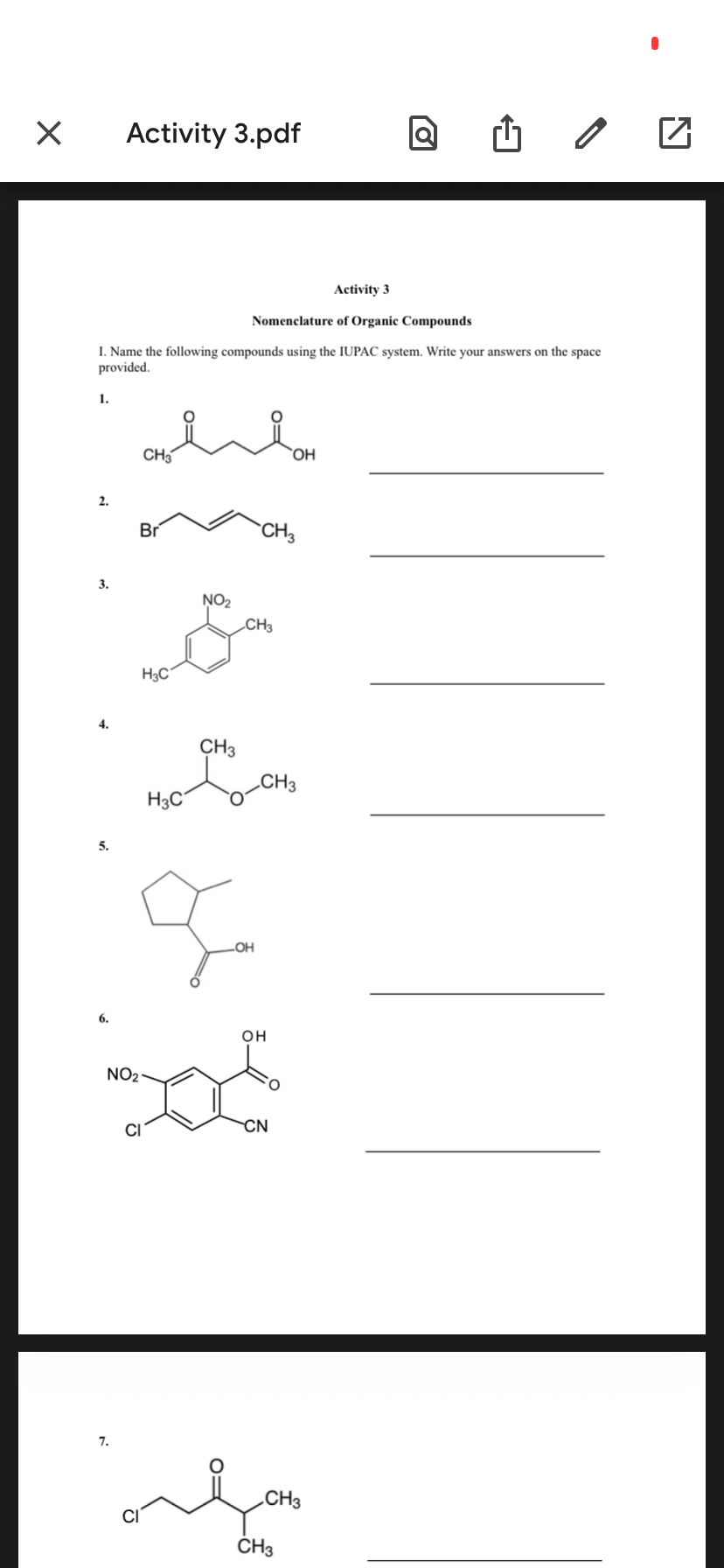
Background
Topic: IUPAC Nomenclature of Organic Compounds
This question tests your ability to systematically name organic molecules, specifically those containing functional groups such as ketones and alcohols.
Key Terms and Formulas
IUPAC: International Union of Pure and Applied Chemistry naming system.
Functional groups: Ketone ($\text{C=O}$), Alcohol ($\text{-OH}$).
Longest carbon chain: Identify the main chain containing the highest priority functional group.
Numbering: Assign numbers to the carbon chain to give the lowest possible numbers to the functional groups.
Step-by-Step Guidance
Identify the longest continuous carbon chain that contains both functional groups.
Determine the priority of functional groups (in this case, carboxylic acid and ketone).
Number the chain so that the highest priority group gets the lowest possible number.
Name the parent chain and add prefixes/suffixes for the functional groups.
Try solving on your own before revealing the answer!
Final Answer: 3-Oxobutanoic acid
The compound is named as a carboxylic acid with a ketone at the 3-position. The longest chain is four carbons (butanoic acid), and the ketone is at carbon 3.
Q2. Name the following compound using the IUPAC system:
Background
Topic: IUPAC Nomenclature of Haloalkenes
This question tests your ability to name compounds with halogen substituents and double bonds.
Key Terms and Formulas
Halogen substituent: Bromine ($\text{Br}$).
Alkene: Double bond ($\text{C=C}$).
Numbering: Number the chain to give the double bond the lowest possible number.
Step-by-Step Guidance
Identify the longest carbon chain containing the double bond.
Number the chain from the end closest to the double bond.
Assign the position of the bromine substituent.
Combine the substituent and parent chain names.
Try solving on your own before revealing the answer!
Final Answer: 1-Bromo-2-butene
The compound is a four-carbon chain (butene) with a double bond at position 2 and a bromine at position 1.
Q3. Name the following compound using the IUPAC system:
Background
Topic: IUPAC Nomenclature of Aromatic Compounds
This question tests your ability to name substituted benzene rings, including nitro and methyl groups.
Key Terms and Formulas
Aromatic ring: Benzene.
Substituents: Nitro ($\text{NO}_2$), Methyl ($\text{CH}_3$).
Numbering: Assign numbers to give the lowest possible set to substituents.
Step-by-Step Guidance
Identify the parent aromatic ring (benzene).
Choose the principal substituent (nitro or methyl) for lowest numbering.
Assign numbers to the substituents based on their positions.
Combine substituent names in alphabetical order.
Try solving on your own before revealing the answer!
Final Answer: 2,4-Dimethyl-3-nitrobenzene
The benzene ring has methyl groups at positions 2 and 4, and a nitro group at position 3.
Q4. Name the following compound using the IUPAC system:
Background
Topic: IUPAC Nomenclature of Ethers
This question tests your ability to name ethers using the IUPAC system.
Key Terms and Formulas
Ether: Oxygen atom connecting two alkyl groups.
Alkyl groups: Methyl ($\text{CH}_3$), Isopropyl ($\text{CH(CH}_3)_2$).
Parent chain: Choose the larger group as the parent.
Step-by-Step Guidance
Identify the two alkyl groups attached to the oxygen atom.
Name the smaller group as an alkoxy substituent.
Name the larger group as the parent chain.
Combine the names to form the IUPAC name.
Try solving on your own before revealing the answer!
Final Answer: 2-Methoxy-2-methylpropane
The compound is an ether with a methoxy group attached to a 2-methylpropane parent chain.
Q5. Name the following compound using the IUPAC system:
Background
Topic: IUPAC Nomenclature of Cycloalkanes with Functional Groups
This question tests your ability to name cycloalkanes with carboxylic acid substituents.
Key Terms and Formulas
Cycloalkane: Cyclopentane.
Carboxylic acid: $\text{-COOH}$ group.
Numbering: Assign the carboxylic acid as position 1.
Step-by-Step Guidance
Identify the cycloalkane ring (cyclopentane).
Assign the carboxylic acid group as position 1.
Check for any other substituents (none in this case).
Name the compound as a cyclopentane carboxylic acid.
Try solving on your own before revealing the answer!
Final Answer: Cyclopentanecarboxylic acid
The compound is a cyclopentane ring with a carboxylic acid group attached.
Q6. Name the following compound using the IUPAC system:
Background
Topic: IUPAC Nomenclature of Aromatic Acids with Multiple Substituents
This question tests your ability to name benzoic acids with multiple substituents (nitro, chloro, cyano).
Key Terms and Formulas
Benzoic acid: Aromatic ring with a carboxylic acid group.
Substituents: Nitro ($\text{NO}_2$), Chloro ($\text{Cl}$), Cyano ($\text{CN}$).
Numbering: Assign numbers to give the lowest possible set to substituents.
Step-by-Step Guidance
Identify the parent aromatic ring (benzoic acid).
Assign the carboxylic acid as position 1.
Number the ring to give the lowest possible numbers to the substituents.
List substituents in alphabetical order in the name.
Try solving on your own before revealing the answer!
Final Answer: 3-Nitro-4-chloro-5-cyanobenzoic acid
The benzoic acid ring has nitro at position 3, chloro at position 4, and cyano at position 5.
Q7. Name the following compound using the IUPAC system:
Background
Topic: IUPAC Nomenclature of Ketones with Substituents
This question tests your ability to name ketones with halogen and methyl substituents.
Key Terms and Formulas
Ketone: $\text{C=O}$ group.
Halogen substituent: Chlorine ($\text{Cl}$).
Methyl substituent: $\text{CH}_3$.
Numbering: Assign numbers to give the ketone the lowest possible number.
Step-by-Step Guidance
Identify the longest carbon chain containing the ketone group.
Number the chain so the ketone gets the lowest possible number.
Assign the positions of the chlorine and methyl substituents.
Combine the substituent names with the parent chain.
Try solving on your own before revealing the answer!
Final Answer: 3-Chloro-2,2-dimethylpropanone
The compound is a propanone with chlorine at position 3 and two methyl groups at position 2.
