 Indietro
Structure and Bonding in Organic Chemistry: Foundations and Acid-Base Concepts
Guida di studio - Note intelligenti
 Appunti personalizzati basati sui tuoi materiali, ampliati con definizioni chiave, esempi e contesto.
Structure and Bonding in Organic Chemistry
Introduction to Organic Chemistry
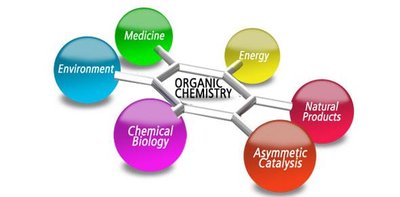
Organic chemistry is the branch of chemistry that studies carbon-containing compounds. The unique ability of carbon to form strong bonds with itself and other elements allows for the creation of a vast array of molecules, including chains and rings. Organic compounds are characterized by the presence of one or more carbon atoms, but not all carbon compounds are considered organic (e.g., diamond, graphite, carbon dioxide).
Key Point: Organic chemistry is central to fields such as biology, medicine, agriculture, and materials science.
Example: Proteins, lipids, carbohydrates, and DNA are all organic compounds found in living organisms.
Atoms, Electrons, and Orbitals
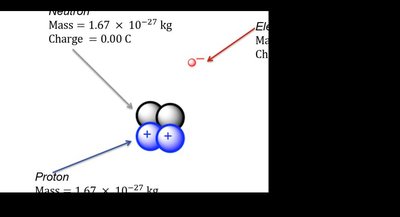
Atoms are composed of protons, neutrons, and electrons. The atomic number (Z) is the number of protons, while the mass number (A) is the sum of protons and neutrons. Electrons exhibit wave-particle duality and are described by orbitals, which are solutions to the Schrödinger equation. The shape and energy of an orbital reflect the probability and stability of an electron's location.
Key Point: Electrons occupy orbitals, and their arrangement determines chemical properties.
Equation: (Schrödinger equation)
Quantum Numbers and Atomic Orbitals
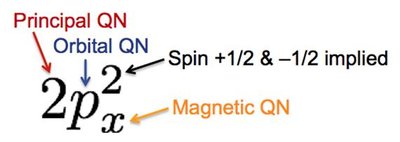
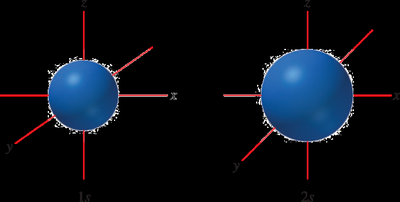
Atomic orbitals are defined by four quantum numbers: principal (n), orbital (l), magnetic (ml), and spin (s). The Pauli exclusion principle states that no two electrons in an atom can have the same set of quantum numbers. The s orbitals are spherical and begin at n=1, while p orbitals are dumbbell-shaped and begin at n=2.
Key Point: Quantum numbers determine the energy and shape of atomic orbitals.
Example: The 2p orbital has three orientations (x, y, z).
Ions and Chemical Bonding
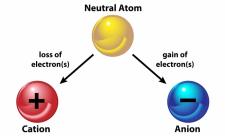
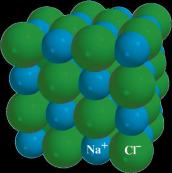
Atoms can lose electrons to form cations or gain electrons to form anions. The attractive force between oppositely charged ions is called an ionic bond, described by Coulomb's law. Ionic compounds form tightly packed lattices and are typically high-melting solids soluble in polar solvents.
Key Point: Ionic bonds are rare in organic chemistry because carbon rarely forms ions.
Equation: (Coulomb's law)
Covalent Bonding
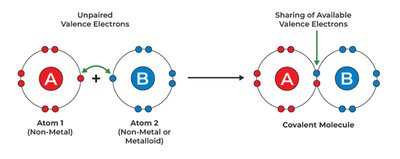
Covalent bonds involve the sharing of electrons between atoms, typically nonmetals. Maximum stability is achieved when atoms have a full valence shell, often isoelectronic with the nearest noble gas. Covalent bonds may be polarized if electrons are not shared equally.
Key Point: Covalent bonds are the most common type of bonding in organic molecules.
Example: In H2, two hydrogen atoms share electrons to achieve a full n=1 shell.
Lewis Structures and the Octet Rule
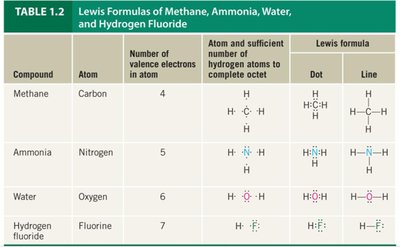
Lewis structures represent electrons as dots or lines, with lines denoting shared pairs in covalent bonds. The octet rule states that second-row elements share electrons until they achieve eight in their valence shell. Multiple bonds (double or triple) may be necessary to satisfy the octet rule.
Key Point: Lewis structures help visualize bonding and electron distribution.
Example: Fluorine in F2 achieves an octet by sharing electrons.
VSEPR Geometries
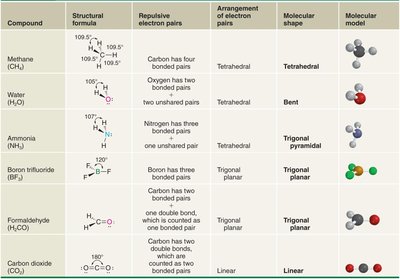
The Valence Shell Electron Pair Repulsion (VSEPR) theory predicts molecular shapes based on repulsion between electron pairs. Common geometries include tetrahedral, trigonal planar, and linear.
Key Point: Molecular geometry affects physical and chemical properties.
Polar Covalent Bonds, Electronegativity, and Dipole Moments
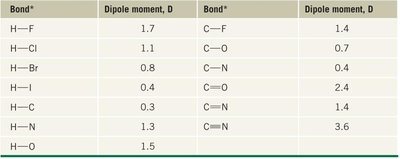
Electronegativity is the ability of an atom to attract electrons. Polar covalent bonds arise when atoms of different electronegativities share electrons unequally, resulting in bond dipoles. The molecular dipole moment is the vector sum of individual bond dipoles.
Key Point: Polar bonds are sites of reactivity in organic molecules.
Example: Carbon tetrachloride (CCl4) is nonpolar, while methylene chloride (CH2Cl2) is polar.


Formal Charge
Formal charge is calculated by subtracting the valence electron count of the neutral atom from the formal valence electron count in the molecule. It helps identify atoms with unusual electron distributions in Lewis structures.
Key Point: Formal charge is important for predicting reactivity and stability.
Equation:
Representing Organic Molecules
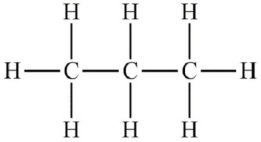
Organic compounds can be represented in several ways: molecular formula, structural formula, condensed formula, and skeletal (bond-line) formula. Each method provides different levels of detail about atom connectivity and bonding.
Key Point: Skeletal formulas are commonly used in organic chemistry for simplicity.
Example: C3H8 (propane) can be written as CH3CH2CH3 (condensed) or with lines representing bonds (skeletal).
Isomers
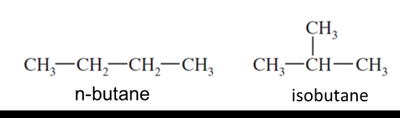
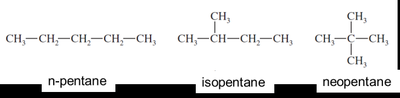
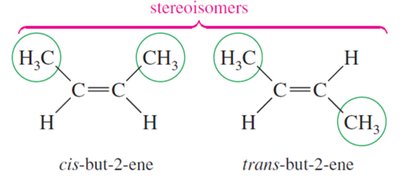
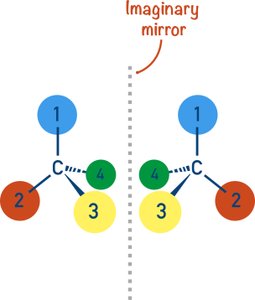
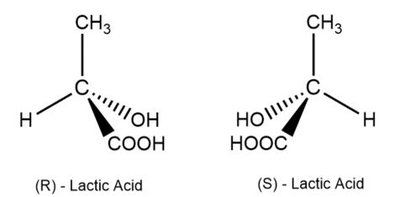
Isomers are molecules with the same molecular formula but different arrangements of atoms. Constitutional (structural) isomers differ in bonding sequence, while stereoisomers differ in spatial orientation. Geometric isomers (cis/trans) arise from restricted rotation, and optical isomers are non-superimposable mirror images.
Key Point: Isomerism increases molecular diversity and affects properties.
Example: n-butane and isobutane are constitutional isomers of C4H10.

Acids and Bases in Organic Chemistry
Brønsted-Lowry Acids and Bases
Acids are species that donate protons, while bases accept protons. Conjugate acids and bases are related by the addition or removal of a proton. Water can act as a base, forming the hydronium ion (H3O+).
Key Point: Acid-base reactions are fundamental to organic chemistry.
Acid Dissociation Constant (Ka) and pKa
The acid dissociation constant (Ka) measures the strength of an acid in water. pKa is the negative logarithm of Ka; lower pKa values indicate stronger acids.
Equation:
Equation:
Structural Factors Influencing Acidity
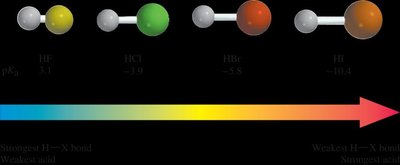
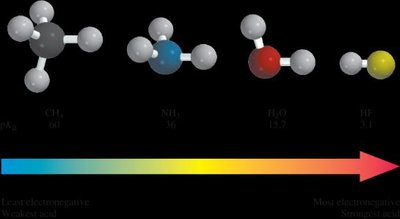
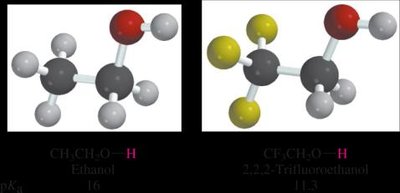
Acidity is influenced by bond strength, electronegativity, inductive effects, and resonance stabilization of the conjugate base.
Factor 1: As the size of the atom bonded to H increases, bond strength decreases and acidity increases.
Factor 2: Higher electronegativity increases acidity by polarizing the H–A bond.
Factor 3: Inductive effects from nearby electronegative atoms increase acidity.
Factor 4: Resonance delocalization stabilizes the conjugate base, increasing acidity.
Lewis Theory of Acids and Bases
Lewis acids accept electron pairs (electrophiles), while Lewis bases donate electron pairs (nucleophiles). Many organic reactions involve exchanges between nucleophiles and electrophiles.
Key Point: Lewis acid-base theory expands the concept of acidity and basicity beyond protons.
Example: BF3 (Lewis acid) reacts with diethyl ether (Lewis base) to form a new bond.
Summary Table: Types of Isomers
Type | Definition | Example |
|---|---|---|
Constitutional Isomers | Same molecular formula, different connectivity | n-butane vs. isobutane |
Geometric Isomers | Different substituents around a bond with restricted rotation | cis- and trans-but-2-ene |
Optical Isomers | Non-superimposable mirror images | (R)- and (S)-lactic acid |
Additional info: These notes expand on brief points from the original material, providing academic context and examples for clarity. All images included are directly relevant to the adjacent explanations and reinforce key concepts.
