 Indietro
Structure and Synthesis of Alkenes: Chapter 7 Study Notes
Guida di studio - Note intelligenti
 Appunti personalizzati basati sui tuoi materiali, ampliati con definizioni chiave, esempi e contesto.
Structure and Synthesis of Alkenes
Elements of Unsaturation
Alkenes are hydrocarbons containing at least one carbon-carbon double bond, which introduces an element of unsaturation. The degree of unsaturation indicates the number of rings and/or multiple bonds present in a molecule, compared to its fully saturated analog.
Element of Unsaturation: Each double bond or ring reduces the hydrogen count by two compared to the saturated formula.
Degree of Unsaturation: Also called unsaturation number or index of hydrogen deficiency.
Alkenes and Cycloalkenes: Both are considered elements of unsaturation.
Calculation: Unsaturations are calculated from both multiple bonds and rings.

Formula for Calculating Unsaturations
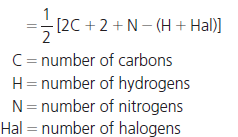
The degree of unsaturation can be calculated using the following formula:
Formula:
Variables: C = number of carbons, H = number of hydrogens, N = number of nitrogens, Hal = number of halogens.
Nomenclature of Alkenes
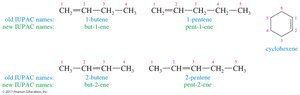
Alkene nomenclature follows IUPAC rules, emphasizing the position and number of double bonds within the longest carbon chain.
Longest Chain: Identify the longest chain containing the double bond.
Numbering: Number the chain so the double bond receives the lowest possible number.
Suffix: The suffix changes from -ane to -ene.
Multiple Double Bonds: Use prefixes (di-, tri-, tetra-) to indicate the number of double bonds.
Ring Nomenclature
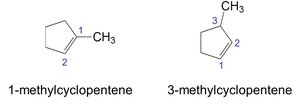
For cyclic alkenes, the double bond is assumed to be between carbon 1 and carbon 2 unless otherwise specified.
Alkenes as Substituents
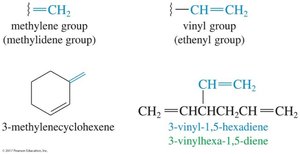
Alkenes can act as substituents on larger molecules, and their nomenclature reflects their position and type.
Methylene Group: (methylidene group)
Vinyl Group: (ethenyl group)
Cyclic Compounds and Isomerism
Cycloalkenes exhibit unique stereochemistry. Trans cycloalkenes are stable only if the ring contains eight or more carbons. All cycloalkenes are assumed to be cis unless specified as trans.
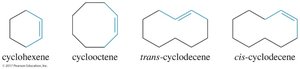
Cis-Trans (Geometric) Isomers
Alkenes can exhibit geometric isomerism, where substituents are arranged differently around the double bond.
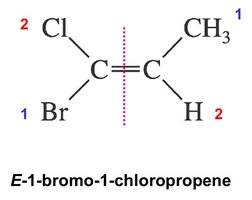
E-Z Nomenclature: Assign priorities to substituents using the Cahn–Ingold–Prelog rules.
E Isomer: Highest priority groups on opposite sides.
Z Isomer: Highest priority groups on the same side.
Relative Stabilities and Bredt’s Rule
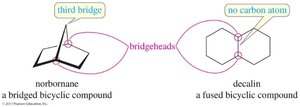
Bredt’s Rule states that a bridged bicyclic compound cannot have a double bond at a bridgehead position unless one of the rings contains at least eight carbon atoms.
Stereochemistry in Dienes
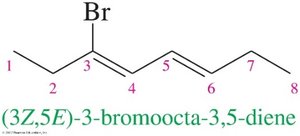
When a molecule contains more than one double bond, the stereochemistry of each must be specified, often using E/Z notation.
Elimination Reactions: E1 and E2
Overview of Elimination Reactions
Elimination reactions are fundamental for the synthesis of alkenes, typically proceeding via E1 or E2 mechanisms. These reactions remove elements (often HX) from alkyl halides or alcohols, forming double bonds.
E1 Reaction: Unimolecular elimination, often shares conditions with SN1 reactions.
E2 Reaction: Bimolecular elimination, requires a strong base and anti-coplanar geometry.

E1 and SN1 Mechanisms
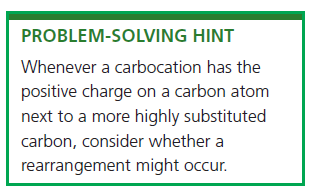
E1 and SN1 reactions often occur under similar conditions, leading to mixtures of products. Carbocation rearrangements are common in E1 reactions.
Zaitsev’s Rule
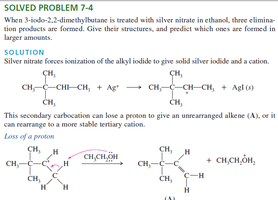
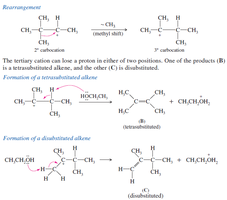
Zaitsev’s Rule predicts that the most substituted (and thus most stable) alkene will predominate when multiple elimination products are possible.
Major Product: The most substituted alkene.
Rearrangement: Carbocation rearrangement can lead to more substituted products.
Hofmann Orientation and Bulky Bases
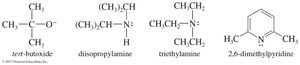
Bulky bases favor the formation of the least substituted alkene (Hofmann product), contrary to Zaitsev’s Rule. Substitution is minimized by using bulky bases.
Bimolecular Elimination: The E2 Reaction
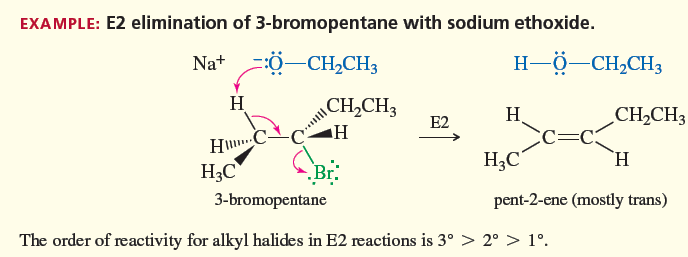
E2 reactions are concerted, requiring a strong base and anti-coplanar arrangement of the hydrogen and leaving group. The Zaitsev product usually predominates unless a bulky base is used.
Substitution vs. Elimination
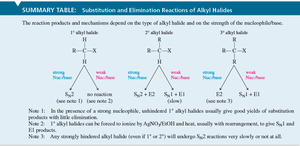
The competition between substitution and elimination depends on the strength of the nucleophile/base, the structure of the alkyl halide, and reaction conditions.
Strong Nucleophiles: Favor SN2 and E2.
Weak Nucleophiles: Favor SN1 and E1.
Primary Halides: Usually undergo SN2, rarely E2.
Tertiary Halides: Favor E1, SN1, and E2 with strong nucleophiles.
Secondary Halides: Can undergo SN1, E1, SN2, or E2.
Bulky Bases and High Temperature: Favor elimination.
Alcohols: Dehydration (E1 Mechanism)
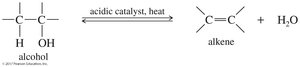
Dehydration of Alcohols
Alcohols can be dehydrated to form alkenes via an E1 mechanism, typically using an acidic catalyst and heat.
Mechanism: Acidic catalyst promotes loss of water, forming a carbocation intermediate.
Product: Alkene and water.
Industrial Synthesis of Alkenes
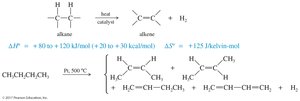
Catalytic Cracking and Dehydrogenation
Alkenes are produced industrially by catalytic cracking of alkanes and dehydrogenation, which removes hydrogen to form double bonds.
Catalytic Cracking: High temperatures and catalysts break larger alkanes into smaller alkenes.
Dehydrogenation: Removal of H2 from alkanes to form alkenes.
Summary Tables
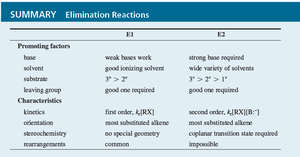
Elimination Reactions: E1 vs. E2
The following table summarizes the differences between E1 and E2 elimination reactions:
Factor | E1 | E2 |
|---|---|---|
Base | Weak bases work | Strong base required |
Solvent | Good ionizing solvent | Wide variety of solvents |
Substrate | 3° > 2° | 3° > 2° > 1° |
Leaving Group | Good one required | Good one required |
Kinetics | First order, | Second order, |
Orientation | Most substituted alkene | Most substituted alkene |
Stereochemistry | No special geometry | Coplanar transition state required |
Rearrangements | Common | Impossible |
Substitution and Elimination Reactions of Alkyl Halides
The following table summarizes the reaction products and mechanisms for alkyl halides based on nucleophile strength and substrate type:
Alkyl Halide | Strong Nucleophile | Weak Nucleophile |
|---|---|---|
1° | SN2 > E2 | No reaction (unless rearrangement) |
2° | SN2 > E2 | SN1 + E1 (slow) |
3° | E2 | SN1 + E1 |
Additional info: These notes cover all major aspects of Chapter 7: Structure and Synthesis of Alkenes, including nomenclature, stereochemistry, elimination mechanisms, and industrial synthesis. The summary tables provide a concise comparison of reaction types and conditions.
