 Indietro
Structure, Properties, and Synthesis of Alkenes: Electrophilic Addition, Oxidation, and Cyclopropanation
Guida di studio - Note intelligenti
 Appunti personalizzati basati sui tuoi materiali, ampliati con definizioni chiave, esempi e contesto.
Structure and Properties of Alkenes
Bonding in Alkenes
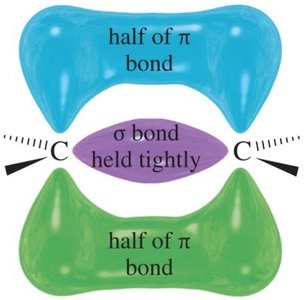
Alkenes are hydrocarbons containing a carbon-carbon double bond, which consists of one sigma (σ) bond and one pi (π) bond. The π bond is formed by the sideways overlap of p orbitals and is more loosely held than the σ bond, making alkenes reactive toward electrophiles.
Sigma bond: Formed by head-on overlap of orbitals; tightly held.
Pi bond: Formed by sideways overlap; electrons are more exposed and reactive.
Reactivity: The double bond acts as a nucleophile, attacking electrophilic species.
Electrophilic Addition Reactions of Alkenes
General Mechanism
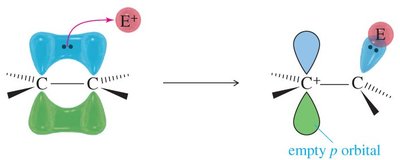
Electrophilic addition is the most common reaction of alkenes. The π electrons attack an electrophile, forming a carbocation intermediate, which is then attacked by a nucleophile.
Step 1: Pi electrons attack the electrophile (E+).
Step 2: Nucleophile attacks the carbocation.
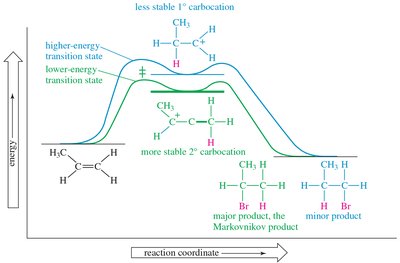
Carbocation stability: More substituted carbocations are more stable.
Markovnikov's Rule
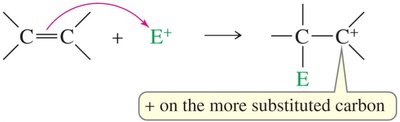
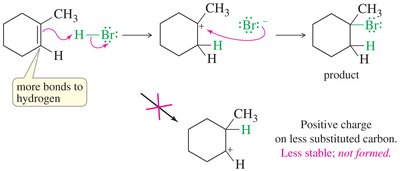
In electrophilic addition, the electrophile adds to the carbon with more hydrogens, generating the most stable carbocation intermediate. This rule predicts the regioselectivity of the reaction.
Markovnikov orientation: Electrophile adds to the less substituted carbon, nucleophile to the more substituted carbon.
Anti-Markovnikov orientation: Occurs in specific cases, such as free-radical addition with HBr and peroxides.
Hydrohalogenation: Addition of HX
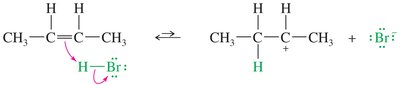
Alkenes react with hydrogen halides (HCl, HBr, HI) to form alkyl halides. The reaction follows Markovnikov's rule unless peroxides are present (anti-Markovnikov with HBr).
Step 1: Protonation of the double bond forms the most stable carbocation.
Step 2: Halide ion attacks the carbocation.
Rearrangements: Possible if a more stable carbocation can be formed.

Reaction-Energy Diagram
The first step (formation of carbocation) is rate-determining. The stability of the carbocation affects the energy profile and product distribution.
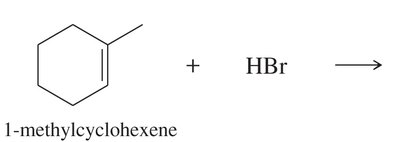
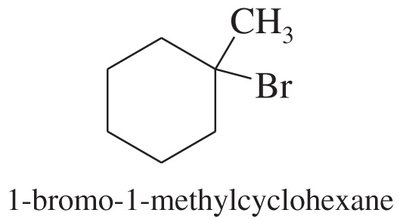
Example: Conversion of 1-methylcyclohexene to 1-bromo-1-methylcyclohexane
Hydrohalogenation of 1-methylcyclohexene with HBr yields 1-bromo-1-methylcyclohexane as the Markovnikov product.
Anti-Markovnikov Addition: Free-Radical Addition of HBr
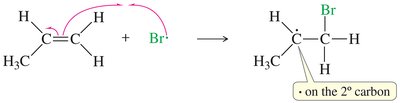
In the presence of peroxides, HBr adds to alkenes via a free-radical mechanism, yielding the anti-Markovnikov product. Only HBr is suitable due to its reactivity.
Step 1: Peroxide bond breaks to form radicals.
Step 2: Hydrogen is abstracted from HBr, forming a bromine radical.
Step 3: Bromine radical adds to the double bond, forming the most stable radical.
Step 4: Another hydrogen is abstracted from HBr.

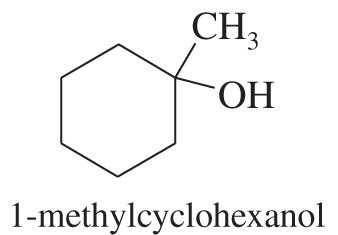
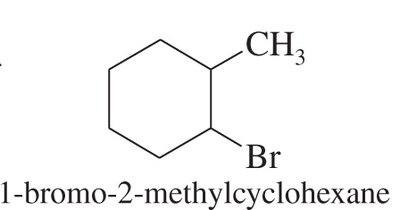
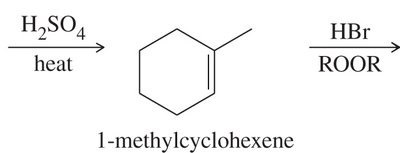
Practice: Conversion of 1-methylcyclohexanol to 1-bromo-2-methylcyclohexane
This synthesis requires the conversion of an alcohol to an alkyl bromide at the neighboring carbon, achieved by radical-catalyzed addition of HBr to 1-methylcyclohexene.
Acid-Catalyzed Hydration
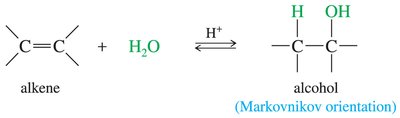
Alkenes react with water in the presence of acid to form alcohols, following Markovnikov's rule. This is the reverse of alcohol dehydration.
Step 1: Protonation of the double bond forms a carbocation.
Step 2: Water attacks the carbocation.
Step 3: Deprotonation yields the alcohol.
Carbocation Rearrangements
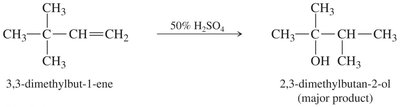
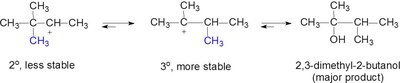
Rearrangements such as methyl shifts can occur to produce more stable carbocations, affecting the product distribution.
Oxymercuration–Demercuration
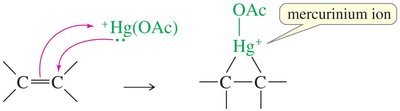
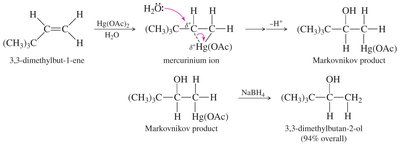
This method achieves Markovnikov hydration of alkenes under milder conditions, without rearrangements or polymerization. The reaction proceeds via a mercurinium ion intermediate.
Step 1: Electrophilic attack forms a mercurinium ion.
Step 2: Water opens the ring, forming an organomercurial alcohol.
Step 3: Demercuration replaces mercury with hydrogen.


Alkoxymercuration–Demercuration
If an alcohol (ROH) is used as the nucleophile, an ether is produced instead of an alcohol.
Hydroboration-Oxidation
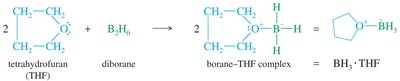
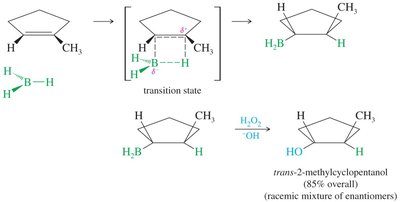
Diborane (B2H6) adds to alkenes with anti-Markovnikov orientation, forming alkylboranes, which are oxidized to anti-Markovnikov alcohols. The addition is syn, with both hydrogen and boron adding to the same side.
Step 1: Borane adds to the double bond.
Step 2: Oxidation with H2O2 yields alcohol.


Practice: Conversion of 1-methylcyclopentanol to 2-methylcyclopentanol
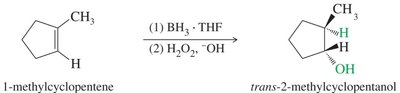
Hydroboration-oxidation of 1-methylcyclopentene yields trans-2-methylcyclopentanol, demonstrating anti-Markovnikov and syn addition.

Polymerization of Alkenes
Alkenes can polymerize via cationic, free-radical, or anionic mechanisms, forming long-chain polymers. Cationic polymerization uses Lewis acids, radical polymerization uses initiators like peroxides, and anionic polymerization requires strong electron-withdrawing groups.
Reduction: Catalytic Hydrogenation
Mechanism and Stereochemistry
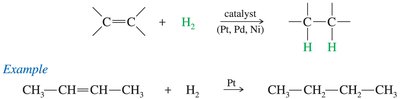
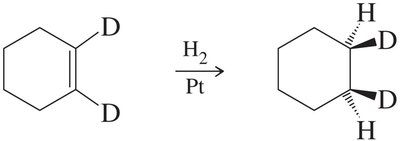
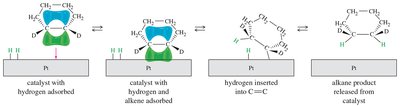
Hydrogen (H2) is added across the double bond in the presence of a metal catalyst (Pt, Pd, Ni), converting alkenes to alkanes. The addition is syn, with both hydrogens adding to the same face.
Step 1: Hydrogen and alkene are adsorbed on the metal surface.
Step 2: Hydrogens insert across the double bond.
Step 3: Reduced product is released.
Addition of Carbenes: Cyclopropanation
Methods of Cyclopropanation
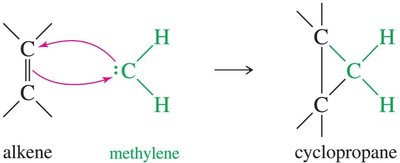
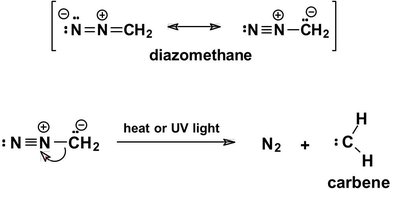
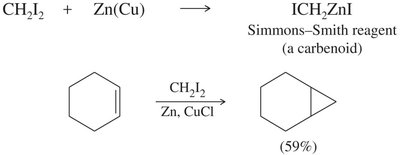
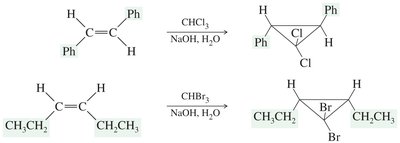
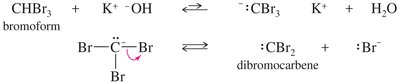
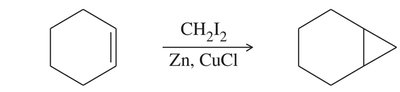
Carbenes (CH2) can be inserted into alkenes to form cyclopropane rings. Methods include diazomethane (toxic, explosive), Simmons–Smith (best method, uses CH2I2 and Zn(Cu)), and alpha elimination of haloforms (CHX3, NaOH, H2O).

Oxidative Additions and Cleavage of Alkenes
Addition of Halogens
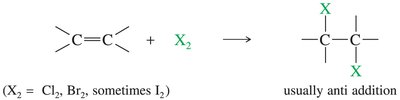
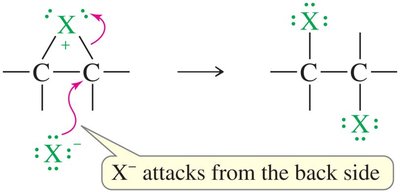
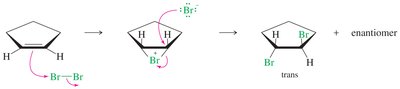
Halogens (Cl2, Br2) add to alkenes to form vicinal dihalides via anti addition. The intermediate is a halonium ion, and nucleophilic attack occurs from the back side.
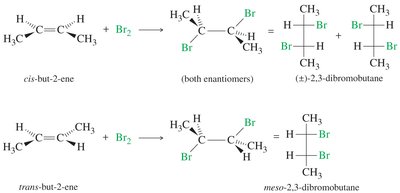
Formation of Halohydrins
Halogen addition in the presence of water forms halohydrins. Water acts as the nucleophile, and the addition follows Markovnikov's rule.
Epoxidation
Alkenes react with peroxyacids (e.g., MCPBA) to form epoxides (oxiranes) in a one-step reaction. Epoxides can be opened by acid-catalyzed hydrolysis to form anti-diols.
Syn-Dihydroxylation
Alkenes are converted to syn-1,2-diols using OsO4 or cold, dilute KMnO4 in base. The addition is syn, and the mechanism involves formation and hydrolysis of an osmate or manganate ester.
Oxidative Cleavage
Warm KMnO4 or ozone (O3) cleaves alkenes to form ketones, acids, or aldehydes. Ozonolysis is milder and does not further oxidize aldehydes.
Olefin (Alkene) Metathesis
Mechanism and Catalysts
Olefin metathesis involves the exchange of alkylidene groups between alkenes, catalyzed by metal-alkylidene complexes. The reaction forms a four-membered ring intermediate, followed by ring opening.
Summary Tables
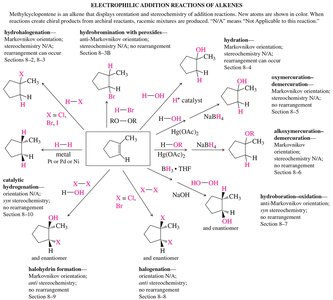
Electrophilic Addition Reactions of Alkenes
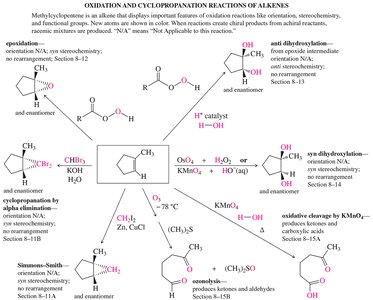
Oxidation and Cyclopropanation Reactions of Alkenes
 Additional info: Academic context and expanded explanations were added to ensure completeness and clarity for exam preparation. All included images directly reinforce the adjacent explanations and mechanisms.
