 Indietro
Substitution and Elimination Reactions of Alkyl Halides: Mechanisms, Products, and Factors
Guida di studio - Note intelligenti
 Appunti personalizzati basati sui tuoi materiali, ampliati con definizioni chiave, esempi e contesto.
Substitution and Elimination Reactions of Alkyl Halides
Overview of SN1, SN2, E1, and E2 Mechanisms
Organic reactions involving alkyl halides commonly proceed via nucleophilic substitution (SN1, SN2) or elimination (E1, E2) mechanisms. The pathway taken depends on the structure of the substrate, the nature of the nucleophile or base, the leaving group, solvent, and reaction conditions such as temperature.
SN1: Unimolecular nucleophilic substitution, involves a carbocation intermediate.
SN2: Bimolecular nucleophilic substitution, concerted mechanism with backside attack.
E1: Unimolecular elimination, involves a carbocation intermediate.
E2: Bimolecular elimination, concerted mechanism requiring anti-periplanar geometry.
Factors Affecting Reaction Pathways
The following factors influence whether substitution or elimination predominates:
Alkyl Halide Structure: Tertiary alkyl halides favor E2 and E1; primary favor SN2.
Nucleophile/Basicity: Strong bases favor E2; weak bases favor SN1/E1.
Leaving Group: Good leaving groups stabilize the transition state and increase rate.
Solvent: Polar protic solvents favor SN1/E1; polar aprotic favor SN2/E2.
Temperature: Higher temperatures favor elimination (E1/E2).
Reagent Concentration: Higher concentration of nucleophile/base favors bimolecular mechanisms (SN2/E2).
Reaction Coordinate Diagrams and Rate-Determining Steps
Reaction coordinate diagrams illustrate the energy changes during a reaction, showing reactants, intermediates, transition states, and products. The rate-determining step (RDS) is the slowest step, often the formation of a carbocation in SN1/E1 or the concerted transition state in SN2/E2.
Regiochemistry and Stereochemistry of Products
Regiochemistry refers to the position of the new bond or double bond formed, while stereochemistry refers to the spatial arrangement of atoms. E2 reactions require anti-periplanar geometry for the leaving group and the hydrogen being abstracted, affecting the stereochemistry of the resulting alkene.
Major and Minor Products in Elimination and Substitution
Multiple products can form in elimination and substitution reactions. The major product is typically the more stable (more substituted) alkene or the product favored by the mechanism and conditions.
Stability of Alkenes: More substituted alkenes are more stable due to hyperconjugation and conjugation.
Product Distribution: Changing the base or solvent can shift the product ratio.
Examples and Applications
Below are representative examples illustrating key concepts:
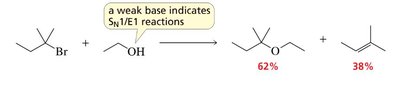
Example 1: SN1/E1 Product Distribution
A weak base (e.g., OH-) with a tertiary alkyl halide leads to a mixture of substitution and elimination products, with substitution slightly favored at room temperature.
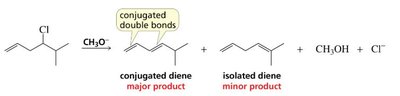
Example 2: E2 Reaction with Conjugated vs. Isolated Diene Products
When a strong base (e.g., CH3O-) reacts with an alkyl halide, the major product is the conjugated diene due to its greater stability, while the isolated diene is the minor product.
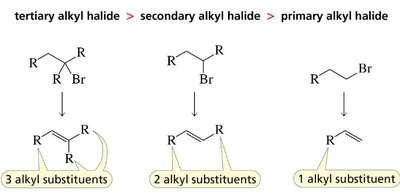
Example 3: Substrate Structure and Reactivity
The rate of elimination increases with the degree of substitution at the carbon bearing the leaving group: tertiary > secondary > primary.
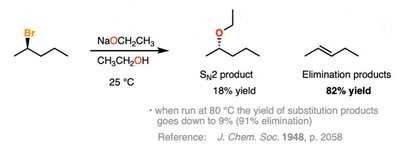
Example 4: Effect of Temperature on Product Distribution
Increasing temperature shifts the product distribution toward elimination. At 25°C, substitution is 18% and elimination is 82%; at 80°C, elimination increases to 91%.
Example 5: Solvent Effects on E2 vs. SN2
Polar aprotic solvents (e.g., DMSO) favor E2 elimination, leading to a high yield of alkene (97%) and a minor SN2 product (3%).
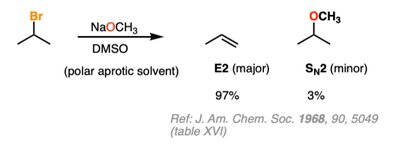
Example 6: Elimination Product Yield
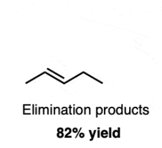
Elimination reactions can produce high yields of alkene products, especially under conditions favoring E2.
Summary Table: Substrate Structure and Typical Elimination Reaction
Type of Substrate | Structure | Elimination Reaction | Notes |
|---|---|---|---|
1°/2° alkyl halide | Primary/secondary carbon with halide | E2 | Requires strong base |
3° alkyl halide | Tertiary carbon with halide | E2 or E1 | E1 possible with weak base |
2°/3° benzyl or allyl halide | Benzyl/allyl group with halide | E2 or E1 | Only if β-hydrogens present |
Vinyl halide | Halide on alkene carbon | E2 | Needs strong base (e.g., NaNH2) |
Aryl halide | Halide on aromatic ring | Neither | Elimination not typical |
Key Equations
SN2 Rate Law:
SN1/E1 Rate Law:
E2 Rate Law:
Additional info:
Hyperconjugation and conjugation stabilize alkenes, favoring more substituted products in elimination.
Anti-periplanar geometry is required for E2 elimination, affecting the stereochemistry of the alkene.
Solvent choice can dramatically affect the mechanism and product distribution.
