 Indietro
Substitution and Elimination Reactions: SN1, SN2, E1, and E2 Mechanisms
Guida di studio - Note intelligenti
 Appunti personalizzati basati sui tuoi materiali, ampliati con definizioni chiave, esempi e contesto.
Substitution and Elimination Reactions
Overview
Substitution and elimination reactions are fundamental processes in organic chemistry, involving the transformation of functional groups in haloalkanes (alkyl halides). These reactions are classified based on their mechanisms, the nature of the nucleophile or base, the substrate structure, and the solvent used. Understanding these mechanisms is crucial for predicting reaction outcomes and designing synthetic strategies.
Haloalkanes (Alkyl Halides)
Structure and Reactivity
Haloalkanes are compounds where a halogen (F, Cl, Br, I) is bonded to an sp3 hybridized carbon. The carbon-halogen bond is polarized due to the electronegativity difference, making the carbon electrophilic and susceptible to nucleophilic attack.
Electrophilic Carbon: Partial positive charge (δ+) due to halogen's electronegativity.
Leaving Group: Halogen acts as a leaving group (L), departing with a pair of electrons.
Nucleophilic Substitution Mechanisms
SN2 Mechanism (Bimolecular Substitution)
The SN2 mechanism is a concerted, single-step process where the nucleophile attacks the electrophilic carbon from the opposite side of the leaving group, resulting in inversion of configuration. The rate depends on both the nucleophile and substrate concentrations.
Rate Law:
Substrate: Favored for methyl, primary, and some secondary alkyl halides.
Stereochemistry: Inversion of configuration (Walden inversion).
Solvent: Polar aprotic solvents (e.g., DMSO, DMF) enhance nucleophilicity.
Good Nucleophile: Required for efficient SN2 reactions.

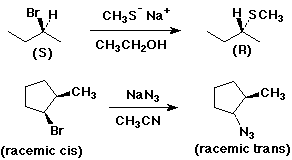
Examples of SN2 Stereochemistry
SN2 reactions at chiral centers result in inversion of configuration, producing enantiomers or diastereomers depending on the substrate.
SN1 Mechanism (Unimolecular Substitution)
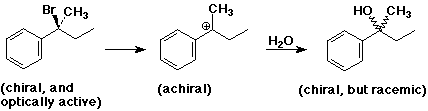
The SN1 mechanism proceeds via a two-step process: first, the leaving group departs, forming a carbocation intermediate; second, the nucleophile attacks the carbocation. The rate depends only on the substrate concentration.
Rate Law:
Substrate: Favored for tertiary and some secondary alkyl halides (sterically hindered).
Stereochemistry: Racemization occurs due to nucleophilic attack from either side of the planar carbocation.
Solvent: Polar protic solvents (e.g., H2O, ROH) stabilize carbocations.
Good Leaving Group: Required for efficient SN1 reactions.
Carbocation Stability
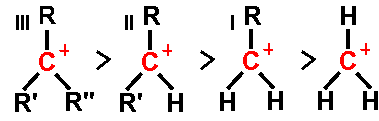
Carbocation stability is a key factor in SN1 reactions. More substituted carbocations are more stable due to hyperconjugation and inductive effects.
Order of Stability: Tertiary > Secondary > Primary > Methyl
Steric Effects in SN2
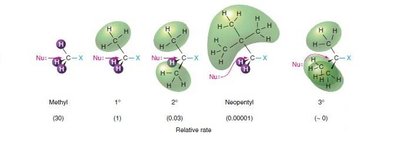
Steric hindrance affects SN2 reaction rates. Less hindered substrates (methyl, primary) react faster than more hindered ones (secondary, tertiary).
Relative Rates: Methyl > Primary > Secondary > Neopentyl >> Tertiary
Solvent Effects
Classification of Solvents
Solvents play a critical role in substitution reactions by affecting nucleophile reactivity and carbocation stability.
Polar Aprotic Solvents: Do not solvate anions, increasing nucleophilicity (e.g., DMSO, DMF, acetone).
Polar Protic Solvents: Solvate anions via hydrogen bonding, decreasing nucleophilicity but stabilizing carbocations (e.g., H2O, ROH).






Nucleophilicity vs. Basicity
Definitions and Trends
Nucleophilicity refers to the ability of a species to donate an electron pair to an electrophilic carbon, while basicity refers to the ability to abstract a proton. Both properties are influenced by charge, solvent, and atomic structure.
Anionic Nucleophiles: Stronger than neutral counterparts.
Period Trends: Nucleophilicity parallels basicity within a period.
Group Trends: Nucleophilicity increases down a group; basicity decreases.
Solvent Effects: Polar aprotic solvents enhance nucleophilicity, especially for small anions like F-.
Elimination Reactions
β-Elimination (E1 and E2 Mechanisms)
Elimination reactions remove atoms or groups from adjacent carbons, forming alkenes. The two main mechanisms are E2 (concerted) and E1 (stepwise).
E2 Mechanism (Bimolecular Elimination)
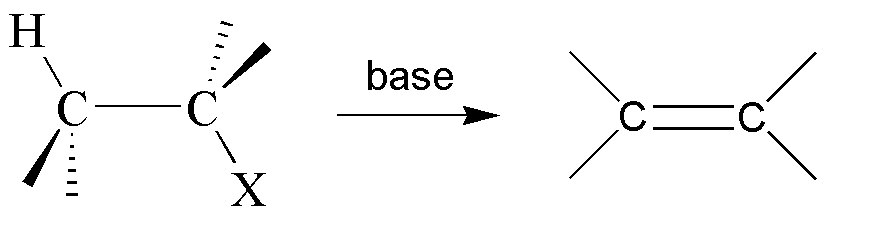
E2 is a single-step, concerted mechanism where a base abstracts a β-hydrogen as the leaving group departs, forming a double bond. Requires anti-periplanar alignment of the hydrogen and leaving group.
Rate Law:
Favored by: Strong bases, primary and secondary substrates, high temperatures.
Stereochemistry: Anti-periplanar geometry required.



E1 Mechanism (Unimolecular Elimination)
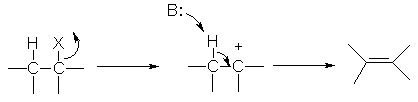
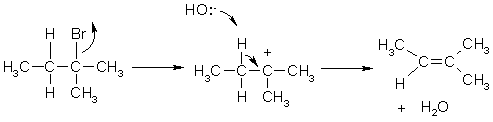
E1 is a two-step mechanism: first, the leaving group departs forming a carbocation; second, a base abstracts a β-hydrogen, forming a double bond. E1 is favored by weak bases and tertiary substrates.
Rate Law:
Intermediate: Carbocation
Favored by: Polar protic solvents, tertiary substrates, weak bases.

Zaitsev's Rule
Zaitsev's Rule states that the most substituted (and thus most stable) alkene is the preferred product in elimination reactions.
Product Stability: More substituted alkenes are more stable due to hyperconjugation.
Factors Determining Substitution vs. Elimination
Substrate Structure and Base/Nucleophile
The competition between substitution and elimination depends on substrate structure, base/nucleophile strength, and steric hindrance.
Primary Substrate: SN2 favored with strong nucleophile; E2 favored with strong, bulky base.
Secondary Substrate: Both SN2 and E2 possible; strong base favors E2.
Tertiary Substrate: SN1/E1 favored with weak base/nucleophile; E2 favored with strong base.









Comparison Tables
SN1 vs. SN2
Feature | SN2 | SN1 |
|---|---|---|
Mechanism | Concerted | Two steps |
Intermediate | None | Carbocation |
Kinetics | Second-order | First-order |
Stereochemistry | Inversion | Racemization |
Nucleophile | Important | Unimportant |
Leaving Group | Important | Important |
Alkyl Group | Methyl > 1° > 2° > 3° | 3° > 2° > 1° > methyl |
Solvent | Polar aprotic | Polar protic |
E1 vs. E2
Feature | E2 | E1 |
|---|---|---|
Mechanism | Concerted | Two steps |
Intermediate | None | Carbocation |
Kinetics | Second-order | First-order |
Stereochemistry | Anti-periplanar | Nonspecific |
Base | Important | Unimportant |
Leaving Group | Important | Important |
Alkene Produced | Zaitsev Rule | Zaitsev Rule |
Summary
Substitution and elimination reactions are central to organic synthesis, with their outcome determined by substrate structure, nucleophile/base strength, solvent, and reaction conditions. Mastery of these concepts enables chemists to design efficient synthetic routes and predict product stereochemistry.
