 Indietro
Chem 120, Mark Merchant Exam 4 Part 3
Guida di studio - Note intelligenti
 Appunti personalizzati basati sui tuoi materiali, ampliati con definizioni chiave, esempi e contesto.
The Krebs Cycle (Citric Acid Cycle / Tricarboxylic Acid Cycle)
Overview of the Krebs Cycle
The Krebs cycle is a central metabolic pathway that occurs in the matrix of the mitochondria. It is also known as the Tricarboxylic Acid (TCA) cycle or Citric Acid Cycle, named for its first product, citric acid, which contains three carboxylic acid groups. The cycle consists of eight distinct enzymatic reactions that play a crucial role in cellular respiration by oxidizing acetyl-CoA to CO2 and generating high-energy electron carriers.
Location: Mitochondrial matrix
Main function: Oxidation of acetyl-CoA, production of NADH, FADH2, and GTP (ATP equivalent)
Key products per cycle: 3 NADH, 1 FADH2, 1 GTP
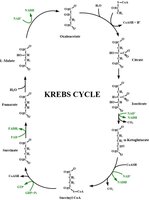
Example: The conversion of citrate to isocitrate is catalyzed by the enzyme aconitase, illustrating the specificity and complexity of the cycle's enzymatic steps.
ATP Yield from the Krebs Cycle
Each round of the Krebs cycle produces several high-energy molecules that are later used in oxidative phosphorylation to generate ATP. The ATP yield is calculated based on the number of NADH, FADH2, and GTP produced:
3 NADH × 2.5 ATP/NADH = 7.5 ATP
1 FADH2 × 1.5 ATP/FADH2 = 1.5 ATP
1 GTP = 1 ATP
Total per cycle: 10 ATP equivalents
Since each glucose molecule yields two acetyl-CoA molecules, the cycle operates twice per glucose, resulting in:
Total ATP from Krebs Cycle per glucose: 20 ATP equivalents
Equation:
Regulation of the Krebs Cycle
Joint Regulation with Glycolysis
The Krebs cycle is tightly regulated in conjunction with glycolysis. The same molecules that inhibit glycolysis also inhibit the Krebs cycle, ensuring coordinated control of cellular energy production.
Inhibitors: ATP, NADH, citrate
Mechanism: These molecules inhibit key enzymes in both pathways, preventing excessive energy production when cellular ATP levels are high.
Example: Citrate acts as an allosteric inhibitor of phosphofructokinase in glycolysis and also inhibits citrate synthase in the Krebs cycle.
Energy Calculations for Glucose Metabolism
Summary of ATP Production
The complete oxidation of one molecule of glucose involves glycolysis, the pyruvate dehydrogenase reaction, and the Krebs cycle. The total ATP yield is calculated as follows:
Glycolysis: 7 ATP
Pyruvate Dehydrogenase: 2 NADH × 2.5 ATP/NADH = 5 ATP
Krebs Cycle: 20 ATP (from two cycles per glucose)
Total ATP per glucose: 32 ATP
Equation:
Example: This calculation demonstrates the efficiency of aerobic respiration in generating cellular energy.
