Ch. 12 - Radicals
Bruice - Organic Chemistry 8th Edition
Bruice8th EditionOrganic ChemistryISBN: 9780135213711Non è quello che usi tu?Cambia libro di testo
Capitolo 12, Problema 46d

Draw the products of the following reactions, including all stereoisomers:
d.

Guida verificata passo dopo passo
1
Step 1: Recognize the type of reaction. The presence of Br₂ and hv (light) indicates a free radical halogenation reaction, which typically occurs at the most stable carbon radical position.
Step 2: Identify the structure of the starting molecule. The given molecule is a branched alkane with a chiral center. Analyze the carbon atoms to determine which positions are most likely to form stable radicals.
Step 3: Determine the most stable radical. In free radical halogenation, tertiary radicals are more stable than secondary radicals, which are more stable than primary radicals. Locate the tertiary carbon in the molecule.
Step 4: Predict the product. Bromine will replace a hydrogen atom at the carbon where the most stable radical is formed. Consider stereochemistry if the reaction occurs at a chiral center.
Step 5: Include all stereoisomers. If the reaction generates a new chiral center, draw both possible stereoisomers (R and S configurations) for the product.

Risposta video verificata per un problema simile:

Questa soluzione video è stata consigliata dai nostri tutor come utile per risolvere questo problema.
Durata del video:
5m

Concetti chiave

Ecco i concetti essenziali che devi comprendere per rispondere correttamente alla domanda.

Electrophilic Addition Reactions

Electrophilic addition reactions involve the addition of electrophiles to nucleophilic sites in alkenes or alkynes. In this case, bromine (Br2) acts as an electrophile, adding across the double bond of the alkene. Understanding this mechanism is crucial for predicting the products formed during the reaction.
Video consigliato:
05:39
Features of Addition Mechanisms.

Stereochemistry and Stereoisomers

Stereochemistry refers to the spatial arrangement of atoms in molecules and how this affects their chemical properties. In reactions involving alkenes, the formation of stereoisomers, such as enantiomers and diastereomers, is common. Recognizing the potential for different stereochemical outcomes is essential for accurately drawing all products.
Video consigliato:
Percorso guidato
1:38
Polymer Stereochemistry Concept 1

Radical Mechanism

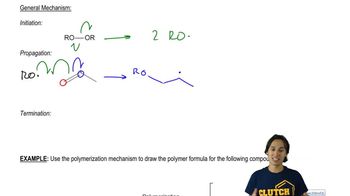
The presence of 'hν' indicates that the reaction may proceed via a radical mechanism, where light initiates the formation of bromine radicals. These radicals can add to the alkene, leading to the formation of brominated products. Understanding radical mechanisms is important for predicting reaction pathways and product distributions.
Video consigliato:
03:28
The mechanism of Radical Polymerization.