Ch. 12 - Radicals
Bruice - Organic Chemistry 8th Edition
Bruice8th EditionOrganic ChemistryISBN: 9780135213711Non è quello che usi tu?Cambia libro di testo
Capitolo 12, Problema 46c

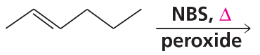
Draw the products of the following reactions, including all stereoisomers:
c.

Guida verificata passo dopo passo
1
Identify the type of reaction: The presence of NBS (N-bromosuccinimide) and peroxide indicates a radical bromination reaction, specifically allylic bromination.
Recognize the allylic position: In the given alkene, the allylic position is the carbon adjacent to the double bond. This is where the bromine will be added.
Initiate the radical mechanism: Peroxide initiates the formation of bromine radicals. The heat (Δ) helps in the homolytic cleavage of the peroxide bond, generating radicals.
Form the allylic radical: The bromine radical abstracts a hydrogen from the allylic position, forming an allylic radical. This radical is stabilized by resonance.
Add bromine to the allylic radical: The bromine radical reacts with the allylic radical, forming the allylic bromide. Consider all possible resonance structures to identify all stereoisomers.

Risposta video verificata per un problema simile:

Questa soluzione video è stata consigliata dai nostri tutor come utile per risolvere questo problema.
Durata del video:
5m

Concetti chiave

Ecco i concetti essenziali che devi comprendere per rispondere correttamente alla domanda.

NBS (N-Bromosuccinimide)

NBS is a reagent commonly used in organic chemistry for bromination reactions, particularly in allylic and benzylic positions. It provides a source of bromine in a controlled manner, allowing for selective substitution reactions. The presence of NBS in the reaction facilitates the formation of radical intermediates, which are crucial for the subsequent steps in the reaction mechanism.
Video consigliato:
Percorso guidato
3:06
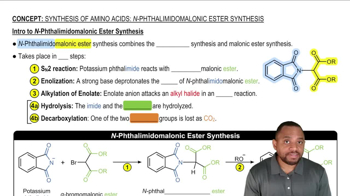
Synthesis of Amino Acids: N-Phthalimidomalonic Ester Synthesis Concept 1

Radical Mechanism

The radical mechanism involves the formation of free radicals, which are highly reactive species with unpaired electrons. In the context of the reaction with NBS, the radical mechanism typically proceeds through initiation, propagation, and termination steps. This mechanism is essential for understanding how bromine is added to the allylic position of the alkene, leading to the formation of various products, including stereoisomers.
Video consigliato:
03:28
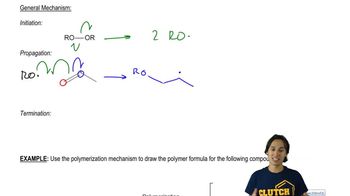
The mechanism of Radical Polymerization.

Stereoisomerism

Stereoisomerism refers to the phenomenon where compounds have the same molecular formula and connectivity but differ in the spatial arrangement of atoms. In reactions involving alkenes and radicals, stereoisomers can arise due to the formation of chiral centers or the presence of double bonds. Understanding stereoisomerism is crucial for predicting the different products formed in the reaction, including cis/trans or E/Z isomers.
Video consigliato:
01:58
Determining when molecules are stereoisomers.