Ch. 15 - Reactions of Carboxylic Acids and Carboxylic Acid Derivatives
Bruice - Organic Chemistry 8th Edition
Bruice8th EditionOrganic ChemistryISBN: 9780135213711Non è quello che usi tu?Cambia libro di testo
Capitolo 15, Problema 79

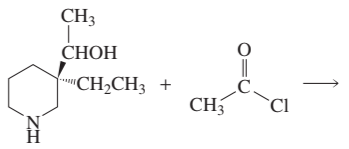
Identify the major and minor products of the following reaction:
Chemical reaction diagram showing reactants and products for nucleophilic acyl substitution, with structures labeled.

Guida verificata passo dopo passo
1
Step 1: Analyze the reactants. The molecule contains two nucleophilic functional groups: a primary amine (-NH2) and a secondary amine (-NH). Both can react with the electrophilic acetyl chloride (CH3COCl). The hydroxyl group (-OH) is less nucleophilic and unlikely to react under these conditions.
Step 2: Consider the reaction conditions. Since only 1 equivalent of acetyl chloride is provided, only one nucleophilic site will react. The primary amine (-NH2) is more nucleophilic than the secondary amine (-NH) due to less steric hindrance and higher electron density.
Step 3: Predict the major product. The primary amine will likely react with acetyl chloride to form an amide bond. The reaction mechanism involves nucleophilic attack by the amine on the carbonyl carbon of acetyl chloride, followed by the elimination of HCl.
Step 4: Predict the minor product. If the secondary amine reacts instead, it will form a different amide product. However, this is less likely due to steric hindrance and the lower nucleophilicity of the secondary amine compared to the primary amine.
Step 5: Summarize the outcome. The major product will be the amide formed from the reaction of the primary amine with acetyl chloride. The minor product, if formed, would result from the reaction of the secondary amine with acetyl chloride.

Risposta video verificata per un problema simile:

Questa soluzione video è stata consigliata dai nostri tutor come utile per risolvere questo problema.
Durata del video:
5m

Concetti chiave

Ecco i concetti essenziali che devi comprendere per rispondere correttamente alla domanda.

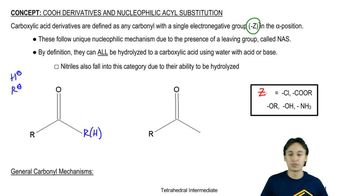
Nucleophilic Acyl Substitution

Nucleophilic acyl substitution is a fundamental reaction in organic chemistry where a nucleophile attacks a carbonyl carbon, leading to the replacement of a leaving group. This reaction is characteristic of carboxylic acid derivatives, such as esters, amides, and acyl chlorides. Understanding this mechanism is crucial for predicting the major and minor products formed during the reaction.
Video consigliato:
01:47
Nucleophiles and Electrophiles can react in Substitution Reactions.

Carboxylic Acid Derivatives

Carboxylic acid derivatives include compounds like acyl chlorides, esters, and amides, which can undergo nucleophilic acyl substitution. Each derivative has different reactivity due to the nature of the leaving group and the electrophilicity of the carbonyl carbon. Recognizing the type of derivative involved in the reaction helps in determining the expected products.
Video consigliato:
03:50
Intro to Carboxylic Acid Derivatives

Product Distribution

In reactions involving nucleophilic acyl substitution, the distribution of products can be classified as major and minor based on factors such as sterics, electronics, and the stability of the resulting compounds. Major products are typically more stable or formed in greater quantities, while minor products may arise from less favorable pathways. Analyzing these factors is essential for predicting the outcome of the reaction.
Video consigliato:
11:07
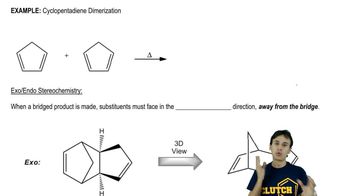
Bridged-Products
Pratica correlata
Domanda del libro di testo

a. When a carboxylic acid is dissolved in isotopically labeled water (H2O18) and an acid catalyst is added, the label is incorporated into both oxygens of the acid. Propose a mechanism to account for this.

1049
views

Domanda del libro di testo

Cardura, a drug used to treat hypertension, is synthesized as shown here.

b. Show the mechanism for conversion of A to B. Which is formed more rapidly, A or B?

1457
views
Domanda del libro di testo

a. When a carboxylic acid is dissolved in isotopically labeled water (H2O18) and an acid catalyst is added, the label is incorporated into both oxygens of the acid. Propose a mechanism to account for this.

c. If an ester is dissolved in isotopically labeled water (H2O18) and an acid catalyst is added, where will the label reside in the product?

1434
views
Domanda del libro di testo

a. A student did not obtain any ester when he added 2,4,6-trimethylbenzoic acid to an acidic solution of ethanol. Why? (HINT: Build models.)

b. Would he have encountered the same problem if he had tried to synthesize the methyl ester of 4-methylbenzoic acid in the same way?

940
views
Domanda del libro di testo

When a compound with molecular formula C11H14O2 undergoes acid-catalyzed hydrolysis, one of the products that is isolated gives the following 1H NMR spectrum. Identify the compound.

1539
views
1
rank
Domanda del libro di testo

Cardura, a drug used to treat hypertension, is synthesized as shown here.

a. Identify the intermediate (A) and show the mechanism for its formation.

946
views