



Ch. 15 - Reactions of Carboxylic Acids and Carboxylic Acid Derivatives
Bruice - Organic Chemistry 8th Edition
Bruice8th EditionOrganic ChemistryISBN: 9780135213711Non è quello che usi tu?Cambia libro di testo
Capitolo 15, Problema 81a

Cardura, a drug used to treat hypertension, is synthesized as shown here.
Chemical reaction diagram illustrating the synthesis of Cardura, highlighting intermediate A and the reaction mechanism.
a. Identify the intermediate (A) and show the mechanism for its formation.

Guida verificata passo dopo passo
1
Step 1: Analyze the reaction sequence. The first step involves the use of potassium carbonate (K₂CO₃), which is a base. This suggests that the reaction may involve deprotonation or nucleophilic substitution.
Step 2: Identify the starting materials and their functional groups. Look for reactive sites such as halides, hydroxyl groups, or acidic hydrogens that could interact with K₂CO₃.
Step 3: Propose the mechanism for the formation of intermediate A. If the starting material contains an acidic hydrogen (e.g., an alcohol or phenol group), K₂CO₃ can deprotonate it to form an alkoxide ion. Represent this step using the equation: ROH+K2CO3→RO-+K2HCO3
Step 4: Consider the role of the alkoxide ion formed. Alkoxide ions are strong nucleophiles and can participate in substitution reactions if an electrophilic site (e.g., an alkyl halide) is present in the starting material. This would lead to the formation of intermediate A.
Step 5: Write the structure of intermediate A based on the substitution reaction. Ensure that the mechanism accounts for the formation of A and aligns with the subsequent steps in the synthesis of Cardura.

Risposta video verificata per un problema simile:

Questa soluzione video è stata consigliata dai nostri tutor come utile per risolvere questo problema.
Durata del video:
5m

Concetti chiave

Ecco i concetti essenziali che devi comprendere per rispondere correttamente alla domanda.

Reaction Mechanism

A reaction mechanism is a step-by-step description of how reactants transform into products in a chemical reaction. It outlines the individual steps, including bond breaking and forming, and the intermediates involved. Understanding the mechanism is crucial for predicting the outcome of reactions and for identifying intermediates like compound A in the synthesis of Cardura.
Video consigliato:
02:16
Heck Reaction Mechanism

Intermediates

Intermediates are species that are formed during the course of a chemical reaction but are not present in the final products. They are often unstable and exist only for a short duration. Identifying intermediates is essential for understanding the overall reaction pathway and for elucidating the mechanism of synthesis, as seen in the formation of compound A in the synthesis of Cardura.
Video consigliato:
04:31
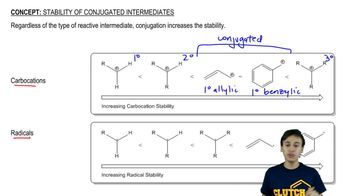
Stability of Conjugated Intermediates

Nucleophilic Substitution

Nucleophilic substitution is a fundamental reaction type in organic chemistry where a nucleophile attacks an electrophile, resulting in the replacement of a leaving group. This process is key in the formation of many organic compounds, including intermediates. In the context of Cardura's synthesis, understanding nucleophilic substitution helps explain how compound A is formed and subsequently transformed into the final product.
Video consigliato:
01:47
Nucleophiles and Electrophiles can react in Substitution Reactions.