Ch. 15 - Reactions of Carboxylic Acids and Carboxylic Acid Derivatives
Bruice - Organic Chemistry 8th Edition
Bruice8th EditionOrganic ChemistryISBN: 9780135213711Non è quello che usi tu?Cambia libro di testo
Capitolo 15, Problema 90

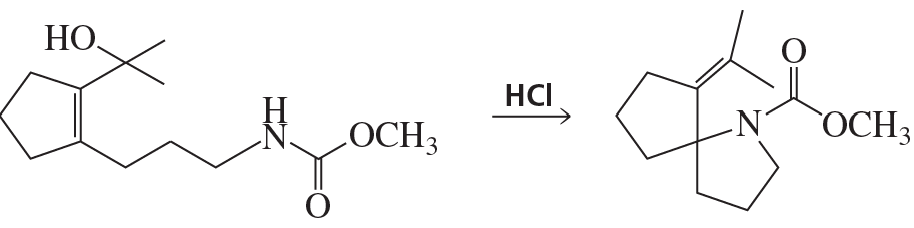
Propose a mechanism that accouts for the formation of the product.
Chemical reaction diagram illustrating the formation of a lactam from a carboxylic acid derivative using HCl.

Guida verificata passo dopo passo
1
Identify the type of reaction: Since HCl is involved, this is likely an electrophilic addition reaction, commonly seen with alkenes or alkynes. Determine the starting material (e.g., an alkene or alkyne) and the product structure to confirm this.
Analyze the reactivity of HCl: HCl is a strong acid that dissociates into H⁺ (proton) and Cl⁻ (nucleophile). The H⁺ will act as an electrophile, seeking an electron-rich site in the starting material.
Determine the first step of the mechanism: The π-electrons of the alkene (or alkyne) will attack the H⁺, leading to the formation of a carbocation intermediate. Use Markovnikov's rule to predict the location of the carbocation (the H⁺ will add to the carbon with more hydrogens, stabilizing the carbocation on the more substituted carbon).
Account for the role of Cl⁻: The Cl⁻ ion, as a nucleophile, will attack the carbocation formed in the previous step, resulting in the formation of the final product, which is a haloalkane.
Verify the mechanism: Ensure that the proposed mechanism is consistent with the product structure and follows the principles of regioselectivity (Markovnikov's rule) and stability of intermediates (carbocation stability).

Risposta video verificata per un problema simile:

Questa soluzione video è stata consigliata dai nostri tutor come utile per risolvere questo problema.

Concetti chiave

Ecco i concetti essenziali che devi comprendere per rispondere correttamente alla domanda.

Acid-Base Reactions

Acid-base reactions involve the transfer of protons (H+) between reactants. In the context of HCl, it acts as a strong acid, donating a proton to a base, which can lead to the formation of various products depending on the reaction conditions. Understanding this concept is crucial for predicting the outcome of reactions involving HCl.
Video consigliato:
02:49
The Lewis definition of acids and bases.

Nucleophilic Substitution Mechanisms

Nucleophilic substitution mechanisms, such as SN1 and SN2, describe how nucleophiles attack electrophiles to replace a leaving group. In the case of HCl, the chloride ion (Cl-) can act as a leaving group, and recognizing the type of substrate involved helps in determining the mechanism and the resulting product.
Video consigliato:
01:47
Nucleophiles and Electrophiles can react in Substitution Reactions.

Reaction Mechanism

A reaction mechanism outlines the step-by-step sequence of elementary reactions that lead to the formation of products. It includes details about bond breaking and forming, intermediates, and transition states. Proposing a mechanism for the reaction involving HCl requires a clear understanding of these steps to accurately depict how the product is formed.
Video consigliato:
02:16
Heck Reaction Mechanism