Ch. 15 - Reactions of Carboxylic Acids and Carboxylic Acid Derivatives
Bruice - Organic Chemistry 8th Edition
Bruice8th EditionOrganic ChemistryISBN: 9780135213711Non è quello che usi tu?Cambia libro di testo
Capitolo 15, Problema 89a

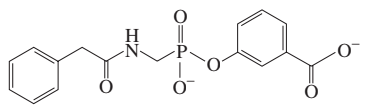
The following compound has been found to be an inhibitor of penicillinase. The enzyme can be reactivated by hydroxylamine (NH2OH). Propose a mechanism to account for the inhibition.
Chemical structure of a compound that inhibits penicillinase, with hydroxylamine reactivating the enzyme.

Guida verificata passo dopo passo
1
Analyze the structure of the compound and identify any functional groups that could interact with the active site of penicillinase. Look for electrophilic centers or reactive groups that could form a covalent bond with the enzyme.
Consider the mechanism of penicillinase. Penicillinase typically hydrolyzes the β-lactam ring of penicillin. Determine if the inhibitor mimics the structure of penicillin or contains a reactive group that could interact with the enzyme's active site.
Propose that the inhibitor forms a covalent bond with a nucleophilic residue in the active site of penicillinase (e.g., a serine hydroxyl group). This covalent bond would block the enzyme's activity by preventing it from interacting with its natural substrate.
Explain how hydroxylamine (NH2OH) could reactivate the enzyme. Hydroxylamine is a nucleophile and could attack the covalent bond between the inhibitor and the enzyme, breaking the bond and releasing the enzyme in its active form.
Summarize the mechanism: The inhibitor forms a covalent bond with the enzyme, rendering it inactive. Hydroxylamine then cleaves this bond, regenerating the active enzyme. Use curved-arrow notation to illustrate the nucleophilic attack and bond formation/breakage in the proposed mechanism.

Risposta video verificata per un problema simile:

Questa soluzione video è stata consigliata dai nostri tutor come utile per risolvere questo problema.
Durata del video:
2m

Concetti chiave

Ecco i concetti essenziali che devi comprendere per rispondere correttamente alla domanda.

Enzyme Inhibition

Enzyme inhibition refers to the process by which a molecule (inhibitor) decreases the activity of an enzyme. Inhibitors can be competitive, non-competitive, or uncompetitive, depending on how they interact with the enzyme and its substrate. Understanding the type of inhibition is crucial for proposing a mechanism, as it influences how the inhibitor affects the enzyme's active site and overall function.
Video consigliato:
Percorso guidato
1:07
Intro to Coenzymes Example 1

Penicillinase Mechanism

Penicillinase, also known as beta-lactamase, is an enzyme that hydrolyzes the beta-lactam ring of penicillin, rendering it ineffective. The mechanism of penicillinase involves the formation of an acyl-enzyme intermediate, where the enzyme covalently binds to the antibiotic. Recognizing this mechanism is essential for understanding how inhibitors can prevent the formation of this intermediate and restore the antibiotic's efficacy.
Video consigliato:
04:32
General Mechanism

Hydroxylamine Reactivation

Hydroxylamine (NH2OH) is a nucleophilic reagent that can reactivate certain enzymes by cleaving acyl-enzyme intermediates formed during inhibition. In the context of penicillinase, hydroxylamine can attack the acyl-enzyme complex, leading to the release of the enzyme and restoring its activity. This reactivation process is important for understanding the dynamics of enzyme inhibition and the potential for reversing the effects of inhibitors.
Video consigliato:
01:17
Reactivity of Molecules