

Ch. 15 - Reactions of Carboxylic Acids and Carboxylic Acid Derivatives
Bruice - Organic Chemistry 8th Edition
Bruice8th EditionOrganic ChemistryISBN: 9780135213711Non è quello che usi tu?Cambia libro di testo
Capitolo 15, Problema 82a

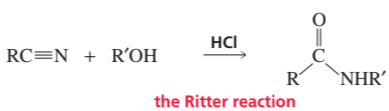
The reaction of a nitrile with an alcohol in the presence of a strong acid forms an N-substituted amide. This reaction, known as the Ritter reaction, does not work with primary alcohols.
Chemical equation illustrating the Ritter reaction: nitrile and alcohol react with HCl to form an N-substituted amide.
a. Propose a mechanism for the Ritter reaction.

Guida verificata passo dopo passo
1
Step 1: Protonation of the nitrile group - In the presence of a strong acid like HCl, the nitrile group (RC≡N) is protonated. This increases the electrophilicity of the carbon atom in the nitrile group, making it more susceptible to nucleophilic attack.
Step 2: Formation of a carbocation from the alcohol - The strong acid also protonates the alcohol (R'OH), leading to the loss of water and the formation of a carbocation (R'+). This step is crucial and explains why the reaction does not work with primary alcohols, as primary carbocations are unstable.
Step 3: Nucleophilic attack by the nitrile - The carbocation (R'+) formed from the alcohol reacts with the nitrogen atom of the protonated nitrile group. This step forms an intermediate species where the nitrogen is bonded to the R' group.
Step 4: Hydrolysis of the intermediate - Water or another nucleophile attacks the intermediate, leading to the cleavage of the triple bond and the formation of an amide functional group (RC=O(NHR')).
Step 5: Deprotonation to form the final product - The final step involves deprotonation of the amide intermediate to yield the N-substituted amide (RC=O(NHR')). This completes the Ritter reaction mechanism.

Risposta video verificata per un problema simile:

Questa soluzione video è stata consigliata dai nostri tutor come utile per risolvere questo problema.
Durata del video:
8m

Concetti chiave

Ecco i concetti essenziali che devi comprendere per rispondere correttamente alla domanda.

Nitriles

Nitriles are organic compounds containing a cyano group (-C≡N), which consists of a carbon triple-bonded to a nitrogen atom. They are important intermediates in organic synthesis and can be converted into various functional groups, including amides. Understanding the reactivity of nitriles is crucial for proposing mechanisms involving their transformation in reactions like the Ritter reaction.
Video consigliato:
01:01
Nitrile Nomenclature

Ritter Reaction Mechanism

The Ritter reaction involves the nucleophilic attack of an alcohol on a nitrile in the presence of a strong acid, leading to the formation of an N-substituted amide. The mechanism typically includes protonation of the nitrile, followed by nucleophilic attack by the alcohol, and subsequent rearrangement to yield the final product. Familiarity with this mechanism is essential for understanding how the reaction proceeds and the role of each reactant.
Video consigliato:
02:16
Heck Reaction Mechanism

Role of Strong Acid

In the Ritter reaction, a strong acid, such as HCl, is used to protonate the nitrile, enhancing its electrophilicity and facilitating the nucleophilic attack by the alcohol. The acid also helps in stabilizing the transition state during the reaction. Recognizing the importance of acid catalysis is vital for grasping how the reaction conditions influence the outcome and efficiency of the Ritter reaction.
Video consigliato:
03:10
Monosaccharides - Strong Oxidation (Aldaric Acid)