Ch. 16 - Reactions of Aldehydes and Ketones • More Reactions of Carboxylic Acid Derivatives
Bruice - Organic Chemistry 8th Edition
Bruice8th EditionOrganic ChemistryISBN: 9780135213711Non è quello che usi tu?Cambia libro di testo
Capitolo 16, Problema 27

A ketone can be prepared from the reaction of a nitrile with a Grignard reagent. Describe the intermediate formed in this reaction, and show how it can be converted to a ketone.

Guida verificata passo dopo passo
1
The reaction begins with the nucleophilic attack of the Grignard reagent (R-MgX) on the carbon atom of the nitrile group (R'-C≡N). This carbon is electrophilic due to the polarization of the triple bond between carbon and nitrogen.
The nucleophilic attack results in the formation of an intermediate imine salt. The structure of this intermediate can be represented as R'-C=N⁻-MgX, where the nitrogen atom carries a negative charge and is bonded to the magnesium ion.
The imine salt intermediate is then hydrolyzed in the presence of water or an acidic workup. During hydrolysis, the imine group (C=N⁻) is converted into a carbonyl group (C=O).
The hydrolysis step involves protonation of the nitrogen atom, followed by the cleavage of the C=N bond and the addition of water to form a ketone (R'-C=O-R).
The final product of the reaction is a ketone, where the alkyl group from the Grignard reagent (R) is attached to the carbonyl carbon of the original nitrile (R'-C≡N).

Risposta video verificata per un problema simile:

Questa soluzione video è stata consigliata dai nostri tutor come utile per risolvere questo problema.
Durata del video:
2m

Concetti chiave

Ecco i concetti essenziali che devi comprendere per rispondere correttamente alla domanda.

Grignard Reagents

Grignard reagents are organomagnesium compounds that act as nucleophiles in organic reactions. They are formed by the reaction of an alkyl or aryl halide with magnesium metal in anhydrous ether. In the context of the reaction with nitriles, Grignard reagents attack the electrophilic carbon of the nitrile, leading to the formation of a new carbon-carbon bond.
Video consigliato:
02:12
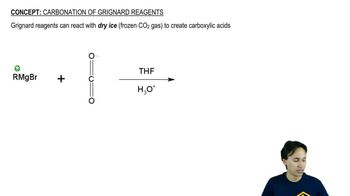
Carbonation of Grignard Reagents

Nitrile Intermediate

When a Grignard reagent reacts with a nitrile, it forms an intermediate known as an imine or a ketimine, depending on the structure of the nitrile. This intermediate contains a carbon-nitrogen double bond and is crucial for the subsequent transformation into a ketone. The imine can be hydrolyzed to yield the corresponding ketone upon treatment with water or an acid.
Video consigliato:
01:01
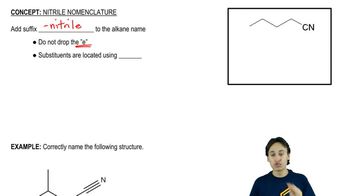
Nitrile Nomenclature

Hydrolysis of Imines

Hydrolysis of imines involves the addition of water to the imine intermediate, leading to the cleavage of the carbon-nitrogen double bond. This reaction typically requires an acid catalyst to facilitate the process. The result is the formation of a ketone and the release of ammonia, completing the conversion from the nitrile to the ketone through the imine intermediate.
Video consigliato:
06:23
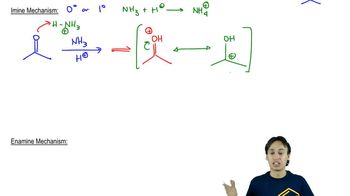
Imine Mechanism