Ch. 16 - Reactions of Aldehydes and Ketones • More Reactions of Carboxylic Acid Derivatives
Bruice - Organic Chemistry 8th Edition
Bruice8th EditionOrganic ChemistryISBN: 9780135213711Non è quello che usi tu?Cambia libro di testo
Capitolo 16, Problema 28

Why is the pKa value of protonated hydroxylamine (6.0) so much lower than the value of a protonated primary amine such as protonated methylamine (10.7)?

Guida verificata passo dopo passo
1
Understand the concept of pKa: The pKa value indicates the strength of an acid. A lower pKa value corresponds to a stronger acid, meaning the compound is more likely to donate a proton.
Examine the structure of protonated hydroxylamine: Protonated hydroxylamine has an -OH group attached to the nitrogen atom. The electronegativity of oxygen increases the electron-withdrawing effect, stabilizing the conjugate base after deprotonation and making the protonated form more acidic (lower pKa).
Compare with protonated methylamine: Protonated methylamine has a methyl group (-CH3) attached to the nitrogen atom. The methyl group is electron-donating, which destabilizes the conjugate base after deprotonation, making the protonated form less acidic (higher pKa).
Consider resonance and inductive effects: In protonated hydroxylamine, the lone pairs on the oxygen atom can interact with the nitrogen atom, further stabilizing the conjugate base. This effect is absent in protonated methylamine, contributing to the difference in pKa values.
Summarize the reasoning: The lower pKa value of protonated hydroxylamine compared to protonated methylamine is due to the electron-withdrawing effect of the -OH group and the stabilization of the conjugate base through resonance and inductive effects, making protonated hydroxylamine a stronger acid.

Risposta video verificata per un problema simile:

Questa soluzione video è stata consigliata dai nostri tutor come utile per risolvere questo problema.
Durata del video:
5m

Concetti chiave

Ecco i concetti essenziali che devi comprendere per rispondere correttamente alla domanda.

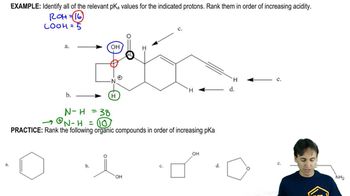
Protonation and pKa Values

Protonation refers to the addition of a proton (H+) to a molecule, which can significantly affect its acidity and basicity. The pKa value is a quantitative measure of the strength of an acid in solution; lower pKa values indicate stronger acids. In this context, the pKa values of protonated hydroxylamine and protonated methylamine reflect their relative stabilities and tendencies to donate protons.
Video consigliato:
07:45
Identifying pKa values

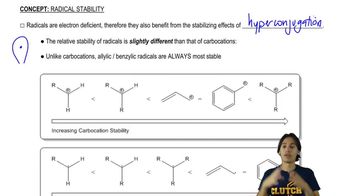
Resonance Stabilization

Resonance stabilization occurs when a molecule can be represented by multiple valid Lewis structures, allowing for the delocalization of electrons. In the case of protonated hydroxylamine, the positive charge can be delocalized over the nitrogen and oxygen atoms, which can lead to a less stable structure compared to protonated methylamine, where the positive charge is localized on the nitrogen atom.
Video consigliato:
03:43
The radical stability trend.

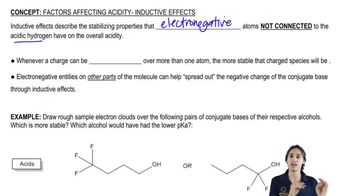
Inductive Effects

Inductive effects refer to the electron-withdrawing or electron-donating effects of substituents on a molecule, which can influence its acidity or basicity. In protonated methylamine, the alkyl group can donate electron density to the nitrogen, stabilizing the positive charge. In contrast, the presence of the electronegative oxygen in protonated hydroxylamine can withdraw electron density, making it less stable and resulting in a lower pKa.
Video consigliato:
01:47
Understanding the Inductive Effect.