Ch. 16 - Reactions of Aldehydes and Ketones • More Reactions of Carboxylic Acid Derivatives
Bruice - Organic Chemistry 8th Edition
Bruice8th EditionOrganic ChemistryISBN: 9780135213711Non è quello che usi tu?Cambia libro di testo
Capitolo 16, Problema 43

Explain why acetals do not react with nucleophiles.

Guida verificata passo dopo passo
1
Acetals are compounds that contain two alkoxy groups (-OR) attached to the same carbon atom, which is also bonded to a hydrogen atom or another carbon atom. This structure makes acetals relatively stable under neutral or basic conditions.
The carbon atom in an acetal is fully saturated (sp³ hybridized) and does not possess a partial positive charge. This is because the electron-donating alkoxy groups stabilize the carbon atom, reducing its electrophilicity.
Nucleophiles are species that donate electron pairs to electrophilic centers. Since the carbon atom in an acetal is not electrophilic, it does not attract nucleophiles effectively.
Additionally, acetals are stable under basic conditions and do not undergo hydrolysis or other reactions unless exposed to acidic conditions. Acidic conditions can protonate one of the alkoxy groups, making the carbon atom more electrophilic and susceptible to nucleophilic attack.
In summary, acetals do not react with nucleophiles because their carbon atom is not electrophilic due to the electron-donating effects of the alkoxy groups, and they are stable under neutral or basic conditions.

Risposta video verificata per un problema simile:

Questa soluzione video è stata consigliata dai nostri tutor come utile per risolvere questo problema.
Durata del video:
1m

Concetti chiave

Ecco i concetti essenziali che devi comprendere per rispondere correttamente alla domanda.

Acetal Structure

Acetals are formed from the reaction of an aldehyde or ketone with an alcohol in the presence of an acid catalyst. They consist of a carbon atom bonded to two alkoxy groups (–OR) and a hydrogen atom or another carbon atom. This structure stabilizes the carbon atom, making it less electrophilic and less susceptible to nucleophilic attack.
Video consigliato:
04:29
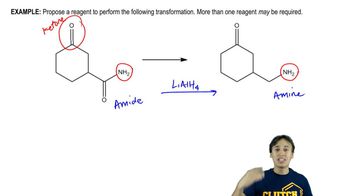
Acetal Protecting Group

Nucleophilicity

Nucleophiles are species that donate an electron pair to form a chemical bond. They are typically attracted to positively charged or electron-deficient centers. In the case of acetals, the carbon atom is not electron-deficient due to the presence of the two electron-donating alkoxy groups, which reduces its reactivity towards nucleophiles.
Video consigliato:
08:27
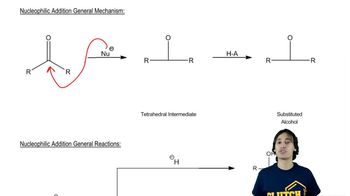
Nucleophilic Addition

Stability of Acetals

Acetals are generally stable under neutral or basic conditions and do not readily undergo hydrolysis or react with nucleophiles. This stability arises from the strong C–O bonds in the acetal structure and the steric hindrance provided by the bulky alkoxy groups, which further protect the carbon center from nucleophilic attack.
Video consigliato:
04:29
Acetal Protecting Group