Ch. 16 - Reactions of Aldehydes and Ketones • More Reactions of Carboxylic Acid Derivatives
Bruice - Organic Chemistry 8th Edition
Bruice8th EditionOrganic ChemistryISBN: 9780135213711Non è quello che usi tu?Cambia libro di testo
Capitolo 16, Problema 42b

What reagent could you use to reduce only the keto group?
<IMAGE>

Guida verificata passo dopo passo
1
Step 1: Analyze the structure of the molecule before and after the reaction. The starting molecule contains a keto group (C=O) and an ester group (COOCH₃). After the reaction, the keto group is reduced to an alcohol (OH), while the ester group remains unchanged.
Step 2: Understand the selectivity required. The reagent must selectively reduce the keto group without affecting the ester group. This requires a mild reducing agent that targets ketones specifically.
Step 3: Recall suitable reagents for selective reduction of ketones. Sodium borohydride (NaBH₄) is a common reducing agent that selectively reduces ketones to alcohols without reacting with esters under standard conditions.
Step 4: Consider the reaction conditions. Sodium borohydride typically works in protic solvents like ethanol or methanol, which help facilitate the reduction of the keto group.
Step 5: Confirm the reagent choice. Sodium borohydride is appropriate for this reaction because it selectively reduces the keto group to an alcohol while leaving the ester group intact.

Risposta video verificata per un problema simile:

Questa soluzione video è stata consigliata dai nostri tutor come utile per risolvere questo problema.
Durata del video:
4m

Concetti chiave

Ecco i concetti essenziali che devi comprendere per rispondere correttamente alla domanda.

Keto Group

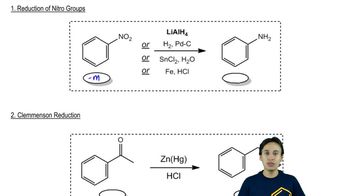
A keto group is a functional group characterized by a carbonyl (C=O) bonded to two other carbon atoms. It is commonly found in ketones, which are organic compounds with the general formula R2C=O. Understanding the structure and reactivity of keto groups is essential for predicting how they will behave in chemical reactions, particularly in reduction processes.
Video consigliato:
04:42
Sequence Groups

Reduction Reagents

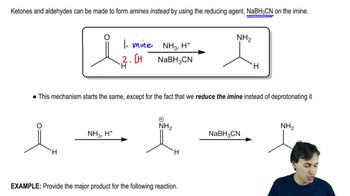
Reduction reagents are substances that donate electrons to another compound, resulting in a decrease in oxidation state. Common reagents for reducing keto groups include sodium borohydride (NaBH4) and lithium aluminum hydride (LiAlH4). The choice of reagent is crucial, as some may reduce other functional groups, while others selectively target keto groups.
Video consigliato:
07:12
Reductive Amination

Selectivity in Organic Reactions

Selectivity refers to the ability of a reagent to react with a specific functional group in the presence of others. In the context of the question, achieving selective reduction of a keto group without affecting other functional groups requires careful consideration of the reagent's properties and the reaction conditions. Understanding selectivity is vital for designing efficient synthetic pathways in organic chemistry.
Video consigliato:
02:17
Identifying organic molecules