Ch. 16 - Reactions of Aldehydes and Ketones • More Reactions of Carboxylic Acid Derivatives
Bruice - Organic Chemistry 8th Edition
Bruice8th EditionOrganic ChemistryISBN: 9780135213711Non è quello che usi tu?Cambia libro di testo
Capitolo 16, Problema 63

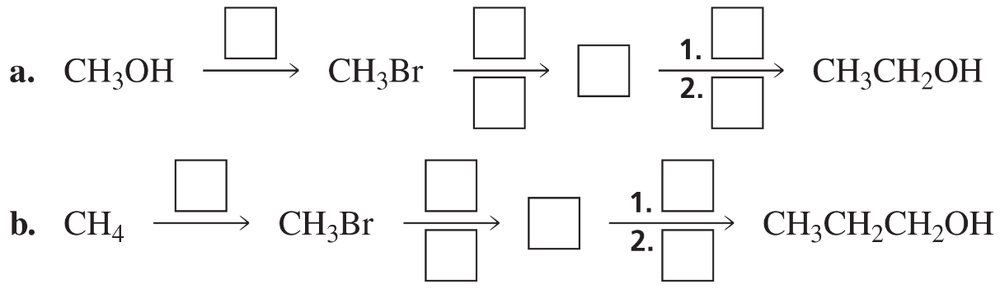
Fill in the boxes:

Guida verificata passo dopo passo
1
Step 1: Analyze the first transformation. The starting material is ethanol (CH3CH2OH), and the product is ethyl bromide (CH3CH2Br). This suggests a substitution reaction where the hydroxyl group (-OH) is replaced by a bromine atom (-Br). A common reagent for this transformation is phosphorus tribromide (PBr3).
Step 2: Examine the second transformation. Ethyl bromide (CH3CH2Br) is converted into ethyl magnesium bromide (CH3CH2MgBr). This is a Grignard reagent formation, which typically involves reacting an alkyl halide with magnesium metal in an ether solvent.
Step 3: Analyze the third transformation. Ethyl magnesium bromide (CH3CH2MgBr) reacts to form a secondary alcohol. The final product is 2-butanol (CH3CH(OH)CH2CH3). This indicates a nucleophilic addition reaction where the Grignard reagent attacks a carbonyl compound. The carbonyl compound in this case is likely acetaldehyde (CH3CHO).
Step 4: Summarize the reagents for each step. For step a, use PBr3 to convert ethanol to ethyl bromide. For step b, use magnesium metal in ether to form ethyl magnesium bromide. For step c, react ethyl magnesium bromide with acetaldehyde followed by acidic workup to yield 2-butanol.
Step 5: Verify the reaction sequence. Ensure that each reagent and intermediate aligns with the chemical transformations shown in the image. Confirm that the final product matches the structure of 2-butanol.

Risposta video verificata per un problema simile:

Questa soluzione video è stata consigliata dai nostri tutor come utile per risolvere questo problema.
Durata del video:
4m

Concetti chiave

Ecco i concetti essenziali che devi comprendere per rispondere correttamente alla domanda.

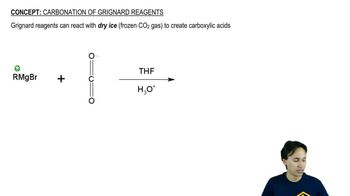
Grignard Reagents

Grignard reagents are organomagnesium compounds, typically represented as R-MgX, where R is an organic group and X is a halogen. They are highly reactive and serve as nucleophiles in organic synthesis, allowing for the formation of carbon-carbon bonds. In the context of the Grignard reaction, they react with electrophiles, such as carbonyl compounds, to form alcohols.
Video consigliato:
02:12
Carbonation of Grignard Reagents

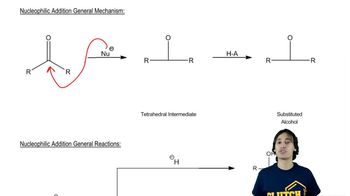
Nucleophilic Addition

Nucleophilic addition is a fundamental reaction mechanism in organic chemistry where a nucleophile attacks an electrophilic carbon atom, typically found in carbonyl groups. This process results in the formation of a new covalent bond and is crucial in the synthesis of alcohols from carbonyl compounds. Understanding this mechanism is essential for predicting the products of reactions involving Grignard reagents.
Video consigliato:
08:27
Nucleophilic Addition

Functional Group Transformation

Functional group transformation refers to the process of converting one functional group into another through chemical reactions. In the Grignard reaction, the transformation of a carbonyl group into an alcohol is a prime example. Recognizing how different functional groups interact and change during reactions is vital for understanding organic synthesis and predicting reaction outcomes.
Video consigliato:
02:36
Identifying Functional Groups