Ch. 16 - Reactions of Aldehydes and Ketones • More Reactions of Carboxylic Acid Derivatives
Bruice - Organic Chemistry 8th Edition
Bruice8th EditionOrganic ChemistryISBN: 9780135213711Non è quello che usi tu?Cambia libro di testo
Capitolo 16, Problema 64a

Thiols can be prepared from the reaction of thiourea with an alkyl halide, followed by hydroxide-ion-promoted hydrolysis.
a. Propose a mechanism for the reaction.

Guida verificata passo dopo passo
1
Step 1: Recognize the reaction components. Thiourea (NH2-CS-NH2) reacts with an alkyl halide (R-X) in the first step. The alkyl halide is an electrophile, and thiourea acts as a nucleophile due to the lone pair on the sulfur atom.
Step 2: Describe the nucleophilic substitution reaction. The sulfur atom in thiourea attacks the carbon atom of the alkyl halide (R-X), displacing the halide ion (X⁻) and forming an intermediate called an alkylisothiouronium salt (R-NH-CS-NH2). This is an SN2 reaction mechanism.
Step 3: Introduce the hydrolysis step. The alkylisothiouronium salt undergoes hydroxide-ion-promoted hydrolysis. The hydroxide ion (OH⁻) attacks the carbon atom of the C=S bond in the intermediate, leading to the cleavage of the C=S bond.
Step 4: Explain the formation of the thiol. The hydrolysis results in the release of the thiol (R-SH) and urea (NH2-CO-NH2) as byproducts. This step involves breaking the C=S bond and replacing it with a C-SH bond.
Step 5: Summarize the overall mechanism. The reaction proceeds via two main steps: (1) nucleophilic substitution of the alkyl halide by thiourea to form the alkylisothiouronium salt, and (2) hydroxide-ion-promoted hydrolysis of the intermediate to yield the thiol and urea.

Risposta video verificata per un problema simile:

Questa soluzione video è stata consigliata dai nostri tutor come utile per risolvere questo problema.
Durata del video:
2m

Concetti chiave

Ecco i concetti essenziali che devi comprendere per rispondere correttamente alla domanda.

Thiourea Structure and Reactivity

Thiourea is a compound containing a sulfur atom bonded to a carbon atom and two amine groups. Its structure allows it to act as a nucleophile in reactions with alkyl halides, where the sulfur atom can attack the electrophilic carbon of the halide, leading to the formation of a thiol. Understanding the reactivity of thiourea is crucial for proposing the mechanism of thiol synthesis.
Video consigliato:
01:17
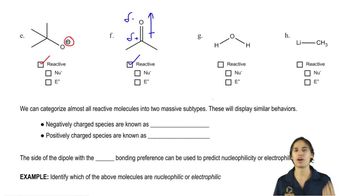
Reactivity of Molecules

Nucleophilic Substitution Mechanism

Nucleophilic substitution is a fundamental reaction mechanism in organic chemistry where a nucleophile replaces a leaving group in a substrate. In the case of thiourea reacting with an alkyl halide, the sulfur atom acts as the nucleophile, attacking the carbon atom bonded to the halide. This process can follow either an SN1 or SN2 pathway, depending on the structure of the alkyl halide and reaction conditions.
Video consigliato:
01:47
Nucleophiles and Electrophiles can react in Substitution Reactions.

Hydroxide-Ion-Promoted Hydrolysis

Hydroxide-ion-promoted hydrolysis involves the reaction of a compound with water in the presence of hydroxide ions, which can facilitate the breaking of bonds and the formation of new ones. In the context of thiol synthesis, after the nucleophilic substitution, hydroxide ions can help hydrolyze any intermediates formed, ultimately leading to the production of the desired thiol. This step is essential for completing the reaction mechanism.
Video consigliato:
Percorso guidato
3:39
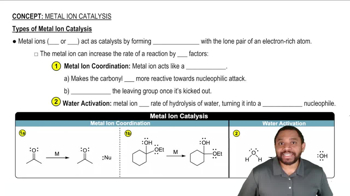
Metal Ion Catalysis Concept 1