Ch. 16 - Reactions of Aldehydes and Ketones • More Reactions of Carboxylic Acid Derivatives
Bruice - Organic Chemistry 8th Edition
Bruice8th EditionOrganic ChemistryISBN: 9780135213711Non è quello che usi tu?Cambia libro di testo
Capitolo 16, Problema 84b

How can the following compounds be prepared from the given starting materials?
b. Chemical reaction showing the conversion of a methoxy compound to a carbonyl compound with a hydrogen atom.

Guida verificata passo dopo passo
1
Step 1: Analyze the starting material and the target compound. The starting material is a methyl ester (cyclopentanecarboxylic acid methyl ester), and the target compound is an aldehyde (cyclopentanecarboxaldehyde). This indicates that the transformation involves the reduction of the ester group to an aldehyde.
Step 2: Identify the appropriate reagent for the reduction. To selectively reduce an ester to an aldehyde, a mild reducing agent such as DIBAL-H (Diisobutylaluminum hydride) is commonly used. DIBAL-H can stop the reduction at the aldehyde stage under controlled conditions.
Step 3: Describe the reaction conditions. The reaction is typically carried out at low temperatures (e.g., -78°C) to prevent over-reduction of the aldehyde to a primary alcohol. After the reaction, hydrolysis is performed to quench the reaction and isolate the aldehyde.
Step 4: Write the reaction mechanism. The mechanism involves the nucleophilic attack of DIBAL-H on the carbonyl carbon of the ester, forming an intermediate aluminum complex. Upon hydrolysis, the intermediate is converted into the aldehyde.
Step 5: Summarize the process. The methyl ester is treated with DIBAL-H at low temperature, followed by hydrolysis, to yield the desired aldehyde. This method ensures selective reduction without over-reduction to the alcohol.

Risposta video verificata per un problema simile:

Questa soluzione video è stata consigliata dai nostri tutor come utile per risolvere questo problema.
Durata del video:
1m

Concetti chiave

Ecco i concetti essenziali che devi comprendere per rispondere correttamente alla domanda.

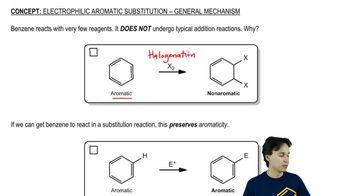
Electrophilic Aromatic Substitution

Electrophilic aromatic substitution (EAS) is a fundamental reaction in organic chemistry where an electrophile replaces a hydrogen atom on an aromatic ring. This process is crucial for modifying aromatic compounds, allowing for the introduction of various functional groups. Understanding the mechanisms of EAS, including the role of catalysts and the stability of intermediates, is essential for predicting the outcomes of reactions involving aromatic compounds.
Video consigliato:
03:07
EAS Review

Reactivity of Carbonyl Compounds

Carbonyl compounds, characterized by the presence of a carbon-oxygen double bond (C=O), exhibit distinct reactivity patterns due to the polarization of the carbonyl bond. They can undergo nucleophilic addition, condensation, and oxidation-reduction reactions. Recognizing how these compounds interact with nucleophiles and electrophiles is vital for synthesizing complex organic molecules from simpler starting materials.
Video consigliato:
01:40
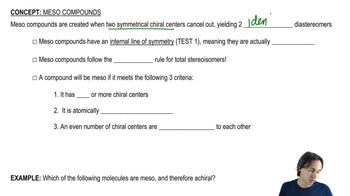
Defining meso compounds.

Protecting Groups in Organic Synthesis

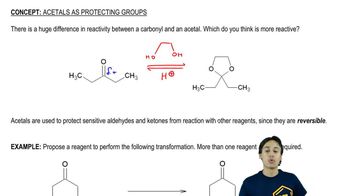
Protecting groups are temporary modifications used in organic synthesis to prevent unwanted reactions at specific functional groups during multi-step synthesis. For example, methoxy (OCH3) can serve as a protecting group for alcohols or carbonyls, allowing selective reactions to occur without interference. Understanding how to effectively use and remove protecting groups is essential for achieving desired transformations in complex organic synthesis.
Video consigliato:
02:44
Protecting Groups