Ch. 16 - Reactions of Aldehydes and Ketones • More Reactions of Carboxylic Acid Derivatives
Bruice - Organic Chemistry 8th Edition
Bruice8th EditionOrganic ChemistryISBN: 9780135213711Non è quello che usi tu?Cambia libro di testo
Capitolo 16, Problema 82

Unlike a phosphonium ylide that reacts with an aldehyde or a ketone to form an alkene, a sulfonium ylide reacts with an aldehyde or a ketone to form an epoxide. Explain why one ylide forms an alkene, whereas the other forms an epoxide.

Guida verificata passo dopo passo
1
Understand the structure of the ylides: A phosphonium ylide contains a positively charged phosphorus atom bonded to a carbon atom with a lone pair of electrons, while a sulfonium ylide contains a positively charged sulfur atom bonded to a carbon atom with a lone pair of electrons.
Analyze the reactivity of the ylides: Phosphonium ylides are more nucleophilic and less electrophilic compared to sulfonium ylides due to the difference in electronegativity between phosphorus and sulfur. Sulfur is more electronegative, making sulfonium ylides more electrophilic and less nucleophilic.
Consider the reaction mechanism for phosphonium ylides: Phosphonium ylides react with aldehydes or ketones via the Wittig reaction. The nucleophilic carbon of the ylide attacks the carbonyl carbon, forming a betaine intermediate, which rearranges to produce an alkene and a triphenylphosphine oxide byproduct.
Consider the reaction mechanism for sulfonium ylides: Sulfonium ylides react with aldehydes or ketones via a different pathway. The electrophilic sulfur atom stabilizes the intermediate, leading to a concerted cyclization reaction that forms a three-membered epoxide ring.
Summarize the key difference: The difference in product formation arises from the nature of the ylide and the reaction mechanism. Phosphonium ylides favor the formation of alkenes due to their nucleophilicity and the Wittig reaction pathway, while sulfonium ylides favor the formation of epoxides due to their electrophilicity and the stabilization of the cyclization intermediate.

Risposta video verificata per un problema simile:

Questa soluzione video è stata consigliata dai nostri tutor come utile per risolvere questo problema.

Concetti chiave

Ecco i concetti essenziali che devi comprendere per rispondere correttamente alla domanda.

Ylide Chemistry

Ylides are neutral molecules containing a positively charged atom adjacent to a negatively charged atom, typically involving phosphorus or sulfur. In organic reactions, ylides can act as nucleophiles, attacking electrophiles such as carbonyl compounds. The nature of the ylide, whether phosphonium or sulfonium, influences the type of reaction it undergoes with aldehydes or ketones.
Video consigliato:
00:28
Introduction to General Chemistry Review

Mechanism of Alkene Formation

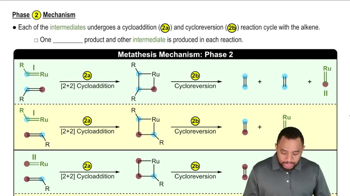
Phosphonium ylides react with aldehydes or ketones through a mechanism known as the Wittig reaction, which involves the formation of an intermediate that ultimately leads to the elimination of a phosphine oxide and the formation of an alkene. This reaction is characterized by the formation of a carbon-carbon double bond, which is a key feature of the Wittig reaction, making it a powerful tool in organic synthesis.
Video consigliato:
Percorso guidato
1:59
Alkene Metathesis Concept 5

Epoxide Formation

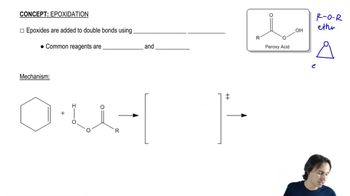
Sulfoniun ylides react with carbonyl compounds to form epoxides through a different mechanism that involves a cyclic transition state. This reaction typically proceeds via a nucleophilic attack on the carbonyl carbon, followed by intramolecular closure to form a three-membered epoxide ring. The unique electronic properties of the sulfonium ylide facilitate this pathway, distinguishing it from the alkene-forming reaction of phosphonium ylides.
Video consigliato:
02:19
General properties of epoxidation.