Ch. 18 - Reactions of Benzene and Substituted Benzenes
Bruice - Organic Chemistry 8th Edition
Bruice8th EditionOrganic ChemistryISBN: 9780135213711Non è quello che usi tu?Cambia libro di testo
Capitolo 18, Problema 24f

Show how each of the following compounds can be synthesized from benzene:
f. m-xylene

Guida verificata passo dopo passo
1
Step 1: Begin with benzene as the starting material. Benzene is an aromatic compound with a six-membered ring and alternating double bonds.
Step 2: Perform a Friedel-Crafts alkylation reaction to introduce the first methyl group onto the benzene ring. Use methyl chloride (CH₃Cl) as the alkylating agent and aluminum chloride (AlCl₃) as the catalyst. This will yield toluene (methylbenzene).
Step 3: Carry out a second Friedel-Crafts alkylation to introduce the second methyl group. Use methyl chloride (CH₃Cl) and aluminum chloride (AlCl₃) again, ensuring that the reaction conditions favor substitution at the meta position relative to the first methyl group. This is due to the electron-donating nature of the methyl group, which directs further substitution to the meta position.
Step 4: Carefully control the reaction conditions to avoid over-alkylation or formation of undesired isomers (e.g., o-xylene or p-xylene). The product formed will be m-xylene (1,3-dimethylbenzene).
Step 5: Purify the m-xylene product using techniques such as distillation or recrystallization to ensure the desired compound is isolated.

Risposta video verificata per un problema simile:

Questa soluzione video è stata consigliata dai nostri tutor come utile per risolvere questo problema.
Durata del video:
4m

Concetti chiave

Ecco i concetti essenziali che devi comprendere per rispondere correttamente alla domanda.

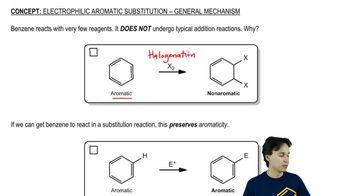
Electrophilic Aromatic Substitution (EAS)

Electrophilic Aromatic Substitution is a fundamental reaction in organic chemistry where an electrophile replaces a hydrogen atom on an aromatic ring. This reaction is crucial for synthesizing substituted aromatic compounds, such as m-xylene from benzene. The process typically involves the generation of a carbocation intermediate, which is stabilized by resonance, allowing for the substitution to occur without disrupting the aromaticity of the ring.
Video consigliato:
03:07
EAS Review

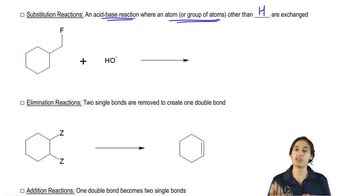
Regioselectivity in Substitution Reactions

Regioselectivity refers to the preference of a chemical reaction to yield one structural isomer over others when multiple possibilities exist. In the case of m-xylene synthesis, understanding the directing effects of substituents on the benzene ring is essential. The presence of electron-donating groups can influence the position where new substituents are added, leading to the formation of meta, ortho, or para products.
Video consigliato:
01:34
Recognizing Substitution Reactions.

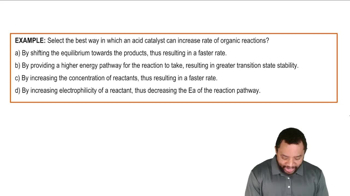
Catalysts in Organic Reactions

Catalysts are substances that increase the rate of a chemical reaction without being consumed in the process. In the synthesis of m-xylene from benzene, catalysts such as aluminum chloride (AlCl3) are often used to facilitate the electrophilic aromatic substitution. These catalysts help generate the electrophile and stabilize the transition state, making the reaction more efficient and selective for the desired product.
Video consigliato:
Percorso guidato
1:22
Introduction to Catalysis Example 1