Ch. 18 - Reactions of Benzene and Substituted Benzenes
Bruice - Organic Chemistry 8th Edition
Bruice8th EditionOrganic ChemistryISBN: 9780135213711Non è quello che usi tu?Cambia libro di testo
Capitolo 18, Problema 24g

Show how each of the following compounds can be synthesized from benzene:
g. 2-phenylpropene

Guida verificata passo dopo passo
1
Step 1: Begin with benzene as the starting material. To introduce a methyl group onto the benzene ring, perform a Friedel-Crafts alkylation reaction. React benzene with methyl chloride (CH₃Cl) in the presence of a Lewis acid catalyst such as aluminum chloride (AlCl₃) to form toluene (methylbenzene).
Step 2: Oxidize the methyl group on toluene to a carboxylic acid group to form benzoic acid. This can be achieved using a strong oxidizing agent such as potassium permanganate (KMnO₄) under basic conditions, followed by acidification.
Step 3: Reduce the carboxylic acid group on benzoic acid to a methyl group to form ethylbenzene. This can be done using a reducing agent such as lithium aluminum hydride (LiAlH₄) or by catalytic hydrogenation.
Step 4: Perform a halogenation reaction on ethylbenzene to introduce a halogen atom (e.g., bromine) at the benzylic position. This can be achieved using N-bromosuccinimide (NBS) in the presence of light or a radical initiator to form 1-bromo-2-phenylethane.
Step 5: Eliminate the halogen atom from 1-bromo-2-phenylethane to form 2-phenylpropene. Use a strong base such as potassium tert-butoxide (KOtBu) to perform an E2 elimination reaction, resulting in the formation of the desired alkene product.

Risposta video verificata per un problema simile:

Questa soluzione video è stata consigliata dai nostri tutor come utile per risolvere questo problema.
Durata del video:
3m

Concetti chiave

Ecco i concetti essenziali che devi comprendere per rispondere correttamente alla domanda.

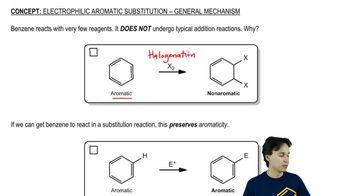
Electrophilic Aromatic Substitution (EAS)

Electrophilic Aromatic Substitution is a fundamental reaction in organic chemistry where an electrophile replaces a hydrogen atom on an aromatic ring, such as benzene. This reaction is crucial for synthesizing various aromatic compounds, including derivatives of benzene. Understanding EAS mechanisms, including the role of catalysts and the stability of intermediates, is essential for predicting the products formed during the synthesis of compounds like 2-phenylpropene.
Video consigliato:
03:07
EAS Review

Alkylation of Aromatic Compounds

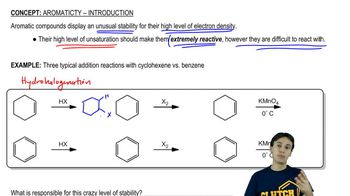
Alkylation involves adding an alkyl group to an aromatic compound, which can be achieved through reactions like Friedel-Crafts alkylation. This process typically uses alkyl halides and a Lewis acid catalyst to facilitate the formation of a new carbon-carbon bond. In the synthesis of 2-phenylpropene from benzene, understanding how to effectively introduce the propene group is vital for achieving the desired product.
Video consigliato:
08:19
Intro to Aromaticity

Rearrangement Reactions

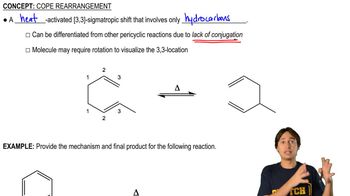
Rearrangement reactions involve the structural reorganization of a molecule, often leading to more stable or reactive forms. In the context of synthesizing 2-phenylpropene, recognizing how intermediates can rearrange during the reaction process is important. This concept helps in understanding how to manipulate reaction conditions to favor the formation of the target compound from benzene.
Video consigliato:
06:28
Definition of Cope Rearrangement