Ch. 20 - The Organic Chemistry of Carbohydrates
Bruice - Organic Chemistry 8th Edition
Bruice8th EditionOrganic ChemistryISBN: 9780135213711Non è quello che usi tu?Cambia libro di testo
Capitolo 20, Problema 28a

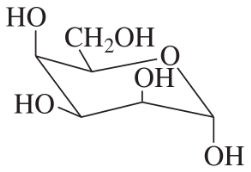
Name the following compounds and indicate whether or not each is a reducing sugar:
a. Structural formula of a carbohydrate with hydroxyl groups, indicating potential reducing sugar properties.

Guida verificata passo dopo passo
1
Step 1: Identify the functional groups in each compound. Look for key features such as aldehydes, ketones, hydroxyl groups, or hemiacetals, as these are important for determining whether the compound is a reducing sugar.
Step 2: Determine if the compound contains a free anomeric carbon. A reducing sugar must have a free anomeric carbon that can open to form an aldehyde or ketone group in solution.
Step 3: Assign the correct name to each compound based on IUPAC nomenclature rules. For carbohydrates, consider the number of carbons (e.g., triose, tetrose, pentose, hexose) and whether the sugar is an aldose or ketose.
Step 4: Check for any modifications to the sugar, such as glycosidic linkages, which may prevent the compound from being a reducing sugar. If the anomeric carbon is involved in a glycosidic bond, the sugar is non-reducing.
Step 5: Conclude whether each compound is a reducing sugar or not, based on the presence of a free anomeric carbon and its ability to reduce oxidizing agents like Benedict's or Fehling's solution.

Risposta video verificata per un problema simile:

Questa soluzione video è stata consigliata dai nostri tutor come utile per risolvere questo problema.
Durata del video:
3m

Concetti chiave

Ecco i concetti essenziali che devi comprendere per rispondere correttamente alla domanda.

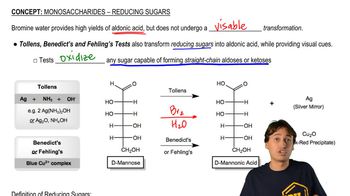
Reducing Sugars

Reducing sugars are carbohydrates that can donate electrons to other molecules, typically due to the presence of a free aldehyde or ketone group. This property allows them to reduce certain chemical reagents, such as Benedict's or Fehling's solutions, which is a key characteristic in identifying them. Common examples include glucose and fructose, which can participate in redox reactions.
Video consigliato:
08:42
Reducing Sugars

Nomenclature of Organic Compounds

Nomenclature in organic chemistry refers to the systematic naming of chemical compounds based on established rules, such as those set by the International Union of Pure and Applied Chemistry (IUPAC). Understanding the structure of a compound, including functional groups and carbon chain length, is essential for accurately naming it. This knowledge is crucial for communicating chemical information clearly.
Video consigliato:
01:40
Defining meso compounds.

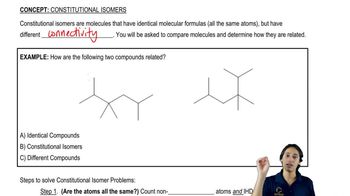
Structural Isomers

Structural isomers are compounds that share the same molecular formula but differ in the arrangement of atoms within the molecule. This variation can lead to different chemical properties and reactivity, including whether a sugar is reducing or non-reducing. Recognizing structural isomers is important for understanding the diversity of organic compounds and their functions.
Video consigliato:
01:10
What is a constitutional isomer?