Ch. 20 - The Organic Chemistry of Carbohydrates
Bruice - Organic Chemistry 8th Edition
Bruice8th EditionOrganic ChemistryISBN: 9780135213711Non è quello che usi tu?Cambia libro di testo
Capitolo 20, Problema 24

Which OH groups are in the axial position in each of the following?
a. β-D-idopyranose
b. α-D-allopyranose

Guida verificata passo dopo passo
1
Step 1: Understand the structure of pyranose rings. Pyranose rings are six-membered cyclic structures formed by the reaction of an aldehyde or ketone group with a hydroxyl group in sugars. The axial and equatorial positions refer to the orientation of substituents on the ring relative to the plane of the ring.
Step 2: Analyze the chair conformation of b-D-idopyranose. In the beta configuration, the anomeric hydroxyl group (-OH) at the C1 position is equatorial. Identify the positions of other hydroxyl groups (C2, C3, C4, C5) and determine which are axial based on their orientation in the chair conformation.
Step 3: Analyze the chair conformation of a-D-allopyranose. In the alpha configuration, the anomeric hydroxyl group (-OH) at the C1 position is axial. Similarly, identify the positions of other hydroxyl groups (C2, C3, C4, C5) and determine which are axial based on their orientation in the chair conformation.
Step 4: Recall that axial positions alternate up and down around the ring in the chair conformation. Use the stereochemistry of each sugar to determine the specific orientation of each hydroxyl group. This requires knowledge of the sugar's Fischer projection and how it translates into the chair conformation.
Step 5: Summarize the axial hydroxyl groups for each sugar. For b-D-idopyranose, list the carbon positions where the hydroxyl groups are axial. For a-D-allopyranose, do the same. Ensure the stereochemistry is consistent with the given configurations (alpha or beta).

Risposta video verificata per un problema simile:

Questa soluzione video è stata consigliata dai nostri tutor come utile per risolvere questo problema.
Durata del video:
1m

Concetti chiave

Ecco i concetti essenziali che devi comprendere per rispondere correttamente alla domanda.

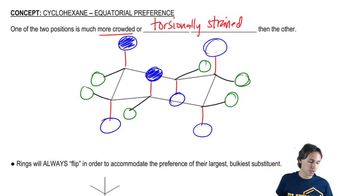
Axial and Equatorial Positions

In chair conformations of cyclohexane and related structures, substituents can occupy axial or equatorial positions. Axial substituents are oriented parallel to the axis of the ring, while equatorial substituents extend outward from the ring. This distinction affects steric interactions and stability, making it crucial for understanding the spatial arrangement of groups in cyclic compounds.
Video consigliato:
04:02
Equatorial Preference

Pyranose Structure

Pyranose refers to a six-membered cyclic form of monosaccharides, derived from aldoses or ketoses. In pyranose, the anomeric carbon is typically involved in a glycosidic bond, influencing the orientation of hydroxyl (OH) groups. Understanding the structure of pyranoses is essential for determining the positions of substituents, such as OH groups, in the chair conformation.
Video consigliato:
03:04
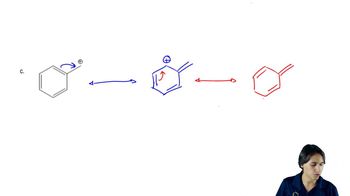
Drawing Resonance Structures

Anomeric Effect

The anomeric effect describes the preference for certain substituents at the anomeric carbon to adopt specific orientations due to electronic interactions. In pyranoses, this effect can influence whether OH groups are positioned axially or equatorially. Recognizing the anomeric effect is important for predicting the stability and reactivity of carbohydrate structures.
Video consigliato:
Percorso guidato
2:02
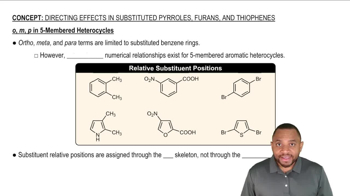
Directing Effects in Substituted Pyrroles, Furans, and Thiophenes Concept 1