Ch. 20 - The Organic Chemistry of Carbohydrates
Bruice - Organic Chemistry 8th Edition
Bruice8th EditionOrganic ChemistryISBN: 9780135213711Non è quello che usi tu?Cambia libro di testo
Capitolo 20, Problema 22-23

When glucose undergoes base-catalyzed isomerization in the absence of the enzyme, mannose is one
of the products that is formed (Section 20.5). Why is mannose not formed in the enzyme-catalyzed reaction?

Guida verificata passo dopo passo
1
Understand the process of base-catalyzed isomerization: In a base-catalyzed isomerization, glucose can undergo an enediol rearrangement, which allows it to convert into different isomers, such as mannose.
Recognize the role of enzymes in isomerization: Enzymes are highly specific catalysts that facilitate reactions by lowering the activation energy and stabilizing transition states. They often have specific active sites that only allow certain substrates to bind.
Identify the specificity of the enzyme involved: In the enzyme-catalyzed isomerization of glucose, the enzyme is specific to the conversion of glucose to fructose, not mannose. This specificity is due to the enzyme's active site, which is tailored to facilitate the conversion to fructose.
Consider the structural differences: Mannose and fructose have different structural arrangements. The enzyme's active site is designed to accommodate the transition state leading to fructose, not mannose.
Conclude why mannose is not formed: Due to the enzyme's specificity and the structural requirements of its active site, mannose is not formed in the enzyme-catalyzed reaction, as the enzyme does not facilitate the necessary rearrangement for mannose formation.

Risposta video verificata per un problema simile:

Questa soluzione video è stata consigliata dai nostri tutor come utile per risolvere questo problema.
Durata del video:
4m

Concetti chiave

Ecco i concetti essenziali che devi comprendere per rispondere correttamente alla domanda.

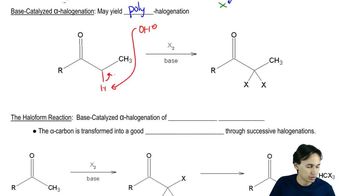
Base-Catalyzed Isomerization

Base-catalyzed isomerization involves the rearrangement of molecular structures through the action of a base, which facilitates the conversion of one isomer to another. In the case of glucose, the base can deprotonate hydroxyl groups, allowing for the formation of different structural isomers, such as mannose. This reaction typically occurs under non-enzymatic conditions, leading to a mixture of products.
Video consigliato:
01:57
Base Catalyzed

Enzyme Specificity

Enzymes are biological catalysts that accelerate chemical reactions with high specificity for their substrates. In the case of glucose isomerization, enzymes like glucose isomerase preferentially convert glucose to fructose rather than mannose. This specificity arises from the enzyme's active site, which is shaped to fit certain substrates, thus preventing the formation of alternative products like mannose.
Video consigliato:
03:
Specific Reactions - Allylic Chlorination

Reaction Mechanism

The reaction mechanism describes the step-by-step process by which reactants are converted into products. In enzyme-catalyzed reactions, the mechanism often involves multiple intermediates and specific transition states that are stabilized by the enzyme. Understanding the mechanism of glucose isomerization helps explain why mannose is not produced when the reaction is catalyzed by an enzyme, as the pathway diverges from that leading to mannose.
Video consigliato:
02:16
Heck Reaction Mechanism