Ch. 6 - The Reactions of Alkenes • The Stereochemistry of Addition Reactions
Bruice - Organic Chemistry 8th Edition
Bruice8th EditionOrganic ChemistryISBN: 9780135213711Non è quello che usi tu?Cambia libro di testo
Capitolo 6, Problema 51b

What is the product of the reaction of maleate and H2O when H2SO4 is used as a catalyst instead of fumarase?

Guida verificata passo dopo passo
1
Step 1: Recognize the structure of maleate. Maleate is the cis-isomer of butenedioic acid (C₄H₄O₄), with two carboxylic acid groups (-COOH) attached to a double bond in the cis configuration.
Step 2: Understand the role of H₂SO₄ as a catalyst. Sulfuric acid (H₂SO₄) is a strong acid that can protonate functional groups, making them more reactive. In this case, it facilitates the addition of water (H₂O) across the double bond in maleate.
Step 3: Predict the reaction mechanism. The reaction involves acid-catalyzed hydration. First, the double bond in maleate is protonated by H₂SO₄, creating a carbocation intermediate. This intermediate is stabilized by resonance due to the proximity of the carboxylic acid groups.
Step 4: Add water to the carbocation intermediate. A water molecule attacks the carbocation, leading to the formation of an alcohol group (-OH) on one of the carbons that originally formed the double bond.
Step 5: Deprotonation and final product formation. The protonated alcohol group loses a proton, resulting in the formation of a dihydroxy compound. The final product is a hydrated derivative of maleate, specifically malic acid (C₄H₆O₅), which contains both hydroxyl (-OH) and carboxylic acid (-COOH) groups.

Risposta video verificata per un problema simile:

Questa soluzione video è stata consigliata dai nostri tutor come utile per risolvere questo problema.
Durata del video:
4m

Concetti chiave

Ecco i concetti essenziali che devi comprendere per rispondere correttamente alla domanda.

Maleate and Fumarate

Maleate and fumarate are geometric isomers of maleic acid, differing in the arrangement of substituents around the double bond. Maleate has a cis configuration, while fumarate has a trans configuration. Understanding these isomers is crucial as they can lead to different reactivity and products in chemical reactions.
Video consigliato:
Percorso guidato
1:18
The Citric Acid Cycle Example 5

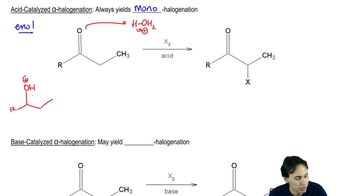
Acid-Catalyzed Hydrolysis

Acid-catalyzed hydrolysis involves the addition of water to a compound in the presence of an acid, which enhances the reaction rate. In this case, H2SO4 acts as a catalyst, facilitating the conversion of maleate into its corresponding product by protonating the double bond, making it more susceptible to nucleophilic attack by water.
Video consigliato:
03:09
Acid Catalyzed

Reaction Mechanism

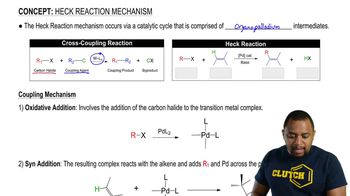
The reaction mechanism outlines the step-by-step process by which reactants are converted into products. In the context of maleate reacting with water under acidic conditions, understanding the mechanism helps predict the formation of the product, which is typically a diol, and illustrates how the catalyst influences the reaction pathway.
Video consigliato:
02:16
Heck Reaction Mechanism