Ch. 6 - The Reactions of Alkenes • The Stereochemistry of Addition Reactions
Bruice - Organic Chemistry 8th Edition
Bruice8th EditionOrganic ChemistryISBN: 9780135213711Non è quello che usi tu?Cambia libro di testo
Capitolo 6, Problema 53c

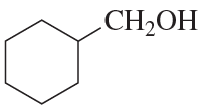
Show how each of the following compounds can be synthesized from an alkene:
c. Cyclohexane structure with a hydroxymethyl group (CH2OH) indicating a synthesis reaction from an alkene.

Guida verificata passo dopo passo
1
Step 1: Identify the target compound. The given compound is cyclopentylmethanol, which contains a cyclopentane ring and a hydroxymethyl (-CH2OH) group attached to it.
Step 2: Choose an appropriate alkene precursor. The precursor alkene should be cyclopentene, as it contains the cyclopentane ring structure and can be functionalized to introduce the hydroxymethyl group.
Step 3: Plan the reaction to introduce the hydroxymethyl group. Use hydroboration-oxidation, a two-step reaction that converts an alkene into an alcohol. In the first step, react cyclopentene with diborane (B2H6) or BH3·THF to form an organoborane intermediate. This step ensures anti-Markovnikov addition, where the boron atom attaches to the less substituted carbon of the double bond.
Step 4: Oxidize the organoborane intermediate. Treat the intermediate with hydrogen peroxide (H2O2) in the presence of a base (such as NaOH). This step replaces the boron atom with a hydroxyl group (-OH), forming cyclopentylmethanol.
Step 5: Verify the product. Ensure that the hydroxymethyl group is attached to the correct carbon (anti-Markovnikov position) and that the cyclopentane ring remains intact.

Risposta video verificata per un problema simile:

Questa soluzione video è stata consigliata dai nostri tutor come utile per risolvere questo problema.
Durata del video:
2m

Concetti chiave

Ecco i concetti essenziali che devi comprendere per rispondere correttamente alla domanda.

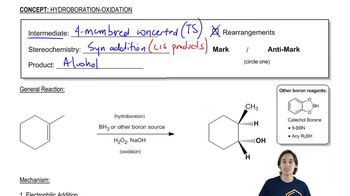
Hydroboration-Oxidation

Hydroboration-oxidation is a two-step reaction process used to convert alkenes into alcohols. In the first step, an alkene reacts with diborane (B2H6) to form an organoborane intermediate, which adds across the double bond in a syn addition manner. The second step involves oxidation of the organoborane with hydrogen peroxide (H2O2) in a basic solution, resulting in the formation of an alcohol with anti-Markovnikov orientation.
Video consigliato:
06:38
General properties of hydroboration-oxidation.

Markovnikov's Rule

Markovnikov's Rule states that when HX (where X is a halogen or hydroxyl group) adds to an asymmetric alkene, the hydrogen atom will attach to the carbon with the greater number of hydrogen atoms already attached. This rule helps predict the major product of electrophilic addition reactions, guiding the synthesis of compounds from alkenes by indicating where functional groups will be added.
Video consigliato:
03:54
The 18 and 16 Electron Rule

Stereochemistry of Reactions

Stereochemistry refers to the spatial arrangement of atoms in molecules and how this affects their chemical behavior. In reactions like hydroboration, the stereochemical outcome is important because it can lead to the formation of specific isomers. Understanding stereochemistry is crucial for predicting the configuration of the final product, especially in reactions that involve chiral centers or require specific stereochemical orientations.
Video consigliato:
Percorso guidato
1:38
Polymer Stereochemistry Concept 1