Ch. 6 - The Reactions of Alkenes • The Stereochemistry of Addition Reactions
Bruice - Organic Chemistry 8th Edition
Bruice8th EditionOrganic ChemistryISBN: 9780135213711Non è quello che usi tu?Cambia libro di testo
Capitolo 6, Problema 58f

What is the major product of the reaction of 2-methyl-2-butene with each of the following reagents?
f. MCPBA (a peroxyacid)

Guida verificata passo dopo passo
1
Identify the type of reaction: MCPBA (meta-chloroperoxybenzoic acid) is a peroxyacid commonly used to perform epoxidation of alkenes. This reaction involves the addition of an oxygen atom across the double bond to form an epoxide (a three-membered cyclic ether).
Analyze the structure of the starting material: 2-methyl-2-butene is an alkene with a double bond between the second and third carbons, and a methyl group attached to the second carbon. The double bond is the reactive site for the epoxidation reaction.
Understand the regioselectivity and stereoselectivity: Epoxidation with MCPBA is a concerted reaction, meaning the oxygen atom is added to the double bond in a single step. The reaction is stereospecific, preserving the stereochemistry of the alkene. Since 2-methyl-2-butene is not stereochemically complex (no cis/trans isomers), this step is straightforward.
Draw the product: The oxygen atom from MCPBA will form a three-membered ring (epoxide) with the two carbons of the double bond. The methyl group on the second carbon remains in place, and the overall structure becomes a substituted epoxide.
Verify the major product: Since MCPBA reacts with the double bond in a predictable manner and there are no competing reactions, the major product will be the epoxide derived from 2-methyl-2-butene. Ensure the structure is drawn correctly, showing the three-membered ring and the methyl substituent.

Risposta video verificata per un problema simile:

Questa soluzione video è stata consigliata dai nostri tutor come utile per risolvere questo problema.
Durata del video:
2m

Concetti chiave

Ecco i concetti essenziali che devi comprendere per rispondere correttamente alla domanda.

Electrophilic Addition Reactions

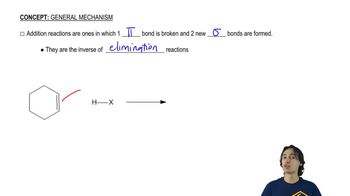
Electrophilic addition reactions involve the addition of electrophiles to alkenes, where the double bond acts as a nucleophile. In the case of 2-methyl-2-butene, the double bond can react with various electrophiles, leading to the formation of more stable carbocations and ultimately the major product of the reaction.
Video consigliato:
05:39
Features of Addition Mechanisms.

Peroxyacids and Epoxidation

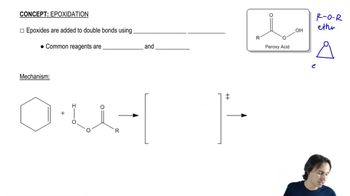
Peroxyacids, such as MCPBA, are strong oxidizing agents that can convert alkenes into epoxides through a process called epoxidation. This reaction involves the formation of a three-membered cyclic ether, which is a key intermediate that can lead to various products depending on subsequent reactions.
Video consigliato:
02:19
General properties of epoxidation.

Regioselectivity and Stereochemistry

Regioselectivity refers to the preference of a chemical reaction to yield one structural isomer over others, while stereochemistry deals with the spatial arrangement of atoms in molecules. In the reaction of 2-methyl-2-butene with MCPBA, understanding these concepts helps predict the major product and its configuration, as the formation of the epoxide can lead to different stereoisomers.
Video consigliato:
Percorso guidato
1:38
Polymer Stereochemistry Concept 1