Ch. 6 - The Reactions of Alkenes • The Stereochemistry of Addition Reactions
Bruice - Organic Chemistry 8th Edition
Bruice8th EditionOrganic ChemistryISBN: 9780135213711Non è quello che usi tu?Cambia libro di testo
Capitolo 6, Problema 58k

What is the major product of the reaction of 2-methyl-2-butene with each of the following reagents?
k. BH3/THF, followed by H2O2, HO- , H2O

Guida verificata passo dopo passo
1
Identify the type of reaction: The reaction involves hydroboration-oxidation, which is a two-step process used to convert alkenes into alcohols. This reaction proceeds with anti-Markovnikov regioselectivity and syn stereochemistry.
Step 1: Hydroboration - The alkene (2-methyl-2-butene) reacts with borane (BH₃) in tetrahydrofuran (THF). The boron atom adds to the less substituted carbon of the double bond, while a hydrogen atom adds to the more substituted carbon. This step occurs in a concerted manner, maintaining syn addition.
Step 2: Oxidation - The organoborane intermediate formed in the first step is treated with hydrogen peroxide (H₂O₂) in the presence of a hydroxide ion (HO⁻). This step replaces the boron atom with a hydroxyl group (-OH), resulting in the formation of an alcohol.
Determine the regioselectivity: Since the reaction is anti-Markovnikov, the hydroxyl group will attach to the less substituted carbon of the original double bond. In 2-methyl-2-butene, this is the terminal carbon of the double bond.
Analyze the stereochemistry: The reaction proceeds with syn addition, meaning the hydrogen and hydroxyl group will add to the same face of the molecule. However, since the product is not chiral in this case, stereochemistry is not a concern for the final product.

Risposta video verificata per un problema simile:

Questa soluzione video è stata consigliata dai nostri tutor come utile per risolvere questo problema.
Durata del video:
2m

Concetti chiave

Ecco i concetti essenziali che devi comprendere per rispondere correttamente alla domanda.

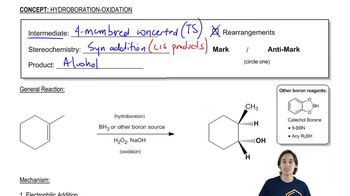
Hydroboration-Oxidation

Hydroboration-oxidation is a two-step reaction process used to convert alkenes into alcohols. In the first step, borane (BH3) adds to the double bond of the alkene, forming a trialkylborane intermediate. The second step involves oxidation with hydrogen peroxide (H2O2) and a base, which replaces the boron with a hydroxyl group, yielding an alcohol. This reaction is notable for its anti-Markovnikov selectivity, meaning the hydroxyl group attaches to the less substituted carbon.
Video consigliato:
06:38
General properties of hydroboration-oxidation.

Markovnikov's Rule

Markovnikov's Rule states that in the addition of HX to an alkene, the hydrogen atom will attach to the carbon with the greater number of hydrogen atoms already present, while the halide (X) will attach to the more substituted carbon. This rule helps predict the outcome of electrophilic addition reactions, guiding chemists in determining the major product formed during such reactions.
Video consigliato:
03:54
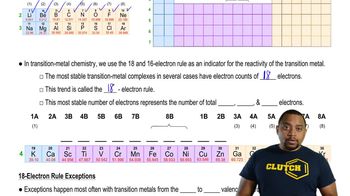
The 18 and 16 Electron Rule

Regioselectivity

Regioselectivity refers to the preference of a chemical reaction to yield one structural isomer over others when multiple products are possible. In the context of the hydroboration-oxidation of alkenes, regioselectivity is crucial as it determines which carbon atom of the alkene will bear the hydroxyl group in the final alcohol product. Understanding regioselectivity is essential for predicting the major product in reactions involving unsymmetrical alkenes.
Video consigliato:
05:09
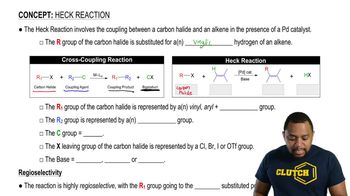
Heck Reaction