Ch. 6 - The Reactions of Alkenes • The Stereochemistry of Addition Reactions
Bruice - Organic Chemistry 8th Edition
Bruice8th EditionOrganic ChemistryISBN: 9780135213711Non è quello che usi tu?Cambia libro di testo
Capitolo 6, Problema 60

What reagents are needed to synthesize the following alcohols?

Guida verificata passo dopo passo
1
Step 1: Analyze the first alcohol structure (2-methyl-1-butanol). To synthesize this alcohol, consider starting with an alkyl halide (e.g., 2-methyl-1-bromobutane) and performing a nucleophilic substitution reaction using hydroxide ion (OH⁻) as the nucleophile.
Step 2: For the second alcohol (tert-butanol), observe that it is a tertiary alcohol. Tertiary alcohols are commonly synthesized via acid-catalyzed hydration of alkenes. Start with 2-methylpropene (isobutylene) and use concentrated sulfuric acid (H₂SO₄) followed by hydrolysis to add water across the double bond.
Step 3: Consider the regioselectivity and stereochemistry of the reactions. For the first alcohol, ensure that the substitution reaction occurs at the correct carbon atom. For the second alcohol, Markovnikov's rule will guide the addition of water to the more substituted carbon.
Step 4: Write the reaction mechanisms for both syntheses. For the first alcohol, show the SN2 mechanism where hydroxide ion attacks the alkyl halide. For the second alcohol, illustrate the carbocation intermediate formed during the acid-catalyzed hydration of the alkene.
Step 5: Verify the reagents and conditions. For the first alcohol, confirm the use of NaOH or KOH in a polar aprotic solvent. For the second alcohol, confirm the use of H₂SO₄ followed by water to complete the hydration process.

Risposta video verificata per un problema simile:

Questa soluzione video è stata consigliata dai nostri tutor come utile per risolvere questo problema.
Durata del video:
3m

Concetti chiave

Ecco i concetti essenziali che devi comprendere per rispondere correttamente alla domanda.

Alcohol Synthesis

Alcohol synthesis involves converting organic compounds into alcohols through various chemical reactions. Common methods include reduction of carbonyl compounds, such as aldehydes and ketones, or through the hydrolysis of alkyl halides. Understanding the structure of the target alcohol is crucial for selecting the appropriate reagents and reaction conditions.
Video consigliato:
02:26
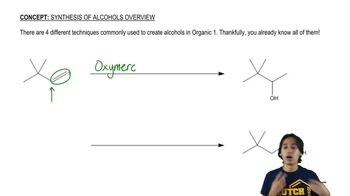
Forming alcohols through Oxymercuration-Reduction.

Reagents for Reduction

Reagents such as lithium aluminum hydride (LiAlH4) and sodium borohydride (NaBH4) are commonly used for the reduction of carbonyl groups to alcohols. LiAlH4 is a strong reducing agent capable of reducing esters and carboxylic acids, while NaBH4 is milder and typically used for aldehydes and ketones. The choice of reagent depends on the specific functional groups present in the starting material.
Video consigliato:
07:12
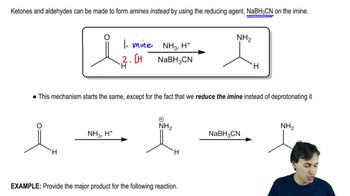
Reductive Amination

Hydrolysis of Alkyl Halides

Hydrolysis of alkyl halides is a method to synthesize alcohols by reacting alkyl halides with water or hydroxide ions. This reaction can proceed via either an SN1 or SN2 mechanism, depending on the structure of the alkyl halide. Understanding the mechanism is essential for predicting the reaction's outcome and the stereochemistry of the resulting alcohol.
Video consigliato:
01:52
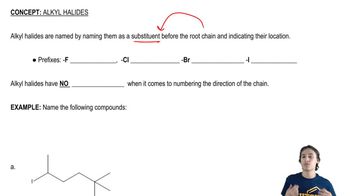
How to name alkyl halides