Ch. 9 - Substitution and Elimination Reactions of Alkyl Halides
Bruice - Organic Chemistry 8th Edition
Bruice8th EditionOrganic ChemistryISBN: 9780135213711Non è quello che usi tu?Cambia libro di testo
Capitolo 9, Problema 33(3)

a. What is the major product obtained when each of the following compounds undergoes an E2 reaction with methoxide ion? Show the configuration of the product.
b. Does the product obtained depend on whether you start with the R or S enantiomer of the reactant?
3.

Guida verificata passo dopo passo
1
Step 1: Identify the type of reaction. The problem specifies an E2 elimination reaction, which is a bimolecular elimination mechanism. In E2 reactions, a strong base (methoxide ion in this case) removes a proton from a β-carbon, and simultaneously, the leaving group (chlorine here) departs from the α-carbon, forming a double bond.
Step 2: Analyze the structure of the reactant. The compound provided is a benzylic halide with a chlorine atom attached to a secondary carbon. The β-hydrogens are located on the adjacent carbons to the α-carbon (the carbon bonded to chlorine).
Step 3: Determine the stereochemical requirement for E2 elimination. E2 reactions require the β-hydrogen and the leaving group to be anti-periplanar (in opposite planes). This stereochemical alignment ensures the elimination proceeds efficiently.
Step 4: Predict the major product. The elimination will result in the formation of a double bond between the α-carbon and the β-carbon. Since the β-carbon adjacent to the benzene ring is more substituted, the major product will follow Zaitsev's rule, favoring the more substituted alkene. The configuration of the product will depend on the anti-periplanar arrangement of the β-hydrogen and chlorine during elimination.
Step 5: Address the stereochemical question. The product obtained does not depend on whether the starting material is the R or S enantiomer because the E2 mechanism is stereospecific and depends only on the anti-periplanar geometry of the β-hydrogen and leaving group, not the absolute configuration of the reactant.

Risposta video verificata per un problema simile:

Questa soluzione video è stata consigliata dai nostri tutor come utile per risolvere questo problema.
Durata del video:
6m

Concetti chiave

Ecco i concetti essenziali che devi comprendere per rispondere correttamente alla domanda.

E2 Reaction Mechanism

The E2 (bimolecular elimination) reaction is a type of elimination reaction where a base removes a proton from a substrate while a leaving group departs simultaneously. This concerted mechanism results in the formation of a double bond. The stereochemistry of the product is influenced by the anti-periplanar arrangement of the leaving group and the hydrogen being removed.
Video consigliato:
09:36
Drawing the E2 Mechanism.

Stereochemistry and Configuration

Stereochemistry refers to the spatial arrangement of atoms in molecules and how this affects their chemical behavior. In the context of E2 reactions, the configuration of the starting material (R or S) can influence the stereochemical outcome of the product. Understanding how to depict and interpret configurations is crucial for predicting the major product.
Video consigliato:
Percorso guidato
1:38
Polymer Stereochemistry Concept 1

Enantiomers and Reaction Outcomes

Enantiomers are pairs of molecules that are non-superimposable mirror images of each other. In E2 reactions, the starting enantiomer can lead to different products based on the stereochemical orientation of the reactant. This means that the product may vary depending on whether the reaction starts with the R or S enantiomer, affecting the final configuration of the product.
Video consigliato:
03:23
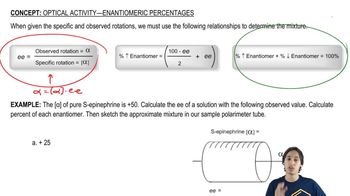
How to solve for the percentage of each enantiomer.