Ch. 9 - Substitution and Elimination Reactions of Alkyl Halides
Bruice - Organic Chemistry 8th Edition
Bruice8th EditionOrganic ChemistryISBN: 9780135213711Non è quello che usi tu?Cambia libro di testo
Capitolo 9, Problema 35a

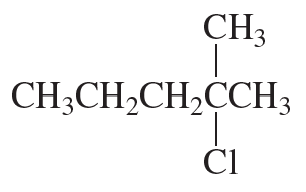
What is the major product formed when the following compounds undergo an E1 reaction?
a. Structural formula of a compound showing carbon chains and a chlorine atom, relevant for E1 reaction analysis.

Guida verificata passo dopo passo
1
Step 1: Identify the reaction type. The problem specifies an E1 reaction, which is a unimolecular elimination reaction. In an E1 reaction, the rate-determining step involves the formation of a carbocation intermediate after the leaving group departs.
Step 2: Analyze the structure of the compound. The given compound is a tertiary alkyl bromide, which is ideal for an E1 reaction because tertiary carbocations are more stable due to hyperconjugation and inductive effects.
Step 3: Determine the leaving group. Bromine (Br) is the leaving group in this molecule. It will depart, forming a carbocation at the tertiary carbon.
Step 4: Consider the possible rearrangements and stability of the carbocation. Since the carbocation is already tertiary, no rearrangement is necessary. The tertiary carbocation is stable and will proceed to the next step.
Step 5: Identify the major product. In an E1 reaction, the elimination of a proton from a β-carbon occurs, forming a double bond. The major product will be the most substituted alkene (Zaitsev's rule), which is formed by removing a proton from the β-carbon that leads to the most stable alkene.

Risposta video verificata per un problema simile:

Questa soluzione video è stata consigliata dai nostri tutor come utile per risolvere questo problema.
Durata del video:
5m

Concetti chiave

Ecco i concetti essenziali che devi comprendere per rispondere correttamente alla domanda.

E1 Reaction Mechanism

The E1 reaction mechanism is a type of elimination reaction that occurs in two steps. The first step involves the formation of a carbocation intermediate after the leaving group departs, while the second step involves the removal of a proton to form a double bond. This mechanism is favored in tertiary and some secondary substrates due to the stability of the carbocation formed.
Video consigliato:
08:09
Drawing the E1 Mechanism.

Carbocation Stability

Carbocation stability is a crucial factor in determining the outcome of E1 reactions. Tertiary carbocations are more stable than secondary or primary ones due to hyperconjugation and inductive effects from surrounding alkyl groups. The more stable the carbocation, the more likely it is to form, influencing the major product of the reaction.
Video consigliato:
05:58
Determining Carbocation Stability

Regioselectivity in Elimination Reactions

Regioselectivity refers to the preference of a chemical reaction to yield one structural isomer over others. In E1 reactions, the formation of the double bond can lead to different alkene products depending on the stability of the resulting alkenes. The more substituted alkene is typically favored due to greater stability, following Zaitsev's rule.
Video consigliato:
00:40
Recognizing Elimination Reactions.