Ch. 11 - Properties and Synthesis of Alkyl Halides: Radical Reactions
Mullins - Organic Chemistry: A Learner Centered Approach 1st Edition
Mullins1st EditionOrganic Chemistry: A Learner Centered ApproachISBN: 9780137566471Non è quello che usi tu?Cambia libro di testo
Capitolo 10, Problema 41a

Which of the reactions studied in this chapter result in oxidation of the organic molecule? Justify your answer.
(a)

Guida verificata passo dopo passo
1
Identify the reactant and product structures in the given reaction. The reactant is a carboxylic acid with an alkene group, and the product is a carboxylic acid with a hydroperoxide group added to the alkene.
Understand the concept of oxidation in organic chemistry. Oxidation typically involves the addition of oxygen or the removal of hydrogen from a molecule.
Examine the change in the functional groups from reactant to product. The addition of the hydroperoxide group (OOH) to the alkene indicates the incorporation of oxygen into the molecule.
Consider the oxidation state of the carbon atoms involved. The carbon atom in the alkene that forms the hydroperoxide group has increased its oxidation state due to the addition of oxygen.
Conclude that the reaction results in the oxidation of the organic molecule, as the addition of the hydroperoxide group represents an increase in the oxidation state of the carbon atoms involved.

Risposta video verificata per un problema simile:

Questa soluzione video è stata consigliata dai nostri tutor come utile per risolvere questo problema.
Durata del video:
8m

Concetti chiave

Ecco i concetti essenziali che devi comprendere per rispondere correttamente alla domanda.

Oxidation in Organic Chemistry

Oxidation in organic chemistry involves the increase in the number of bonds to oxygen or other electronegative atoms, or the loss of hydrogen atoms. It often results in the formation of new functional groups, such as alcohols to ketones or aldehydes, or the addition of oxygen to form peroxides. In the given reaction, the addition of an oxygen atom to form a hydroperoxide group indicates oxidation.
Video consigliato:
00:56
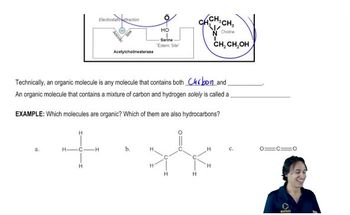
What is an organic molecule?

Functional Groups

Functional groups are specific groups of atoms within molecules that are responsible for the characteristic chemical reactions of those molecules. In the reaction shown, the transformation involves the formation of a hydroperoxide group (–OOH) from an alkene, which is a key indicator of oxidation. Recognizing changes in functional groups is crucial for identifying reaction types and mechanisms.
Video consigliato:
02:36
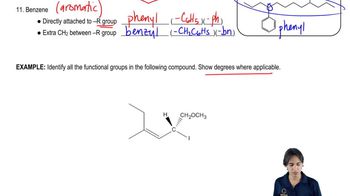
Identifying Functional Groups

Peroxide Formation

Peroxide formation involves the addition of an oxygen-oxygen single bond to a molecule, often resulting from the reaction of an organic compound with molecular oxygen (O2). This process is a common type of oxidation reaction in organic chemistry. In the provided reaction, the formation of a hydroperoxide group from an alkene is a classic example of peroxide formation, indicating the molecule has undergone oxidation.
Video consigliato:
02:26
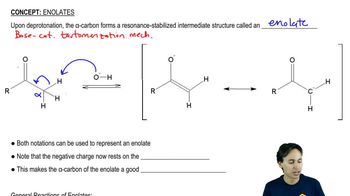
Formation of Enolates