Ch. 5 - Chemical Reaction Analysis: Thermodynamics and Kinetics
Mullins - Organic Chemistry: A Learner Centered Approach 1st Edition
Mullins1st EditionOrganic Chemistry: A Learner Centered ApproachISBN: 9780137566471Non è quello che usi tu?Cambia libro di testo
Capitolo 4, Problema 48a(ii)

For each of the following acid–base reactions, (ii) calculate Keq. If a pKa is not one of the ten common ones we learned in Chapter 4, it will be given to you.
(a) Chemical reaction diagram showing hydroxide ion reacting with sulfuric acid to form hydronium and bisulfate ions.

Guida verificata passo dopo passo
1
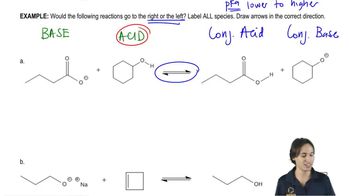
Identify the acid and base on the reactant side of the reaction, as well as the conjugate acid and conjugate base on the product side.
Determine the pKₐ values of the acid on the reactant side and the conjugate acid on the product side. If the pKₐ values are not provided, refer to the given data or a pKₐ table.
Calculate the difference in pKₐ values between the acid on the reactant side and the conjugate acid on the product side using the formula: ΔpKₐ = pKₐ (conjugate acid) - pKₐ (acid).
Use the relationship between ΔpKₐ and the equilibrium constant (K_eq): K_eq = 10^(-ΔpKₐ). This equation allows you to calculate K_eq from the ΔpKₐ value.
Substitute the calculated ΔpKₐ value into the equation and simplify to determine the equilibrium constant (K_eq).

Risposta video verificata per un problema simile:

Questa soluzione video è stata consigliata dai nostri tutor come utile per risolvere questo problema.
Durata del video:
5m

Concetti chiave

Ecco i concetti essenziali che devi comprendere per rispondere correttamente alla domanda.

Acid-Base Equilibrium

Acid-base equilibrium refers to the state in which the rates of the forward and reverse reactions of an acid and its conjugate base are equal. This equilibrium can be quantified using the equilibrium constant (K_eq), which expresses the ratio of the concentrations of products to reactants at equilibrium. Understanding this concept is crucial for calculating K_eq in acid-base reactions.
Video consigliato:
04:00
Determining Acid/Base Equilibrium

pKₐ and Kₐ Relationship

The pKₐ is a logarithmic scale that indicates the strength of an acid, with lower values corresponding to stronger acids. It is related to the acid dissociation constant (Kₐ) by the equation pKₐ = -log(Kₐ). This relationship is essential for determining the equilibrium constant (K_eq) in acid-base reactions, as it allows for the conversion between pKₐ values and Kₐ values.
Video consigliato:
02:56
Isomeric Relationships

Common Acid-Base Reactions

Common acid-base reactions involve the transfer of protons (H⁺) between acids and bases. Familiarity with these reactions, including the identification of strong and weak acids and bases, is vital for predicting the direction of equilibrium and calculating K_eq. Recognizing the common acids and their pKₐ values helps streamline the process of determining the equilibrium constant in various reactions.
Video consigliato:
02:49
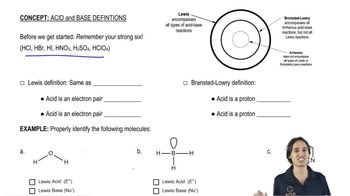
The Lewis definition of acids and bases.
Pratica correlata
Domanda del libro di testo

For each of the following reactions, identify the bonds that are broken and formed. Be sure to indicate whether the bond that is broken is a σ bond or a π bond.

(a)

1086
views

Domanda del libro di testo

For each of the following acid–base reactions, (i) predict which side of the reaction you expect to be favored. If a pKa is not one of the ten common ones we learned in Chapter 4, it will be given to you.

(a)

1065
views
Domanda del libro di testo

The following table of strain energies is associated with a variety of 1,2-gauche interactions. Use this table to answer the questions (i)–(iv).

For each of the bond rotations shown, (i) identify which you believe to be more stable, (ii) calculate ∆G°, (iii) calculate the equilibrium constant, and (iv) draw the transition state.

(c)

1108
views
Domanda del libro di testo

For each of the following acid–base reactions, (iv) draw the transition state, paying close attention to the degree of bond forming and breaking present in the transition state. If a pKa is not one of the ten common ones we learned in Chapter 4, it will be given to you.

(a)

813
views
Domanda del libro di testo

For each of the following acid–base reactions, (iii) calculate ∆G°. If a pKa is not one of the ten common ones we learned in Chapter 4, it will be given to you.

(a)

1154
views
Domanda del libro di testo

For each of the following reactions, identify the bonds that are broken and formed. Be sure to indicate whether the bond that is broken is a σ bond or a π bond.

(c)

1150
views