Ch. 5 - Chemical Reaction Analysis: Thermodynamics and Kinetics
Mullins - Organic Chemistry: A Learner Centered Approach 1st Edition
Mullins1st EditionOrganic Chemistry: A Learner Centered ApproachISBN: 9780137566471Non è quello che usi tu?Cambia libro di testo
Capitolo 4, Problema 48a(iii)

For each of the following acid–base reactions, (iii) calculate ∆G°. If a pKa is not one of the ten common ones we learned in Chapter 4, it will be given to you.
(a) Chemical reaction diagram showing hydroxide ion reacting with sulfuric acid to form hydronium and bisulfate ions.

Guida verificata passo dopo passo
1
Identify the acid and base on both sides of the reaction. Determine which species is donating a proton (acid) and which is accepting a proton (base). Similarly, identify the conjugate acid and conjugate base formed after the reaction.
Write the equilibrium constant expression (K_eq) for the reaction using the relationship between the pKa values of the acid and conjugate acid. Recall that K_eq = 10^(pKa(conjugate acid) - pKa(acid)).
Calculate the equilibrium constant (K_eq) using the pKa values provided or known. If the pKa values are not directly given, refer to the provided data or standard tables.
Use the relationship between Gibbs free energy change (∆G°) and the equilibrium constant: ∆G° = -RT ln(K_eq), where R is the gas constant (8.314 J/(mol·K)) and T is the temperature in Kelvin (usually 298 K unless otherwise specified).
Substitute the calculated K_eq value into the ∆G° equation and simplify. Ensure all units are consistent (e.g., convert ln to base e if needed). This will give the ∆G° value for the reaction.

Risposta video verificata per un problema simile:

Questa soluzione video è stata consigliata dai nostri tutor come utile per risolvere questo problema.

Concetti chiave

Ecco i concetti essenziali che devi comprendere per rispondere correttamente alla domanda.

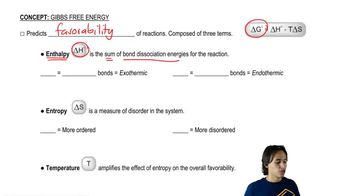
Gibbs Free Energy (∆G°)

Gibbs Free Energy (∆G°) is a thermodynamic quantity that indicates the spontaneity of a reaction at constant temperature and pressure. A negative ∆G° value suggests that a reaction is spontaneous, while a positive value indicates non-spontaneity. In acid-base reactions, ∆G° can be calculated using the equilibrium constant (K) or the pKₐ values of the acids and bases involved.
Video consigliato:
05:02
Breaking down the different terms of the Gibbs Free Energy equation.

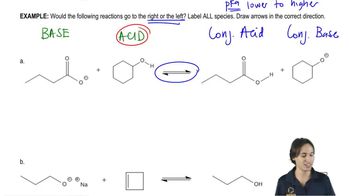
Acid-Base Equilibrium and pKₐ

The strength of an acid or base is often expressed in terms of its dissociation constant (Kₐ for acids and K_b for bases), with pKₐ being the negative logarithm of Kₐ. The pKₐ value provides insight into the tendency of an acid to donate protons; lower pKₐ values indicate stronger acids. Understanding pKₐ is essential for predicting the direction of acid-base reactions and calculating ∆G°.
Video consigliato:
04:00
Determining Acid/Base Equilibrium

Relationship between pKₐ and Gibbs Free Energy

The relationship between pKₐ and Gibbs Free Energy is crucial for calculating the free energy change in acid-base reactions. The equation ∆G° = -RT ln(K) can be adapted using pKₐ values, where K is the equilibrium constant derived from the pKₐ of the acids and bases involved. This relationship allows for the determination of the spontaneity of the reaction based on the relative strengths of the acids and bases.
Video consigliato:
05:02
Breaking down the different terms of the Gibbs Free Energy equation.