Ch. 6 - Stereoisomerism: Arrangement of Atoms in Space
Mullins - Organic Chemistry: A Learner Centered Approach 1st Edition
Mullins1st EditionOrganic Chemistry: A Learner Centered ApproachISBN: 9780137566471Non è quello che usi tu?Cambia libro di testo
Capitolo 5, Problema 47h

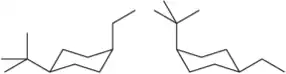
Define the relationship between each set of two molecules as chain isomers, positional isomers, functional group isomers, enantiomers, diastereomers, conformational isomers, or identical
(h) Two molecular structures illustrating different isomer types, labeled for comparison of their relationships.

Guida verificata passo dopo passo
1
Step 1: Analyze the molecular structures of the two compounds provided in the image. Observe the arrangement of the carbon chains and substituents to identify any differences in connectivity or functional groups.
Step 2: Determine if the molecules have the same molecular formula. This is essential to confirm that they are isomers. Count the number of carbon and hydrogen atoms in each molecule.
Step 3: Examine the connectivity of the atoms in each molecule. If the molecules differ in the arrangement of the carbon skeleton, they are chain isomers. If the functional groups are different, they are functional group isomers.
Step 4: Check the position of substituents or functional groups. If the substituents are located at different positions on the same carbon skeleton, the molecules are positional isomers.
Step 5: If the molecules have identical connectivity but differ in spatial arrangement, determine if they are stereoisomers (enantiomers or diastereomers). If the molecules are identical in every aspect, they are identical compounds.

Risposta video verificata per un problema simile:

Questa soluzione video è stata consigliata dai nostri tutor come utile per risolvere questo problema.

Concetti chiave

Ecco i concetti essenziali che devi comprendere per rispondere correttamente alla domanda.

Isomerism

Isomerism refers to the phenomenon where two or more compounds have the same molecular formula but different structural or spatial arrangements. This can lead to variations in physical and chemical properties, making isomers an essential topic in organic chemistry. Understanding the different types of isomers helps in predicting reactivity and behavior of organic compounds.
Video consigliato:
06:47
Monosaccharides - D and L Isomerism

Types of Isomers

There are several types of isomers, including chain isomers (differing in the arrangement of the carbon skeleton), positional isomers (differing in the position of a functional group), and functional group isomers (differing in the functional groups present). Additionally, stereoisomers like enantiomers (non-superimposable mirror images) and diastereomers (not mirror images) are crucial for understanding molecular interactions and biological activity.
Video consigliato:
01:10
What is a constitutional isomer?

Conformational Isomers

Conformational isomers, or conformers, are different spatial arrangements of a molecule that result from rotation around single bonds. These isomers can interconvert easily and often have distinct energy levels and stability. Understanding conformational isomers is important for grasping the dynamics of molecular interactions and the influence of sterics on reactivity.
Video consigliato:
03:29
Understanding what a conformer is.