Ch. 6 - Stereoisomerism: Arrangement of Atoms in Space
Mullins - Organic Chemistry: A Learner Centered Approach 1st Edition
Mullins1st EditionOrganic Chemistry: A Learner Centered ApproachISBN: 9780137566471Non è quello che usi tu?Cambia libro di testo
Capitolo 5, Problema 47e

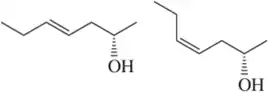
Define the relationship between each set of two molecules as chain isomers, positional isomers, functional group isomers, enantiomers, diastereomers, conformational isomers, or identical
(e) Two chemical structures showing hydroxyl groups, illustrating relationships between isomers in organic chemistry.

Guida verificata passo dopo passo
1
Step 1: Understand the definitions of the terms provided in the problem. For example: Chain isomers differ in the carbon chain arrangement, positional isomers differ in the position of a functional group, functional group isomers have different functional groups, enantiomers are non-superimposable mirror images, diastereomers are stereoisomers that are not mirror images, conformational isomers differ by rotation around a single bond, and identical molecules are the same in every aspect.
Step 2: Analyze the molecular structures of the two given molecules. Look for differences in the carbon chain, functional groups, or stereochemistry. If the structures are not provided, ensure you have them drawn or described clearly.
Step 3: Compare the carbon chain arrangement. If the molecules differ in the branching or length of the carbon chain, they are chain isomers.
Step 4: Examine the position of functional groups. If the functional group is located at different positions on the carbon chain, the molecules are positional isomers. If the functional groups themselves are different, they are functional group isomers.
Step 5: Evaluate stereochemistry. If the molecules are mirror images but not superimposable, they are enantiomers. If they are stereoisomers but not mirror images, they are diastereomers. If the difference is due to rotation around a single bond, they are conformational isomers. If none of these differences exist, the molecules are identical.

Risposta video verificata per un problema simile:

Questa soluzione video è stata consigliata dai nostri tutor come utile per risolvere questo problema.
Durata del video:
4m

Concetti chiave

Ecco i concetti essenziali che devi comprendere per rispondere correttamente alla domanda.

Isomerism

Isomerism refers to the phenomenon where two or more compounds have the same molecular formula but different structural or spatial arrangements. This leads to distinct physical and chemical properties among the isomers. Understanding isomerism is crucial for analyzing the relationships between different molecules, as it encompasses various types such as chain, positional, functional group, and stereoisomers.
Video consigliato:
06:47
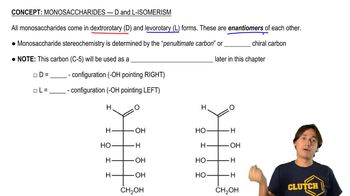
Monosaccharides - D and L Isomerism

Stereoisomers

Stereoisomers are compounds that have the same molecular formula and connectivity of atoms but differ in the spatial arrangement of their atoms. This category includes enantiomers, which are non-superimposable mirror images, and diastereomers, which are not mirror images of each other. Recognizing stereoisomerism is essential for understanding the three-dimensional aspects of molecular interactions and reactivity.
Video consigliato:
01:58
Determining when molecules are stereoisomers.

Structural Isomers

Structural isomers are compounds that share the same molecular formula but differ in the connectivity of their atoms. This includes chain isomers, which differ in the arrangement of the carbon skeleton, and positional isomers, which have the same functional groups in different positions. Grasping structural isomerism is vital for distinguishing between compounds that may have similar properties but behave differently in chemical reactions.
Video consigliato:
01:10
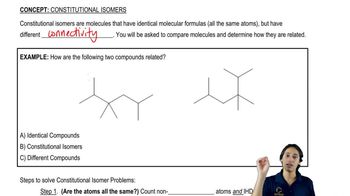
What is a constitutional isomer?