Ch. 6 - Stereoisomerism: Arrangement of Atoms in Space
Mullins - Organic Chemistry: A Learner Centered Approach 1st Edition
Mullins1st EditionOrganic Chemistry: A Learner Centered ApproachISBN: 9780137566471Non è quello che usi tu?Cambia libro di testo
Capitolo 5, Problema 22a

Of the following pairs, identify the higher priority substituent according to the CIP rules. (R = position of attachment to the asymmetric center.)
(a)

Guida verificata passo dopo passo
1
Step 1: Understand the CIP (Cahn-Ingold-Prelog) priority rules. These rules are used to assign priorities to substituents attached to a chiral center based on atomic number, connectivity, and bonding.
Step 2: Analyze the substituents in the given pair. The first substituent is a hydroxyl group (-OH) attached to a single-bonded carbon (R-CH(OH)). The second substituent is a hydroxyl group (-OH) attached to a double-bonded carbon (R-C(OH)=C).
Step 3: Compare the atomic numbers of the atoms directly attached to the asymmetric center. Both substituents have oxygen atoms directly attached, so the comparison moves to the next level of connectivity.
Step 4: Evaluate the connectivity of the carbon atoms bonded to the oxygen. In the first substituent, the carbon is single-bonded to other atoms, while in the second substituent, the carbon is double-bonded. Double bonds increase priority because they are treated as if the atom is bonded to two identical atoms.
Step 5: Conclude that the substituent with the double-bonded carbon (R-C(OH)=C) has higher priority according to the CIP rules, as the double bond increases the effective atomic connectivity.

Risposta video verificata per un problema simile:

Questa soluzione video è stata consigliata dai nostri tutor come utile per risolvere questo problema.

Concetti chiave

Ecco i concetti essenziali che devi comprendere per rispondere correttamente alla domanda.

CIP Rules (Cahn-Ingold-Prelog)

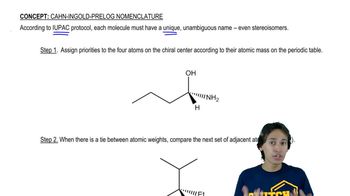
The Cahn-Ingold-Prelog (CIP) rules are a set of guidelines used to assign priority to substituents attached to a chiral center in organic molecules. These rules are based on the atomic number of the atoms directly attached to the chiral center; higher atomic numbers receive higher priority. If the first atoms are the same, the comparison continues to the next atoms in the substituent chain until a difference is found.
Video consigliato:
01:48
Why stereoisomers need their own naming system.

Chirality and Asymmetric Centers

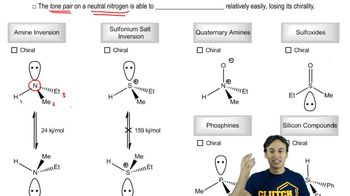
Chirality refers to the property of a molecule that makes it non-superimposable on its mirror image, often due to the presence of an asymmetric center, typically a carbon atom bonded to four different substituents. The configuration of these substituents around the asymmetric center is crucial for determining the molecule's optical activity and its interactions in biological systems.
Video consigliato:
05:41
Understanding Other Chiral Atoms

Substituent Priority

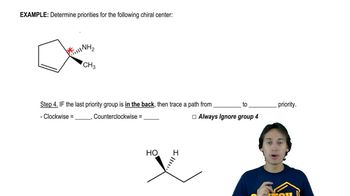
Substituent priority is determined by the CIP rules and is essential for distinguishing between different stereoisomers. In a pair of substituents, the one with the higher priority will influence the overall stereochemistry of the molecule. Understanding how to evaluate and compare substituents based on their atomic composition and connectivity is key to correctly applying the CIP rules in stereochemical analysis.
Video consigliato:
02:15
Determining Priorities