
Ch. 6 - Stereoisomerism: Arrangement of Atoms in Space
Mullins - Organic Chemistry: A Learner Centered Approach 1st Edition
Mullins1st EditionOrganic Chemistry: A Learner Centered ApproachISBN: 9780137566471Non è quello che usi tu?Cambia libro di testo
Capitolo 5, Problema 24d

Prioritize the substituents at each chiral center and then, by comparing them to the models you created in Section 6.3.2, label the absolute configuration as R or S.
(d)

Guida verificata passo dopo passo
1
Step 1: Identify the chiral center in the molecule. A chiral center is a carbon atom bonded to four different substituents. In the given structure, the central carbon atom is bonded to a hydrogen (H), a methoxy group (CH3O), a chlorine atom (Cl), and a carbonyl group (C=O).
Step 2: Assign priorities to the substituents based on the Cahn-Ingold-Prelog (CIP) priority rules. The rules state that the substituent with the highest atomic number gets the highest priority. Here, chlorine (Cl) has the highest atomic number, so it is priority 1. The carbonyl group (C=O) is priority 2 because the carbon is double-bonded to oxygen. The methoxy group (CH3O) is priority 3, and hydrogen (H) is priority 4 because it has the lowest atomic number.
Step 3: Orient the molecule so that the lowest priority group (hydrogen, priority 4) is pointing away from you. This is typically represented as a dashed wedge in the structure.
Step 4: Determine the order of the remaining substituents (1, 2, 3) in a clockwise or counterclockwise direction. If the sequence is clockwise, the configuration is R. If the sequence is counterclockwise, the configuration is S.
Step 5: Compare the orientation and priority sequence to the models you created in Section 6.3.2 to confirm the absolute configuration as R or S.

Risposta video verificata per un problema simile:

Questa soluzione video è stata consigliata dai nostri tutor come utile per risolvere questo problema.

Concetti chiave

Ecco i concetti essenziali che devi comprendere per rispondere correttamente alla domanda.

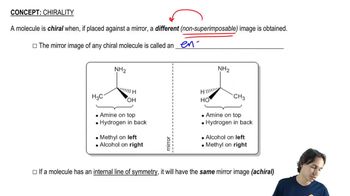
Chirality

Chirality refers to the geometric property of a molecule that makes it non-superimposable on its mirror image, much like left and right hands. Chiral centers, typically carbon atoms bonded to four different substituents, are crucial in determining the molecule's stereochemistry. Understanding chirality is essential for labeling configurations as R or S.
Video consigliato:
05:10
What is chirality?

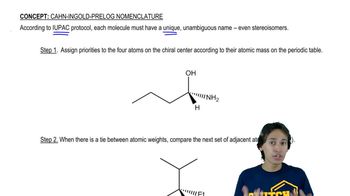
Cahn-Ingold-Prelog Priority Rules

The Cahn-Ingold-Prelog (CIP) priority rules are a set of guidelines used to assign priority to substituents attached to a chiral center based on atomic number and connectivity. The substituent with the highest atomic number receives the highest priority. If two substituents have the same atomic number, the priority is determined by the next atoms in the substituent chain, which is vital for determining R or S configurations.
Video consigliato:
01:48
Why stereoisomers need their own naming system.

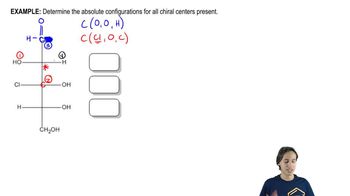
Absolute Configuration

Absolute configuration refers to the specific three-dimensional arrangement of atoms around a chiral center, designated as either R (rectus) or S (sinister). This designation is determined by the orientation of the highest priority substituents when viewed from a specific perspective. Correctly identifying the absolute configuration is crucial for understanding the molecule's behavior and reactivity in chemical reactions.
Video consigliato:
05:25
Determining Absolute Configurations