Ch. 23 - Carbohydrates and Nucleic Acids
Wade - Organic Chemistry 9th Edition
Wade9th EditionOrganic ChemistryISBN: 9780135213728Non è quello che usi tu?Cambia libro di testo
Capitolo 23, Problema 25a

Show the product that results when fructose is treated with an excess of methyl iodide and silver oxide.

Guida verificata passo dopo passo
1
Identify the functional groups in fructose: Fructose is a monosaccharide with a ketone group (ketose) and multiple hydroxyl (-OH) groups. These hydroxyl groups are reactive and can undergo methylation.
Understand the role of methyl iodide (CH3I) and silver oxide (Ag2O): Methyl iodide is a methylating agent, and silver oxide acts as a base to facilitate the reaction. Together, they replace the hydrogen atoms of hydroxyl groups with methyl groups (-CH3).
Determine the reaction mechanism: Each hydroxyl group in fructose reacts with methyl iodide in the presence of silver oxide to form a methoxy group (-OCH3). This process is repeated for all hydroxyl groups, as the reaction is carried out with an excess of methyl iodide.
Account for the ketone group: The ketone group in fructose does not react with methyl iodide under these conditions, so it remains unchanged in the product.
Draw the final product: The final product is a fully methylated derivative of fructose, where all hydroxyl groups are converted to methoxy groups (-OCH3), and the ketone group remains intact. Represent this structure clearly, ensuring all substituents are shown.

Risposta video verificata per un problema simile:

Questa soluzione video è stata consigliata dai nostri tutor come utile per risolvere questo problema.
Durata del video:
2m

Concetti chiave

Ecco i concetti essenziali che devi comprendere per rispondere correttamente alla domanda.

Fructose Structure and Reactivity

Fructose is a monosaccharide with a ketone functional group and multiple hydroxyl groups. Its structure allows it to undergo various chemical reactions, including alkylation. Understanding the specific sites of reactivity in fructose is crucial for predicting the products formed when it reacts with reagents like methyl iodide.
Video consigliato:
06:06
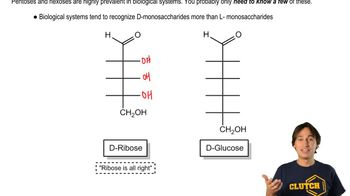
Monosaccharides - Common Structures

Alkylation Reaction

Alkylation is a chemical reaction where an alkyl group is transferred to a nucleophile. In this case, methyl iodide acts as the alkylating agent, providing a methyl group that can attach to the hydroxyl groups of fructose. Recognizing how alkylation modifies the structure of fructose is essential for determining the final product.
Video consigliato:
03:19
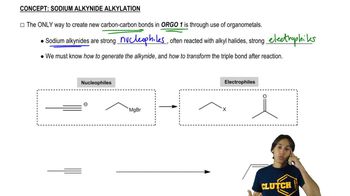
Sodium Alkynide Alkylation

Role of Silver Oxide

Silver oxide serves as a base in this reaction, facilitating the deprotonation of the hydroxyl groups on fructose. This increases the nucleophilicity of the hydroxyl groups, making them more reactive towards methyl iodide. Understanding the role of silver oxide helps clarify how it influences the reaction mechanism and product formation.
Video consigliato:
03:02
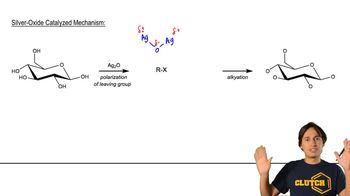
Silver Oxide Catalyzed Mechanism